Though reviews have been mixed, the Netflix series Hemlock Grove holds a special place in my heart. I am not sure whether it is simply the weird melange of various horror elements, or if it is just the disturbing essence of something that lurks beneath the service, unspoken by characters who are not quite aware of it themselves, but I have lapped up the first two seasons, begun to read the novel and am awaiting the third, and final season, with great anticipation.
For those of you who have yet to hear of this series (for something Netflix has made itself, it has seemingly not made much of a fuss about it), I would undoubtedly recommend it. The series begins in a small Pennsylvania town, which suffers a terrible string of murders: young women found savaged by some unknown beasts. A young Roma boy, the scion of a wealthy household and a whole cast of other characters seek to uncover the truth. Of course, everything is embedded in the supernatural it a wonderfully dark mixture of tropes and concepts from gothic horror integrated into a modern setting.
Anyone who has not seen the series can do so on Netflix, but do be careful about reading this entry. There will be spoilers.
So, given my interest in identity, particularly MBTI, and my love for the series, it was only a matter of time before I prepared an entry on its characters. Thus, without further ado, here are my MBTI analyses.
 |
| Image shared by amor-da-poeta |
Peter Rumancek - ISFP (The Composer)
Above all, Peter's actions are informed by a strong sense of self and personal values, formed through this self-hood and through the environments through which he has lived. Having been raised as a Roma, he has internalised the values of these people (or at least the values as they are represented in Hemlock Grove). This is where his sense of self stems from, those he deems to be his people: his family. Familial ties are more important to him than anything else and Peter truly cares about those whom he considers to be part of his inner circle, which eventual begins to include Roman, Letha and various others. He is willing to do whatever it takes to help his mother when she is imprisoned, even at expense of himself. This demonstrates a strong Introverted Feeling (Fi). This is very much followed by Peters perceptiveness. Peter notices things and is appreciates novel sensations and experiences, such as his love of exploration and always wanting to see what is beyond the horizon. This is his Extroverted Sensing (Se). Of course, Peter has access to a whole world of symbols and hidden meanings, through his dreams. Though his ability to decode them is relatively undeveloped, he is led by gut instincts which guide him at key moments, this being demonstrable of Introverted Intuition (Ni). Finally, Peter's inferior function, Extroverted Thinking (Te) comes forth in his impulsive behaviour and general inability to plan ahead. Even when he tries to prepare in advance, things tend to go awry. These functions lead Peter into being an ISFP - the Seeker and Keeper of Human Values.
 |
| Image shared by thewisestwolf |
Roman Godfrey - ESFP (The Performer)
Scion of the Godfrey family, Roman overindulges in physical sensation. Sex and cigarettes form a huge part of his lifestyle, and he has a predatory attitude to his relationships with women, often using some of his latent supernatural abilities to coerce them into giving themselves to him. He always seeks out novel sensations in which to indulge himself, and has developed quite the appreciation for the finer things in life. This is demonstrative of a dominant Se. Following this is Fi, for Roman has extremely strong feelings for those whom he is close to. He adores his sister, Shelly, his cousin Letha, and holds his mother with increasing contempt as the season progresses. As the story progresses, the intensity of his bond with Peter increases until Roman is almost dependent upon him. Most people pass him by without him caring, and he only takes his feelings out on others if they are pent up, and usually through physical means (sex and violence), hearkening back to his Se. Roman is not the most proficient planner, though his tertiary Te expresses itself through his ability for force his will upon the eternal world. This manifests through his powers, which always take a toll on him and leave him reeling, but which do enable him to make others do as he wishes. Finally, Roman's life is hugely influenced by visions, images and symbols, a hidden world which he has intense connection to, yet cannot fully understand. This is his inferior Ni, allowing access to, but not full appreciation of these hidden mysteries. Roman struggles with the things he sees in his dreams, far more than Peter, and while informed by gut instinct, less so than Peter. For these reasons, Roman is an ESFP, the Motivator Presenter.
 |
| Image shared by ossafracta |
Letha Godfrey - ESFJ (The Harmoniser)
Above everything, Letha cares for others and wants to ensure that everyone is getting along. This care is not reserved for people she is close to, but for everyone. She offers emotional support to those who have witnessed the terrible murders, even though she is not close to them. In doing so, she specifically offers her support, as an aide, someone to listen. Her emotions likewise change depending upon whom she is with. She picks up on her father's stress when he drives her home from the clinic and immediately seeks to reassure him. When she goes into labour, she wants above anything else to support those around her, even though she is the one having the experience. These all demonstrate a dominant Extroverted Feeling (Fe). Secondary to this is her Introverted Sensing (Si), for Letha is very much informed by her past experiences. The lessons her parents have taught her stick inside her head and she does not rebel against them quickly. When her father tells her to do something, she might complain and object, but she often does it. She has learnt many lessons and is able to use her experiences to inform the present. Despite her relative ignorance as to the supernatural elements in the series, Letha is able to spot connections quickly and is able to pick up on unspoken problems and tensions, even when people are trying to hide things from her. Furthermore, she does not shy away from these potentials, instead earnestly wishing to learn more about them. This is her tertiary Extroverted Intuition (Ne). Finally, Letha's inferior function is her Introverted Thinking (Ti) and she does not spend much time trying to organise her own thoughts. This leads to a feeling that often she is bumbling through the world, rather than organising everything in her head, for she is guided more by emotion, care and her own experiences than abstract reasoning. Thus, Letha is ESFJ, a hostess of the world.
 |
| Image shared by xpeterrumancekx |
Shelly Godfrey - INFP (The Idealist)
Largely due to an oppressive upbringing and an inability to vocalise her thoughts, Shelly has been forced to live in a world entirely her own, internalising everything. This has undoubtedly led to the formation of her dominant Fi. Shelly has a very small inner circle of people about whom she cares, yet she is willing to do anything it takes to protect and help them. Take, for example, her actions in protecting Peter, Letha and Roman, actions which led to her getting shot. Furthermore, with Roman, she cares for him so much that she literally glows with happiness when he touches her face. Shelly demonstrates a wealth of inner emotion. For instance, when she is corresponding with her uncle, she is verbose, clear and extremely expressive. Following this is her love of ideas. Shelly reads and paints and seeks many ways of absorbing and exploring, even if she is unable to go out into the world and seek her own place, she demonstrates an auxiliary Ne in her interest in novelty. Shelly is driven by a want to understand things and to do so from new perspectives. She has, however, absorbed many lessons from her experiences, particularly those with her mother, Roman and Dr. Pryce She has taken these lessons to heart and they certainly make her more cautious when encountering new things, particularly in the flesh. This is her Si. Beneath is all is her Te, which is undeveloped and prevents her from being able to get the wealth of thoughts within her into the outer world. The constrictive environment of her life and that those around her constantly strive to control her means she struggles to affect her environment as she would like. Due to this, Shelly is an INFP, making life kinder and gentler.
 |
| Image shared by welcometopeculiarity |
Destiny Rumancek - ENFJ (The Teacher)
Much like Letha, Destiny wants to ensure that those around her are safe. Of course, she cares about her family, particularly Peter, more than she does others, yet at the same time she demonstrates a wealth of care for those she is not so close to. She cares about Roman, even though she has many reasons not to, and goes out of her way to help him and Letha. Destiny faces great risk, often her own powers, in order to protect those around her. She bares the risk because she cares and she cares without much discrimination. This, and her willingness to forgive (not to mention her ability to manipulate others), are the marks of a dominant Fe. Of course, second only to her compassion is her immersion within the world of hidden meanings and symbols. Her mystical side allows her access to a whole realm of representations and messages and it is her task to not only understand them, but also to take instruction from them. This visions enable her to see the world as she wishes it to be and then she has to make it happen. This is her Ni. Destiny has a physical side. She enjoys pleasure and sells a diluted version of her gifts to the public, which a fair amount of farce. Furthermore, she has style and wants to present herself properly. This is tertiary Se. Finally, we have an inferior Ti. Destiny lives in a world of emotion and instinct, not in an analytical dominion of logic.Thus, Destiny is an ENFJ, the Envisioner Mentor.
 |
| Image shared by godfreygifs |
Clementine Chasseur - INTJ (The Mastermind)
A member of the Order of the Dragon, Clementine has adopted their principles and thus has a clear understanding of the way in which the world works. She has been imbued with a vision, the image of a world in which the supernatural and the mortal are somewhat able to coexist, provided that werewolves and upir keep by the pact parisienne. Of course, she struggles with this, often seeming to want to simply purge the world of those which she views as beasts. Yet her faith remains strong and she follows the inner pull to create this vision of the world: her dominant Ni. Furthermore, Clementine is able to take her inner vision and shape the world before her accordingly. Her rigorous training enables her to plan and wait patiently for the correct moment to strike. Though she has her impulsive moments, Dr Chasseur plays the long game, biding her time until the best moment to further her long term plan. This is her auxiliary Te. Her tertiary function, Fi, manifests through her personal values and beliefs, which determine much of her morality. Clementine keeps a lot to herself, unwilling to reveal herself to those who are not extremely close to her. So emotionally insular, she is told that all she knows is how to take, she is unable to give. Underneath everything else is her inferior Se. Clementine is known to indulge herself in her pleasures, one of them being women, another being drink. She has a somewhat addictive personality, demonstrative of an undeveloped Se. Thus, Chasseur is an INTJ, one of life's independent thinkers.
Olivia plays the long game and her goals are her own. However, she pursues them without doubt and without falter, willing to do whatever it takes to attain her desired outcome: a perfect child, an heir. There have been many failed attempts, and each of these have been slain, by Olivia's own hand. The way in which she wishes to future to be is entirely defined by her inward sense of purpose, by her internalised superiority and complete faith in the role of the upir. This is undoubtedly the work of a dominant Ni. Even when threatened, not that much can truly harm her, her sense of purpose wins out. Following this is an auxiliary Fe. Although Olivia does not care for others, save perhaps for Roman, she demonstrates far too much awareness of the emotions of others for her to lack this function. She has managed to achieve so much in her life through playing others, through winning over their hearts and minds, inspiring them to adore her. The feelings of others are hers to do with as she wishes. Without her Fe, Olivia would never have achieved so much. Of course, Olivia never doubts herself, or her purpose and many of her rationalisations stem from her tertiary Ti, through which she can rationally organise the contents of her own intentions. So aware of the emotions of others, it is only through the potency of her Ni and the support of her Ti that she can be so cruel. Her Ti enables her to retain her sense of superiority, to rationalise her disregard for others and their infinitesimal lifetimes. Underneath all of these lurks her inferior Se. Undeveloped as it is, it leads Olivia into addiction and a need for the physical. This comes out her in her need to feed, her reliance upon drugs to retain her thirst and her seemingly insatiable want for the pleasures of the flesh. Olivia demands extravagance. Only the best music, food and lovers will do for her. For these reasons, Olivia is clearly an INFJ, fittingly known as an author, for it is by her hand that so much of the happenings in Hemlock Grove come to pass.
 |
| Image shared by neymalia |
Norman Godfrey - ISFJ (The Protector)
Defined by traditions, Norman is dominated by his family name and his past. He is a relatively cautious man, slow to change and dependent upon the lessons he has learnt over his lifetime. Certainly, Norman is led by experience, rejecting out of hand gut instincts and visions, refusing to believe his own daughter when she claims to have been impregnated by an angel. He has certainly internalised the scientific method of a slow and steady approach to life and its sensations. This is his dominant Si. One of the few things that breaks him out of this caution, however, is protecting those he cares about. Truly, he has an inner circle of people for whom he would die if he had to, but Norman is far more caring generally and genuinely wants to help people. This is, after all, why he became a psychiatrist. This is his Fe. Norman possesses a tertiary Ti, which secures him as a consummate scientist. He is dismissive of visions and the paranormal, wanting a logical explanation and it takes him a long time before he is able to wrap his head around some of the things which are going on in his town. His rationality is a personal one, however, and he is more than willing to allow others to get on with their own lives, and is even willing to support people who are different from him. Finally, we have the inferior Ne, which imbues Norman with a niggling curiosity, the likes of which often get him into dire straights. A man fascinated with ideas, Norman Godfrey is always interested in novelty, yet he is tempered by his natural caution. Therefore, Norman is an ISFJ, service before self.
 |
| Image shared by anotherbrokenavenue |
Lynda Rumancek - ESFJ (The Harmoniser)
Undoubtedly the better mother of the series, Lynda is largely defined by her position as a mother. This role leads her into her unlawful activities, for above all she wishes to create a life for herself and her son. Her ties to the other Rumanceks are not inconsiderable, but she cares far more intensely for Peter. However, it should be noted that Lynda's dominant Fe manifests in the readiness with which she expresses concern for those around her, particularly those of whom she is initially suspicious. Though she keeps some distance from them, Lynda comes to care for Roman and Letha, even expressing some concern for Olivia, though this is quickly replaced. Lynda isn't stereotypically kind, instead she is more concerned with maintaining harmony and protecting herself and those she cares about. This is demonstrated in her willingness to make a deal with Olivia, though she disapproves of her methods. Throughout her life, Lynda has experienced much as this manifests through her auxiliary Si. She has memorised many tips and tricks, having spent a life on the run from the law. When presented with a problem, Lynda knows how to respond and she had learnt well the need for a contingency plan. Tertiary is her Ne, for Lynda shows a great ability to think on her feet and overcome challenges unconventionally, though these methods are all informed through her previous experiences. Less of a concern for her is inner, logical consistency, manifested in an inferior Ti. Lynda is wonderful at many things, though she does not spend much time organising her inner thoughts. Thus, Lynda is ESFJ, everyone's trusted friend.
 |
| Image shared by hemlockgroveaddict |
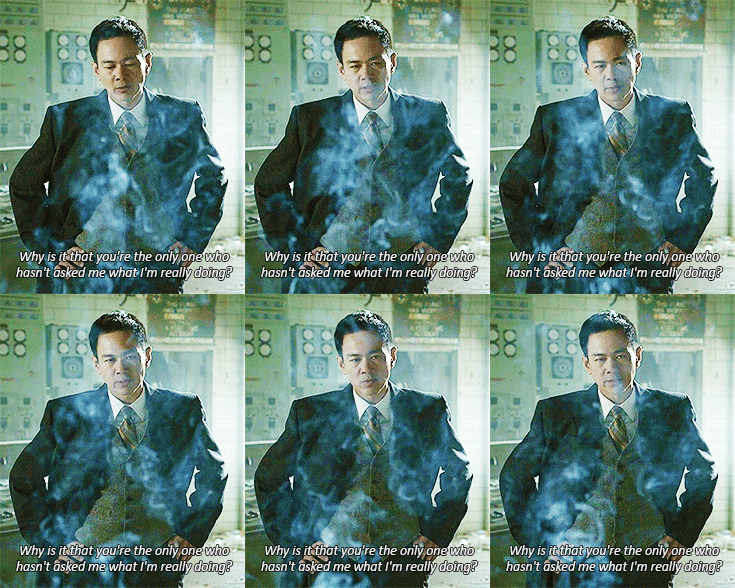
Dr Johann Pryce - ENTJ (The Commander)
Pryce is a man of vision: he foresees a world in which technology and science has overcome what he deems to be perfectly malleable barriers to human advancement. Death, life, all such things are there to be bent and controlled and manipulated by his intellect, but he is not blindly exploring for the sake of it. No, Johann wants to advance himself and prove what can be done. He views his science as greater than a world of myth and superstition with lycanthropes and upir both easily explained by his work...which can also serve to overcome them. His ability to plan and meet deadlines (but also his being so limited by them) is indicative of a dominant Te. Johann thinks of something and the world must bend to accommodate his will. Very little can stop him. These plans are fuelled by an inner vision, a determination for a future state which he wishes to bring into being. This is his auxiliary Ni, granting him a purpose, a vision for how he wishes to see the world. His wishes to become a renowned scientist, to do things that no other human being could dream of doing. It is this sense of directed purpose which filters up into his planning. As a man of science, Johann must be attentive to the state of things as they are and this is his Se: his tertiary function. Before he acts, Dr Pryce watches with keen eye, capable of noticing the most minute of details before synthesising things as they are with how he wishes them to be. Finally, we have Johann's Fi, his emotions, which are kept under control and largely ignored. However, when he grows angry, Pryce shows his anger through acts of violence. Of course, he is not easy to anger, for his feelings are his own, relatively unaffected by the acts of others. Thus, Pryce is an ENTJ, a Commandant Organiser.
 |
| Image shared by lorastyrels |
Olivia Godfrey - INFJ (The Prophet)
I am sure that many will disagree with my typing of Olivia. They will see Olivia and INFJ and immediately refuse it, thinking that there is no way she could be. Yet this is why I think she is quite clearly an INFJ:Olivia plays the long game and her goals are her own. However, she pursues them without doubt and without falter, willing to do whatever it takes to attain her desired outcome: a perfect child, an heir. There have been many failed attempts, and each of these have been slain, by Olivia's own hand. The way in which she wishes to future to be is entirely defined by her inward sense of purpose, by her internalised superiority and complete faith in the role of the upir. This is undoubtedly the work of a dominant Ni. Even when threatened, not that much can truly harm her, her sense of purpose wins out. Following this is an auxiliary Fe. Although Olivia does not care for others, save perhaps for Roman, she demonstrates far too much awareness of the emotions of others for her to lack this function. She has managed to achieve so much in her life through playing others, through winning over their hearts and minds, inspiring them to adore her. The feelings of others are hers to do with as she wishes. Without her Fe, Olivia would never have achieved so much. Of course, Olivia never doubts herself, or her purpose and many of her rationalisations stem from her tertiary Ti, through which she can rationally organise the contents of her own intentions. So aware of the emotions of others, it is only through the potency of her Ni and the support of her Ti that she can be so cruel. Her Ti enables her to retain her sense of superiority, to rationalise her disregard for others and their infinitesimal lifetimes. Underneath all of these lurks her inferior Se. Undeveloped as it is, it leads Olivia into addiction and a need for the physical. This comes out her in her need to feed, her reliance upon drugs to retain her thirst and her seemingly insatiable want for the pleasures of the flesh. Olivia demands extravagance. Only the best music, food and lovers will do for her. For these reasons, Olivia is clearly an INFJ, fittingly known as an author, for it is by her hand that so much of the happenings in Hemlock Grove come to pass.