Showing posts with label religion. Show all posts

Thursday, 26 April 2018

Trials of Faith: ‘Dragon Age: Inquisition’ and Crises of Meaning

“Cast the Chantry aside, and new problems replace old ones. We will learn nothing from history.”
We blink our eyes, unsure as to where we are. Inky fog has enclosed all about, and a great nothingness seems to extend in all directions. We are then brought to our senses with a rush of panic. Finding ourselves all at once in the Fade, the realm of spirits and demons, pursued by the scuttling creatures we later come to recognise as ‘fearlings’. But within the space of this opening scene, there is no sense to be had — only the overwhelming sense of the need to flee. In media res, Dragon Age: Inquisition begins with a literal flight from fear.[i] Though we are not quite yet abandoned, there is a luminous figure calling out to us in warning. Her voice gives us direction — delivers us from this incongruous realm of shifting dust and shadows. We reach out to one we can only see as a saviour, though never do our hands quite meet. Then there is only rubble as we collapse back into reality, into the aftermath of a great cataclysm.


Through the deliberate construction of its narrative, Inquisition does not fully contextualise its opening scene until midway through the game. Our character is defined by a personal discontinuity, a rupture in their memory and their connection to the past. As far as others know, we have fallen out of the Fade, guided by the luminous hands of Andraste (Dragon Age’s messianic figure) herself. Though we know not how we came to be there, we are at once thrown into a world faced with a crisis of meaning, a crisis of which our character forms a singular locus.
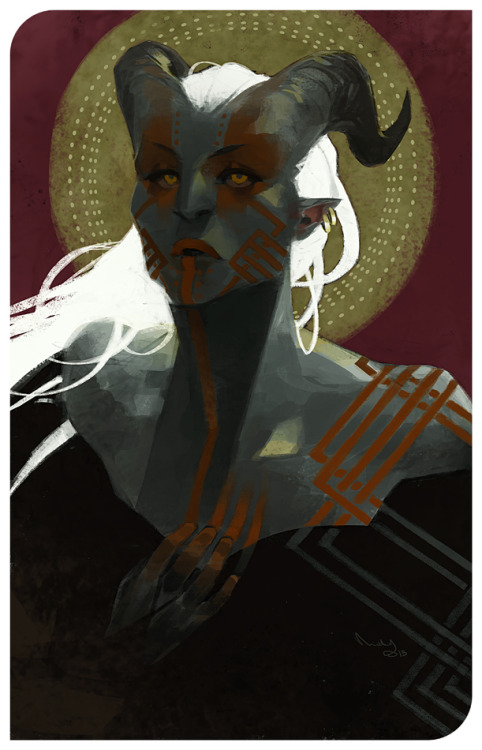
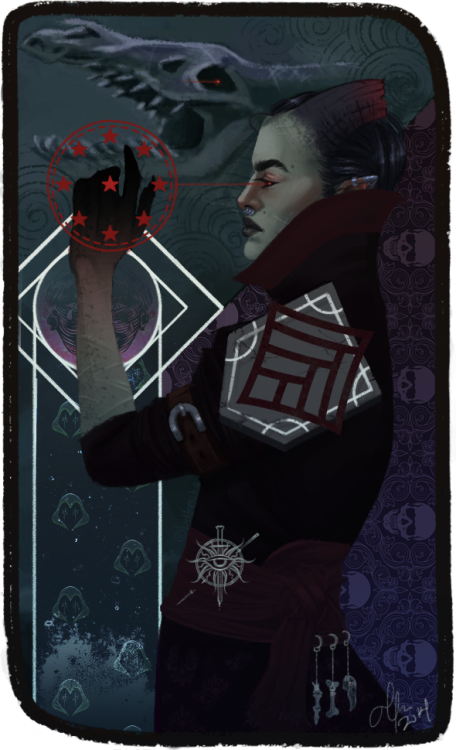
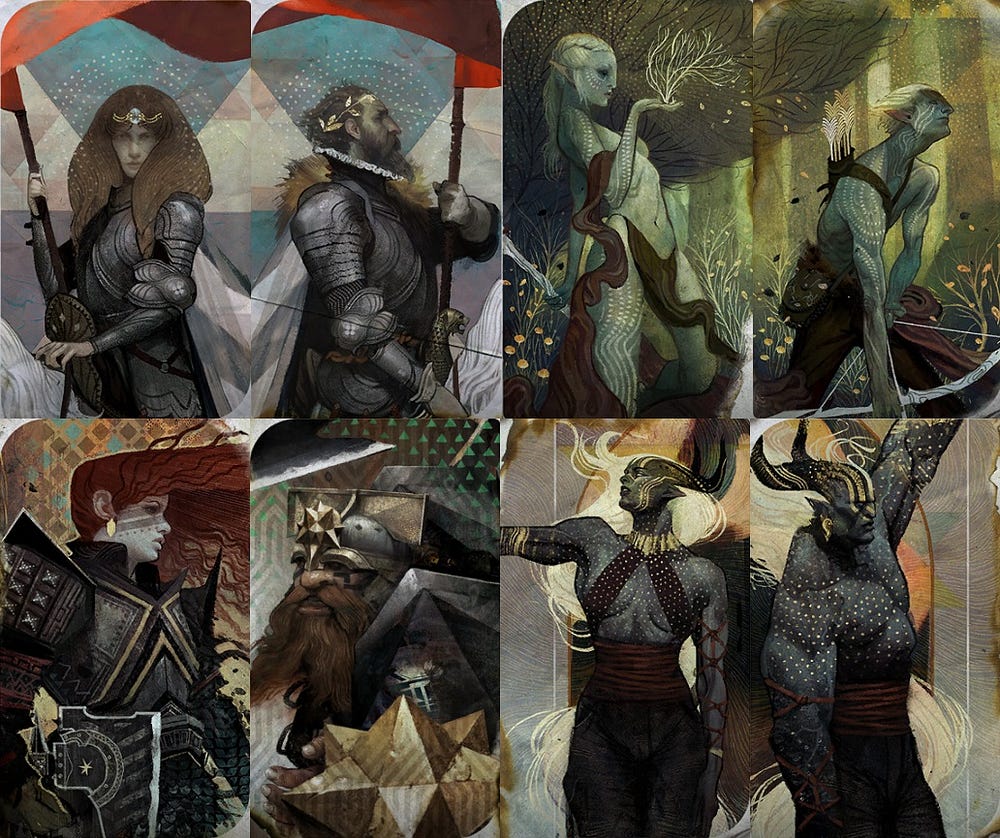
The Inquisitor Tarot Cards — Dragon Age: Inquisition
Following our flight from fear, we awaken in a cell, our hands bound and a curious light intermittently emanating from our left palm. It is within this cell that we meet Seeker Cassandra Pentaghast and Sister Leliana, the respective right and left hands of the Divine. No greeting is offered, only the words “Tell me why we shouldn’t kill you know”. At once, an account is demanded, and the price of failure is the loss of one’s life. Yet we have be severed from our past, left with fragments of our passage through a realm of dreams and spirits. We have no answers to give.
Continue reading here on my Medium account.

Saturday, 9 December 2017

Sartre and Self: Abolition or Expansion?

Jean-Paul Sartre defines consciousness as nothingness.[i] This is fundamental to his framework of human agency as resting on, or erupting from a metaphysics of absolute freedom. As nothingness, human consciousness cannot be thought of as a substance or an object and can thus have no determinate qualities that can then be regarded as the causes or source of one’s actions. To think such is to be in mauvaise foi, or bad faith[ii] – which is as close to the concept of sin as one can find in Sartre’s philosophical framework/theology.[iii] In this sense, Sartre’s consciousness is entirely ‘for-itself’, wholly distinguished from the objects of the world, the ‘in-itself’.

Likewise, for Sartre action is structurally framed entirely as a modality of nihilation, of negatité.[iv] The world exists as a set of circumstances external to the self. These conditions are positive and substantive – meaning that they are something, they are there. When consciousness acts it injects its own negativity into the world such that it destroys the world as it was when consciousness found it. Action reaches out for something that is not in the world – a nothingness – and negates the world in which such a nothingness exists, bringing it into being.[v] As such, even acts we might consider to be wholly creative or productive prove, at least on Sartre’s account, to be wholly negative.

As nothingness, Sartre’s account seems – at least to me – unable to maintain the presence of a coherent notion of individuality. Assuredly, Sartre’s philosophical outlook is wholly individualistic, premised entirely on the nothingness of an individual consciousness being fundamentally transcendent from the world, and the others it finds within it. Though Sartre makes an attempt at justifying the primacy of the individual, attempting to ground individuation in his picture of our phenomenological experience, I find this wholly unsatisfying. To me, it seems that Sartre repeats (almost entirely without criticism) a naturalised picture of individuation, whereby we find a whole host of assumptions taken as given. The claim that we experience the world as individuals is transposed into a metaphysical picture whereby the world exists as a lump of stuff (a plenum of being) and in which we are by our innate nature a transcendent nothingness that slips itself into the world in order to change it.

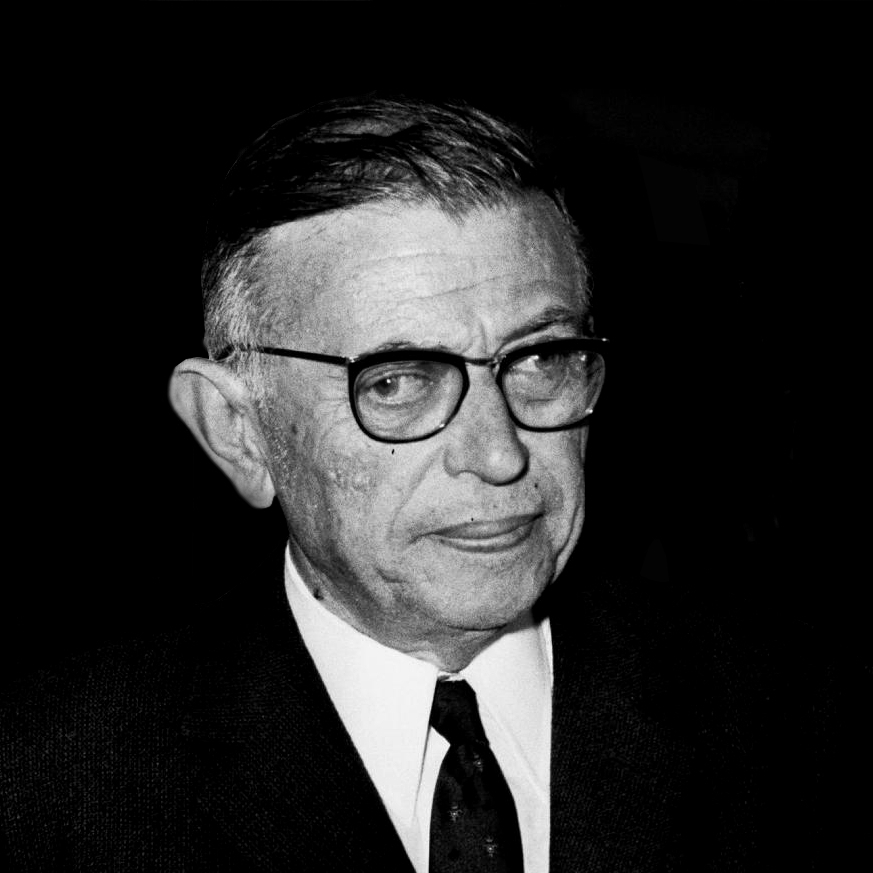
Sartre 1967 crop.jpg
Jean-Paul Sartre

I do not take issue with Sartre’s notion of the self as nothingness per se, but find that many of its implications seem to be at odds with his own conclusions. If there is to be no positive content to consciousness, then there seems to be no grounds for differentiation between individuals. As such, the notion that an individual is – by their very nature – utterly distinct both from the world and from each other appears to become untenable. Given that Sartre’s account rests upon the absolute insolubility of individual choice, it seems altogether impossible (if not exceptionally difficult) to defend him from the charges of individualism. One is an absolute agent, totally and completely responsible for one’s own choices, there is no real space within Sartre’s framework to consider the conditions or contexts of one’s own action. These contexts, the facticity of the world, exists only to be nihilated or falsely accused of determining our actions – and thus we return to bad faith.

Bad faith is a multifaceted concept for Sartre, illustrated with a broad array of examples.[vi] Underlying these is the notion that one is in bad faith whenever one abdicates from their own freedom. As such, to refuse to recognise your absolute power to choose is to be in bad faith. We can thereby consider bad faith as consciousness turning its negativity upon itself – attempting to paradoxically nullify its own possibilities.[vii] Bad faith is a form of cannibalism, in which consciousness attempts to falsely limit its own potential, to narrow itself or bind itself to a fixed notion of self.[viii]

If we are to thus think of bad faith – the closest thing to sin in Sartre’s eyes – as a form of reducing the self in light of preconceived notions, then a tension arises with his own account of individuation. Is it not perhaps a pertinent question to ask: isn’t the very notion of individuation itself a form of bad faith?

There seems to me to be little distinction between framing the individual as nothing and framing the individual as everything. The result of such a move would be to rest on a picture of fundamental unity, rather than fundamental division. If we follow this line, does it not become plausible to say that Sartre’s distinction of the individual and world rests entirely upon a pre-conceived notion of the individual?

To collapse so radically the distinction between the self and the world is to say that the self is the world. Not that the self is part of the world, but that self is everything. The notion of self as an isolated entity becomes merely an ideological habit. Just as Sartre critiques a positive notion of the self that sacrifices individual freedom in exchange for a clearly demarcated and absolute individuality, could we not – in the very same spirit of critique – turn back on Sartre’s configuration of the self as an isolated void? There seems no reason to cling to this notion of individuality, no justification to take this total solitude and distinction as the ground of one’s being (or, more accurately, nothingness).[ix]

We thus end up with a position similar to that advocated by Alan Watts in his numerous musings (both textual and aural) on spirituality, religion, and modern life. His position is perhaps best summarised in his text The Book, a title which is avowedly tongue in cheek and appropriately highlights his self-styled image as a self-professed trickster and philosophical entertainer. Within The Book, Watts references the Upanishads, lifting the quote: “That is the Self. That is the real. That art thou!”[x] By this, Watts is specifically referring to collapsing, or at the very least renegotiating, the distinction between self and other, between the individual and the world. With this particular quote, Watts is elucidating a picture of the world wherein there can be no absolute distinction between it and the individual. The ‘that’ is everything, it is every element of existence.

Image result
Alan Watts

Now, if we follow this picture and expand the self concept to be completely inclusionary the result is that Sartre’s framework comes to refute itself. As mentioned earlier, Sartre’s account of action is fundamentally premised upon the negation of the world. The self comes to nihilate the state of things as it finds it in order to actualise something else – something that does not yet exist. Sartre is clear that in order to do this, the individual must “posit the actual situation as nothingness”,[xi] he must see the state of things as something that can be transcended or overcome by one’s action. Though Sartre may not maintain this, we could read this need to view the world as nothing as a parallel to the need to recognise one’s own consciousness as nothingness. The structure of the world equally becomes nothing. As such, action becomes a negation of the nothingness of the world, the production of an actuality which can then in turn be negated. As we have seen above, bad faith can – at least partially – be conceived in terms of the attempt to negate one’s own nothingness. If we maintain this parallel between consciousness and the world, it appears that human action itself becomes a form of bad faith. The result is either to abandon bad faith or to abandon Sartre’s account, and perhaps these two conclusions are inseparable.

Sartre may maintain that the nothingness of the world is only thus through the positing activity of consciousness – a point which is meant to establish that the world is only nothing when consciousness acts on it. This in itself raises a further question about the notion of being within Sartre, with how he fundamentally conceives of the world as an actuality, rather than a negativity.
It seems to me that the abolition of the self as a positive entity, an abolition that is made all the more convincing in light of our phenomenological experience, should also prompt further reflection on our notion of individuation. Sartre’s account certain succeeds in the former,[xii] but fails to adequately justify the retention of an individuated self. It seems that we are prompted to ask whether or not we need to abolish the self or expand it? This in itself prompts the further question: are these notions distinct? If so, what is the distinction?

Works Cited

Kirkpatrick, Kate, ‘Is Shame an Emotion?’, The Oxford Philosopher, 2017 <https://theoxfordphilosopher.com/category/theology/> [accessed 9 December 2017]

———, Sartre and Theology (London: Bloomsbury Publishing PLC, 2017)

Sartre, Jean-Paul, Being and Nothingness, trans. by Hazel E. Barnes (UK: Routledge, 2003)

Watts, Alan, The Book: On the Taboo Against Knowing Who You Are (UK: Souvenir Press Ltd, 1966)


[i] Jean-Paul Sartre, Being and Nothingness, trans. by Hazel E. Barnes (UK: Routledge, 2003), chap. The Origin of Negation.
[ii] Sartre, chap. Bad Faith.
[iii] I chose the term ‘theology’ quite specifically here as, despite his avowed atheism, Sartre’s language and approach are steeped in theological language and concepts. This is noted by Kate Kirkpatrick in her work, see: Kate Kirkpatrick, ‘Is Shame an Emotion?’, The Oxford Philosopher, 2017 <https://theoxfordphilosopher.com/category/theology/> [accessed 9 December 2017]; Kate Kirkpatrick, Sartre and Theology (London: Bloomsbury Publishing PLC, 2017).
[iv] Sartre, p. 433.
[v] Sartre, pp. 433–37.
[vi] Sartre, chap. Bad Faith.
[vii] Sartre, p. 48.
[viii] In particular, we see this in his dual example of the homosexual and the champion of sincerity. Homophobic connotations aside (as difficult as that may be given their prevalence in this example), Sartre’s broader point is that there is no fixed self upon which we can pin our choices and behaviours. See: Sartre, pp. 63–67.
[ix] Pun intended.
[x] Alan Watts, The Book: On the Taboo Against Knowing Who You Are (UK: Souvenir Press Ltd, 1966), p. 150.
[xi] Sartre, p. 435.
[xii] One interesting observation of this is the way in which in mirrors the abolition or reorientation of the concept of self as notable across various mystical traditions – regardless of their ‘religious affiliation’.

Sunday, 11 January 2015

Victory in the Qun - Platonic Influences in Dragon Age

With a new university term starting tomorrow (accompanied by an increasing awareness that it is going to be academically demanding) I thought now to be an ample opportunity to write up an entry which I have been intending to write for a while. 

Once again, my attention is fixed on Dragon Age, but this time it is not a character I wish to examine, but one of the fictional belief systems: the Qun. To put a philosophical spin on things, I am going to compare the Qun to the political philosophy of Plato, as found in the Republic. Though I am loathe to make strong claims as to where particular ideas within fiction have come from, I think that there is more than enough similarity between the two systems (and also enough of a difference) to indicate that the Qun has been at the very least influenced by Platonic philosophy.

Image posted by Shalizeh7

Defining the Qun

In short, the Qun is a philosophy in both a capital "P" and lower-case "p" sense. It is both an series of positions taken towards the exploration of both the world and abstract concepts as well as, in the lower-case "p" sense, a way of life. Essentially, it is a philosophical approach to being, comparable to religion in the way it generalises its principles and seeks to extend them, sometimes through the overt use of force, upon those who do not abide by it. 

It regards itself as being singular as a form of truth: to live by the Qun is to live an ordered life of purpose, whereas to live outside of it is to live in a state of chaos. In this sense, it is highly pragmatic, focused upon end results and attempts to create a perfect society. This is further reflected in the assigning of roles from birth. Every Qunari has a singular role, which is also used as their name, and their entire lives are devoted to fulfilling it. 

We know that knowledge of the Qun is not something that is easy to come by, for not even all Qunari are fully aware of the system by which they live. For most, they simply know as much of the Qun as they need to in order to fulfil their assigned role, with only the priesthood aware of the bigger picture. 

To simply, here are the most important points of the Qun:

  • Every Qunari is assigned a role, which is also their name. Their entire lives are dedicated to this role and though the role can change, it is not a matter of personal preference or choice. 
    • These roles can have their basis in established gender roles.
  • Questioning the diktats of the Qun is seen as a moral failure, the response to which is "re-education".
  • There exists a natural order of things, embodied in the Qun. It is meaningless to struggle against this order, the very act of struggling is an illusion. 
  • The Qun is a path of faith, to abandon it is to embrace chaos. 
  • Existence is a choice, and within existence itself there is a choice between order and a mindless struggle against it.
  • Everything is part of a universal order.
Adaar doesn&#8217;t usually wear vitaar but what if
Image posted by The Minttu

The Triumvirate

Though we have relatively little interaction with Qunari society and are never shown what their people are like on their own terms (we always seem them out of their own environments and through the lens of outsider cultures who are, almost completely, in opposition to them, regarding the Qun as a dangerous force), conversations with various Qunari / Tal-Vashoth (those of the Qunari race who have chosen to live outside of the Qun) do reveal to us how their people govern.

Qunari society is divided into three parts and each of these segments possesses a different figurehead/ruler. The three parts represent the body, the mind and the soul. The bodily branch is known as the Antaam, and is ruled over by the Arishok. Mind is represented by the Arigena and consists mostly of craftsmen. Finally, Soul is embodied in the Ariqun, leader of the priesthood. 

The Arishok is a military leader and the Antaam consist of soldiers and other miltaristic agents. Their role is to protect the Qun and to spread it through military force. They are the only branch of the three who venture out of Qunari lands and are exclusively male, due to the belief that only men can be proficient warriors. Interestingly, women are able to serve in the military, if they show the aptitude, but they are regarded as male should they do so. This indicates that there biologically female individuals can be competent warriors, but that competency in martial practice is seen as masculine. This also indicates that the Qunari regard gender as distinct from biological sex.  

Always female (though others in this branch of society may vary), the Arigena rules over the industrial, agricultural and mercantile aspects of their society. They are fundamentally providers, crafting what the Qunari need and ensuring that it reaches all areas of society as needed. 

The Ariqun, leader of the priests, can be either male or female and serves as the ultimate spiritual guide of the people. Fundamentally, their role is to ensure that the Qun is upheld as well as to interpret it in times of uncertainty. Under this branch fall the Ben-Hassrath: enforcers of religious law who can be of either gender. Their role is to seek out those who are straying from the path and re-educate them, as well as ensuring that new converts to the Qun follow their assigned role. Effectively, they are inquisitors, religious police. The other important segment are the, exclusively female Tamassrans, who are in command of breeding and have huge influence with the society. They decide who breeds with who, what roles Qunari are assigned and are also responsible for educating them into these roles. 

Whilst the Qunari view these three segments as equal and necessary, their is a strong implication as to a lack of power balance. The Ariqun, who is in command of the very philosophy which dominates the lives of all Qunari, seemingly possesses the power to exile even other leaders should they see fit. The importance here is that there is no actual hierarchy, but their is an implied imbalance of power.


Image posted by Mathiaarkoniel

So how does any of this relate to Plato?

Well, on the level of appearances, Plato too devises his 'perfect' society as having three distinct branches: the Crafters, the Warriors and the Rulers. Furthermore, Plato envisages a society in which everybody is given a clear role based on the aptitudes they display in youth. His system does not possess the concept of family as we see it, instead raised collectively by a branch of the rulers in charge of educating the youths. 

The connection to the Qun is evident, as the three elements of Qunari society very easily map onto the three Platonic categories. The Arigena has the crafters, the Arishok has the warriors and the Ariqun is in charge of matters spiritual. Each three areas has an important degree of overlap. Plato's crafters exist to provide for all within his Republic, they keep things running on an agricultural and industrial level, so do those ruled by the Arigena. Warriors of the Qun exist to protect it, as do the Warriors of Plato's Republic. Importantly, there is no indication within Plato (as far as I am aware, at least) of there being any reason for the Warrior caste to invade other lands to spread the Republic's ideals, as there is the Qun. Though they are not known as rulers, the priesthood under the Ariqun serve the same role as the Philosopher Kings in the Republic: they guide the society and control the roles of those born into it, as well as raising the children collectively. 

Another interesting point of comparison is in the ability of those who live by the systems to understand them. Plato argues in the Republic that certain incorrect mythologies must be used in order to ensure that people of the Bronze (and perhaps Silver) category are discouraged from questioning the order of things. In this sense, it is a white lie in order to prevent them from trying to understand something that they, as Bronze souls, are unable to. Likewise, as aforementioned, those who live by the Qun know only enough of the Qun as is relevant to their position, with only the Priests able to fully understand how the system functions in regard to itself. Both systems seem to have an attitude that some people just cannot grasp the bigger picture and therefore cannot be told it. 

by Egor Gafidov
Image posted by Shinmakoss

However, there are some interesting differences.

Perhaps to be considered as a central difference is the concept of hierarchy between the three categories. The Qun, at least theoretically, considers each segment of their society to be equal. Plato certainly considers each of the categories to be necessary, for a healthy society (he compares society to a living organism in which each part needs to function properly if the whole is to function at all). However, he does make a value distinction between the three categories. He assigns each segment a metal. The Crafters are bronze, the Warriors are silver and the Rulers are gold. This has the implication that the Rulers are more important, if not overtly more valuable, than the other segments, and establishes an overt hierarchy. The more egalitarian nature of the Qun is further embodied in each part of society having their own ruler. Whereas the Qun implies that each aspect of society has a command of itself, Plato has a distinct class whose role is to philosophically rule over all aspects of society. 

A second important difference is gender roles. Plato does not discuss gender specifically in the Republic, though some discussion is given to biological sex (there is also no indication that he would have considered the two to be different concepts). Interestingly, he seems to abolish it as a problem within his Republic, arguing that men and women are equally capable. This is, however, specifically regarding positions within the ruling class of Gold Souls, which is open to both genders, somewhat, within the equivalent Qunari caste. However, there is no statement that women would be excluded from the Silver Souled warriors. 

A third point I find interesting, is the terminology used within the Qunari triumvirate. The three segments are thought to represent body, mind and soul. Plato talks of his Republic as an extension of the individual soul, which he sees as consistent of three parts: appetite, spirit and reason. Illustrated in his allegory of the charioteer, he views appetite and spirit to be the lower portions of the soul (bronze and silver in turn) and argues that they must be guided (though, at least under my interpretation, not strictly controlled) by reason (the charioteer). There is a discrepancy between the way in which these terms correlate between the two systems. Appetite, the most bodily portion of the soul, nicely fits with the category of Body with the Qunari. Yet Plato assigns this to his Bronze crafters. The Qun assigns it to the Warriors. Further, spirit, the portion of the soul assigned to Warriors by Plato closely correlates with Soul, which is given to the Priesthood under the Qun, who are representative of the Ruling class within Plato. Reason, which correlates more closely with Mind is given to the crafters. It seems here as if there is a clear reference to Plato's system, though a deliberate turning it on its head. The portion of the soul (or, at least, its equivalent) given to the Rulers, Plato's highest caste, is instead given to the equivalent of his lowest class. 

Image posted by Bitter Siha

Therefore, whilst I do not think that the Qun is simply a fictionalised representation of Plato lifted directly from the Republic, I do consider it to be a fictionalised account of Plato in the sense that many of its key concepts and ideas are clearly derived from various aspects of Platonic philosophy. Personally, I think there there is something absolutely enthralling about representations of the Qun throughout the Dragon Age saga, something that is at once extremely attractive and yet utterly repellent. What draws me to it is its evident basis in what I consider to be a fundamentally very interesting philosophical system. It breaths a new kind of life into the system, placing it into a fantasy context, trying to understand how individual characters might feel about the system, personalising Plato's relatively impersonal system. 

Needless to say, I hope that we learn more about the Qun in further Dragon Age instalments and that it does its job of providing a fresh supply of food for thought. . 

Image posted by Kalenkos
Thank you for reading!

Monday, 25 August 2014

Feeling the Force – Emotion within the Religions of Star Wars

A topic covered extensively by many Star Wars enthusiasts concerns the links of the Jedi religion to that of various schools of Buddhism. I, for one, have definitely noticed (not so much when I first experienced the series as a child, more so now that I have done some peripheral research into various Buddhist topics) how readily certain ideas within the Jedi religion lend themselves to comparison with some ideas within the Buddhist belief structure. 

Of course, there are many who love the series who would argue that such comparisons are of no merit, as we are dealing with a fantasy world here. To those individuals I would say, fair enough, you can consider it to be pure escapism if you wish, but also that the world we live in is so amply called a world, as it is our entire realm of experience. Thus, it informs any attempt to escape it, it bleeds into the fantasies we create for ourselves and there are many of us who enjoy picking apart these fantasies, not with the intention to be critical of them (at least not all the time) but to use the ideas presented within it as a kind of thought experiment, as a projection of thought which might be able to reveal to us something about the world beyond the escapist fantasy.
Star Wars
S - Lpis
Image posted by Quark Master

My intention is not to replicate a post drawing such comparisons, for sources (which are far more informed than I) have already done so. However, to provide an illustration of the kinds of comparison I am discussing, one need only look at the concept of the Force. Within the Star Wars universe, the Force is a power which resonates throughout the whole of creation, a metaphysical power which is linked to life itself. This in itself can be compared to eastern ideas of the Chi, though the more interesting comparison comes with the examination of the idea that Jedi strive to become unified with the force after they die. Likewise, within Buddhist thought, the goal is to avoid rebirth through relinquishing attachment and achieve a unity with the rest of creation, ultimately relinquishing one’s individuality, which is, within Buddhism, often viewed as illusory. Of course, some of those who achieve such unity remain as force ghosts, though this in itself is comparable to the idea of certain figures within Buddhism who are able to return to this world in order to help guide those who have yet to attain Nirvana. 

Now that I have addressed such cavils, it is time to turn my attention to that which I wish to focus on in this entry: Emotions.

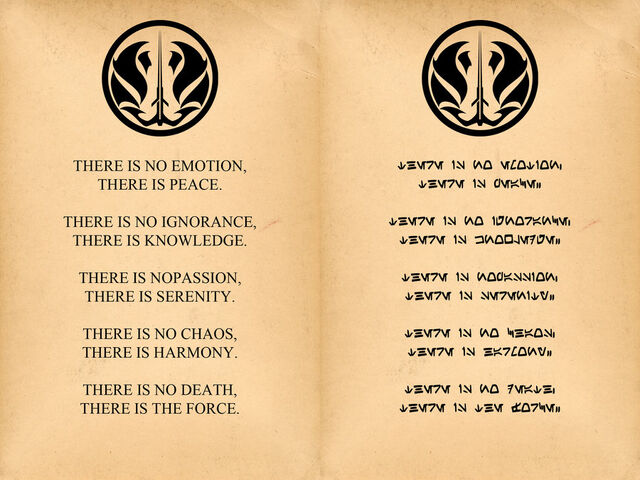
Jedi Catechisms

Image

Presented above is the Jedi Code, the central tenants of their religion, the principles which inform their actions, which guide them on how to behave. True enough, the code itself does not provide instruction in the same as, for example, the ten commandments of the Judeo-Christian faith. Instead, this code present a series of assertions which are phrased somewhat metaphysically. They are presented in pairs, denying one thing and affirming its opposite. On one reading, we could consider this to be actively denying the existence of certain things, though a more likely interpretation is that they are presenting certain ideas as undesirable. 

Emotion, ignorance, passion, chaos and death all exist. They are not things which can be denied, at least not in the same way that certain metaphysical concepts (with the exception of chaos, which is one such metaphysical concept) can be doubted, for they are each very real parts of the experience of life. 

Thus, I consider the code to be largely arguing against certain concepts, prescriptively instructing its adherents to move away from them and instead embrace certain other ideals, which are contrasted against those prohibited. 

Some of these contrasts, however, seem to be somewhat questionable. When someone is peaceful, they often say that they “feel” peaceful or they “feel” at peace. Likewise, we experience our emotions as a “feeling”. This does not entirely deconstruct or disregard the comparison which has been established here, but it allow us to contrast the two concepts without viewing them as being in complete opposition. Likewise, serenity and passion are by no means entirely opposed, for the former is a lack of trouble and the latter is simply and enthusiasm or desire. Naturally passion can often lead away from serenity, but, unless we understand serenity as opposed to excitement (which is possible), then there is no reason to see them as in direct opposition. Finally, chaos and harmony are by no means opposed. Chaos is opposed to orderly, whereas harmony means without opposition. I consider it possible for something to be without order yet without opposition. Of course, here chaos is characterised in its links to destruction, though we need not consider these two ideas wed. 

“Attachment is forbidden. Possession is forbidden. Compassion, which I would define as unconditional love, is essential to a Jedi's life. So you might say, that we are encouraged to love.” - Anakin

Fundamentally, the Jedi are against emotions, against attachments. On the surface, this seems relatively unproblematic, for it seeks to attain an ethical ideal in which one surrenders their ego, their self-centeredness and attempts to give themselves entirely to others generally, rather than to another individual. It seeks complete equality, to open up compassion to all with not conditions required. At first, it seems like this is a good thing, that this is something we should all try to work towards. Whilst I agree that a little more selflessness would be a good thing and that I would more than encourage others (and myself) to seek to act with greater depth of compassion, striving to undo attachments does cause a few problems.

First of all, this kind of extreme equality completely deconstructs and eliminates what we can term “Relationships of Preference”. By this I mean any kind of relationship which, by definition, requires preferential treatment. The most iconic of these would be marriage or committed romantic attachment. You save your loved one over a stranger because they are your loved one. In virtue of being your loved one, granting this kind of preferential treatment is, in a way, required. Of course, this has limits. It is more justifiable to save your loved one over one stranger, less so to save them over five strangers and almost completely non-justifiable to save them over one thousand strangers.

Of course, Jedi, like many members of religious orders, are discouraged from forming romantic attachments, engaging in sensual relations and producing children, so these love relations are openly forbidden by them, thus weakening the criticism. This is true, but romantic relationships are not the only Relationships of Preference. Another, more important one is friendship.

Friendship too is a relationship of preference, for you favour your friends over those you do not know. If you do not, then the integrity of the friendship is called into question. Obviously, friendships, as with all human relationships, are complex and vary infinitely based on the difference combinations of individuals and circumstances. Yet, underneath the specifics, the very concept of a friendship is one based on preference and attachment.

Yet, these two things are forbidden by the strict ethical aspirations of the Jedi, at least in theory. In practice, attachments are obviously going to develop between masters and padawan and between members of the order more generally. However, underneath this, their spiritual philosophy does not encourage them to embrace such attachment, but to attempt to transcend it.

I am not sure on my thoughts on this, at least not entirely, though I think it difficult to build a belief system based on compassion if, at its very centre, it conceptually forbids all preference and therefore the very idea of friendship. 

The Dark Side

“Fear is the path to the dark side. Fear leads to anger. Anger leads to hate. Hate leads to suffering.” - Yoda

Now, the Jedi have their reasons for this opposition to emotions, as they seek emotions themselves as a link to what they deem to be the evil, Dark Side of the Force. According to their believe system, anyone who attempts to wield the force and yet who embraces their emotions is doomed to fall from the light side of the force and become corrupted by a force of destruction, leading away from equality and peace and into rage, domination and passion.
Image


Presented above is the Sith Code, which presents itself more as a pathway than the code of the Jedi. It opens through establishing passion as truth, contrasting it to peace and then showing how this can lead one onwards into other, stronger concepts, with the ultimate goal being that of freedom.

If they Jedi seek unity with the force and to undo the bonds of individualism, the Sith seek to wholeheartedly bask in their ego, in their individual identity. This comes with a terrible narcissistic side effect, in turn leading to megalomania. Essentially, the Sith embrace what the Jedi try to escape: emotion, particularly the darker feelings of fear and hatred. In embracing these feelings and harnessing their strength, the Sith gains great power, but they do so at the expense of their own control, for ultimately they become slaves to their own unfettered emotions, which they are unable to impose control over, for fear of losing them and thus the source of their own power. 

Sith are powered on uncontrolled desire and there is a possible allusion to the philosophy of Nietzsche, more specifically the idea of the Will to Power, which is loosely considered to be the driving force behind all humanity: the desire for influence and power. Likewise, the Sith ultimately seek control, corrupted by their uncontrolled desires.

However, the Jedi have seemingly tarnished all emotion due to the threat of the Dark Side. Rather than acknowledging that darker emotions can bring a great amount of power and corruption and yet realising that this corruption is not only linked to darker emotions but also to the manner and degree with which they are embraced, they instead treat the very concept of emotion as the element of corruption. 

One possible argument, which I personally do not regard highly, is that the Jedi are not at all contra emotions, but instead they oppose themselves to uncontrolled emotions, to wild and unshackled passion, which, alongside the emotions involved, seems to be half of that which leads to one’s becoming a Sith. However, the very first line of the Jedi code “there is no emotion” defies this interpretation, as it sets their entire philosophy up in opposition to the very idea of emotion.

Fundamentally, I consider attachment and emotions as something which has an important role within the life of a human being. I sympathise with the Buddhist viewpoint, as a great deal of suffering lies within such things and I definitely contend that there is something important in their attitudes. Releasing yourself of some attachment and feeling can be excellent, but removing it entirely, seems to strip you of one of the most innately human aspects of being a person.
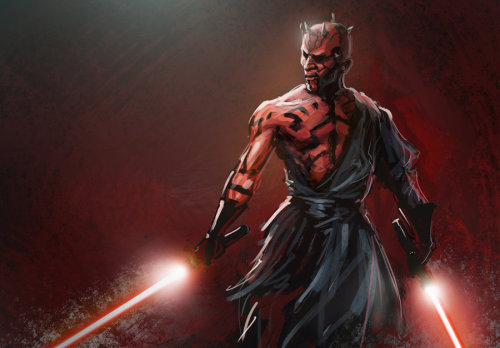
Maul
By:rashomike
Image posted by Tobuyaz


Of course, we cannot go the other way and wallow in our feelings all the time, as reason as an equally important part to play within the framework of being. A concept which is explored within the work of Plato is the idea that passion and desire are both important for the individual to be a complete person, yet must always be guided (not controlled, as some might think) by reason and rationality. 

Star Wars however, does not do this. Its narrative, especially within the film series, less so in the expanded universe (which is, in my opinion, the best part), very clearly establishes it as a fight between good and evil, with the Jedi and their “emotionless” philosophy firmly presented as good with any alternative presented as wrong or associated with the Dark Side. Ultimately, Star Wars seems to hold a strange message that emotions cannot be trusted, that those with power (shown within as the force) must always strive to abstract away from the emotions which make us fully fleshed out individuals.

My attitude it simple: both sides are wrong in their approach to emotions and this is why neither of them ultimately manage to succeed, as even though the films conclude with the fall of the Dark Side, one glance at the expanded universe reveals that light and dark have struggled and overcome one another cyclically throughout history. 

Therefore, I consider neither the Jedi nor the Sith to have the ultimate philosophy due to their inability to deal with emotions in an understandable manner. Emotions are fundamentally important to us both as indicators of identity, and also as elements of morality (those moral systems which attempt to abstract away from emotion seem to ultimately prove hollowly impractical) and thus cannot be expunged, as the Jedi would have it. However, they cannot be allowed to run riot, otherwise we result in an inability to exist within plurality. Uncontrolled emotions allow the ego to swell, make an individual truly that, individual with no ability to recognise the full humanity of another person. Only through tempering emotion with empathy and compassion can this be achieved. 

Thanks for reading :)
Thursday, 10 July 2014

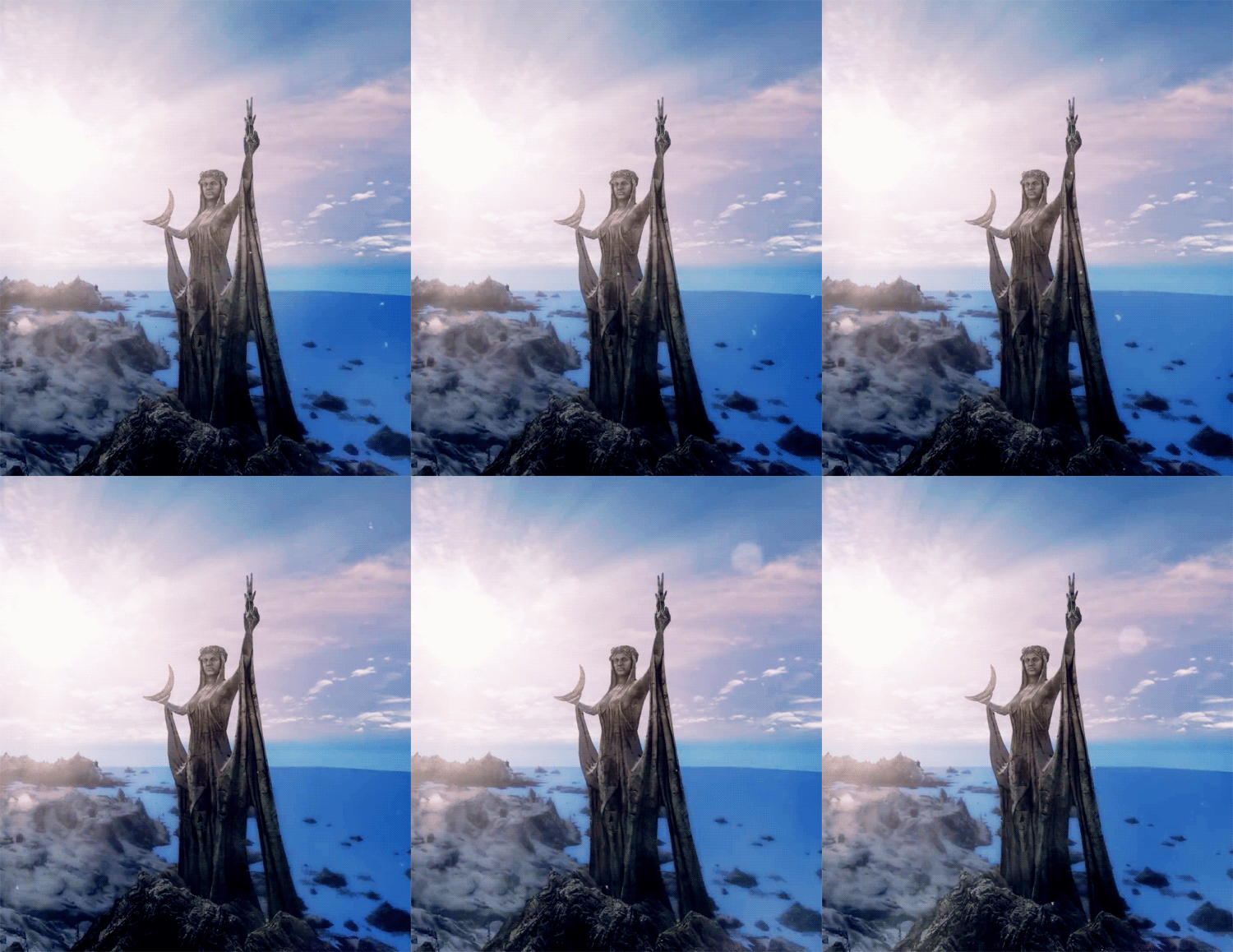
Aedra and Daedra and Moth Priests, Oh My! - Religion in the Elder Scrolls

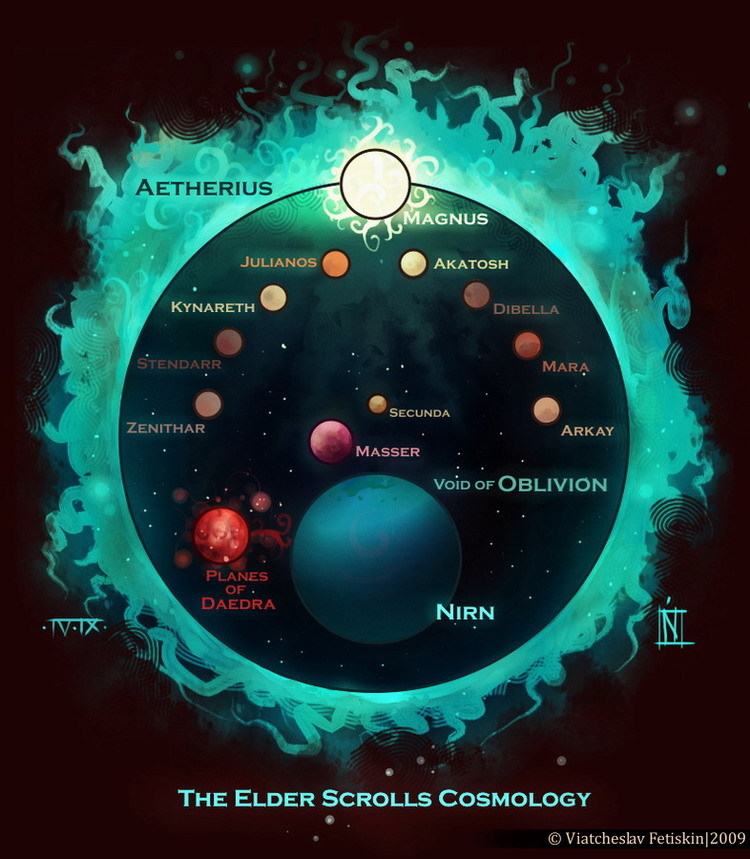
Though they have been with us for a while now, the Elder Scrolls games gained a huge amount of prestige with their 2011 release of Skyrim, the fifth instalment in the saga and one of the most immersive and beautifully rendered games I have ever played. These games are all set within the same world, though they have each tended to restrict the experience to a single region of this wider world, as well as allowing many years to have passed within the world between each game.

Something which has remained consistent, yet relatively in the background, throughout the games is the inclusion of a religious element, as is to be expected when a huge selling point for the games is cultural immersion. I find religion a fascinating topic and this applies equally to the real world religions and to religion as they it is represented in fiction and thus I was interested in thinking about how the religions within the Elder Scrolls are constructed, what elements from history have been taken and been made fictional as well as some of the commentary that one might be able to take from certain readings of them.

Image posted by Illith-Anthonar

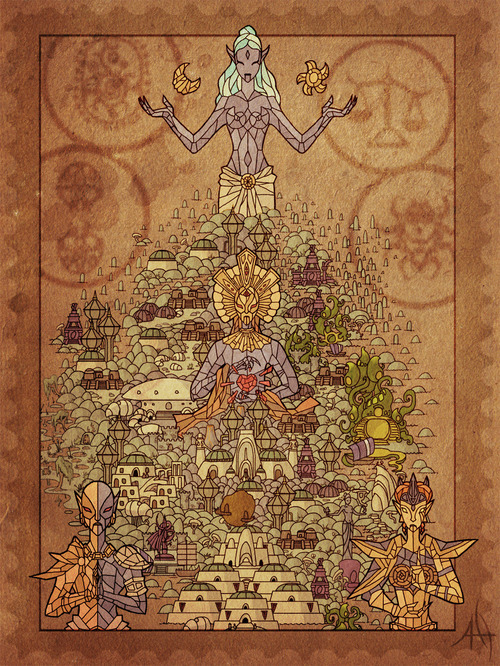
Aedra and Daedra 

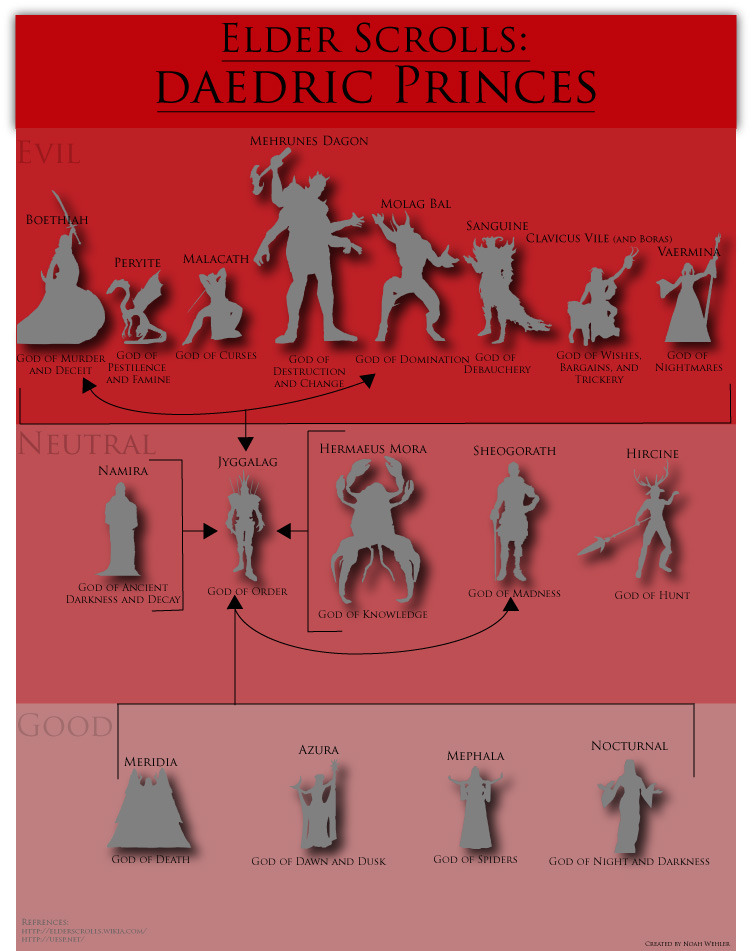
The two primary religious groups within the more recent games are the followers of the Divines (or the Aedra) and the cultists of the Daedric Princes (the Daedra). From the outset, we can note that the former is an organised religion, with Churches and formal temples and clerical hierarchies, as well as formalised religious texts and practices, whereas the latter (for the most part) are portrayed as being less strict, more wild and informal.

Without much difficulty, these can map onto Christianity and the amorphous Paganism against which it is often framed, a reading which is further supported by the former’s view that the latter are dangerous and often deserving of death for their practices. Interestingly, Daedra worship links nicely with the concept of Paganism as neither of them can be clearly defined into a neat little box. Just as the term Pagan can cover a vast range of cultures and religious / philosophical positions, there are many Daedric princes, each with very different practices and attitudes, and whilst we can argue that there are common threads running between the Daedra, there are also similar commonalities running through various forms of Paganism, otherwise the term would have no meaning whatsoever.


Furthermore, one can clearly see parallels between Christianity and the Aedra, as these Gods very rarely appear in the game (and when they do, they are not so much characters as spectacles), which reflects the traditional Christian conception of the way in which Gods interacts with the world as being either as a background influence, only very rarely making his will directly manifest in the form of miracles. This conversely applies to the Daedra, who directly speak to mortals and who take an overt and active interest in the moral world, which is much more in line with certain Pagan attitudes towards the Gods, such as the attitudes which are held by the Greeks and which are made evident in Homer's Iliad and Odyssey. 

Image posted by FusRoDamnGurl

The relationship between the followers of the Aedra and the Daedric cultists also mirrors the historical relationship between Christianity and Paganism. In short, the two are at odds, though they are evidently not complete opposites, with elements mingling in a grey, in between area and they evidently share a history. Often, followers of the Daedra are tolerated, if not welcomed, though they are seen as being more primitive. Though there is obvious hostility, for a branch of the church, the Vigilants of Stendarr, exist to deal out justice, which specifically includes the hunting of Daedra and their followers. Evidently, this is a reference to the concept of a religious inquisition, often used not to hunt those of other faiths, but all those who do not uphold the faith in question. 

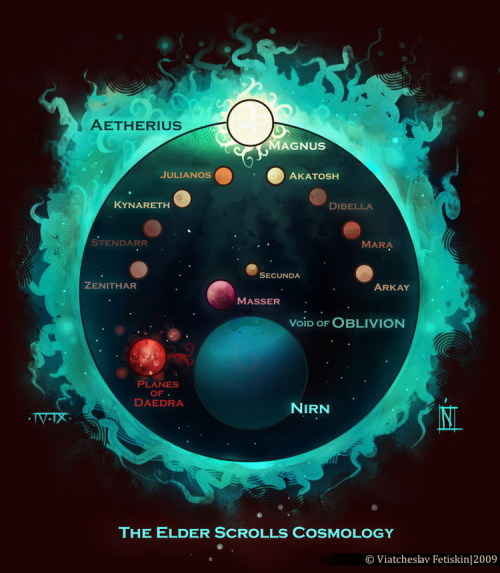
Traditionally, the God of Christianity is conceived of as a perfect being, one who is associated with any concept which can be deemed noble. Likewise, the domains of the Nine Divines are all concerned with lofty concepts such as Time, Love, Logic, Work, Nature etc. These are transcendent Gods, whose followers are focused on a realm beyond their own. On the other hand, the Daedric princes rule over domains such as Conspiracy, the Hunt, Madness, the Outcast, Domination, etc. We can see clearly that they share some concepts (there is an Aedra of nature (Kynareth) and a Daedra of the Hunt (Hircine)), though they cover these in different ways. Kynareth promotes the beauty of nature and unity with it, whereas Hircine is concentrated in the beastial nature of all creatures and the chaos within the wilderness. The trend suggests that the Daedric princes are far more mortal, representing the more practical elements of the world, in all its ugliness rather than the transcendental concepts, though this is not to say that the two are mutually exclusive.

Image posted by Stuff That Art Does

The Meaning of Godhood

Interestingly, the Elder Scrolls series can be used to allow us to reflect on what actually makes a God. At the centre of this discussion are the Tribunal, a group of three, ancient elves who managed to obtain immortality and great power through manipulating an artefact known as the Heart of Lorkhan, which was taken from Lorkhan, an Aedra himself, for tricking the other Gods into creating the world. Essentially, through harvesting the divine energy left within the heart, the three became "living Gods". 

Ultimately, however, throughout the course of Morrowind's central plot, the three are ultimately stripped of their powers and their religious following, with one of their number, Vivec, even suggesting that they should be considered Saints and Heroes rather than Gods in their own right.

What is suggested here is that, in spite of their using a source of power that is linked to an Aedra and in spite of their extensive power and immortality, the Tribunal are not truly Gods. A God is not constituted by his power, or by his following, but by his very essence and nature. The Aedra are Gods because they are powerful spiritual beings whose power was used to create the world and all living things within it. Both their nature and their actions give them the title, not their power.

Thus, whilst the Daedric princes are also powerful, they cannot be rightly called Gods. Sure, they are also spiritual beings, but they have no connection to the mortal world, and a rumoured to have been born from a force which hates it with a deep-rooted passion. They, like the Tribunal, have power and a following, but they cannot be correctly called Gods. 

Image posted by C0nn3ct

The Moth Priests

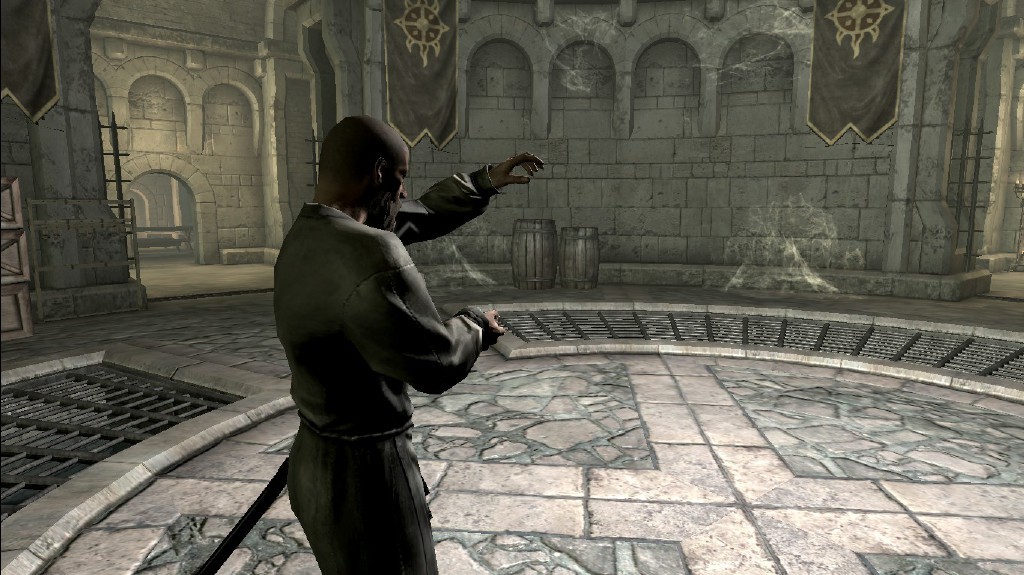
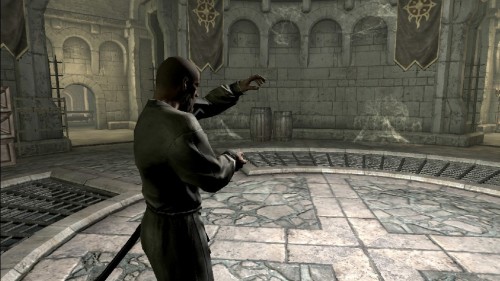
A final point I wish to raise is in connection with the Moth Priests. For a series named the Elder Scrolls, the Scrolls themselves, which are used to contain prophecies, rarely seem to surface in many of the plot lines. The nature of these scrolls is interesting, as they are supposed to represent the idea of divine knowledge which, whilst it can be somewhat understood, can never be fully comprehended and which costs much. In order to read the scrolls, one must prepare in accordance with the rituals of the Moth Priests, with those who do not are unable to read the scrolls and suffer for the attempt. Yet even with the utmost preparation, reading the scrolls ultimately results in blindness.

The initial, and by no means wrong, reading lends itself to the idea that there exists knowledge outside of the realm of mortals that we cannot freely or properly understand. It highlights that knowledge comes with a price and that there are some things which will always be beyond our ken, the attempt to bring them into our understand results in a terrible loss.

However, another reading could argue that what is truly being represented is the idea that fervent devotion to a cause or to an idea, such as an organised religion or a personal philosophy, can result in an inability to clearly perceive the world around you. Through their academic devotion to the scrolls, the Moth Priests are ultimately unable to actually interact with the world in which they live, due to the price they have paid. So fixated on the future, on the prophecies within the scrolls, they become estranged from the present. 

Image posted by LizardBorn

So that does it for my reading of religion within the Elder Scrolls! Thanks for reading!

Friday, 4 July 2014

Lilith: Redeeming a Legacy

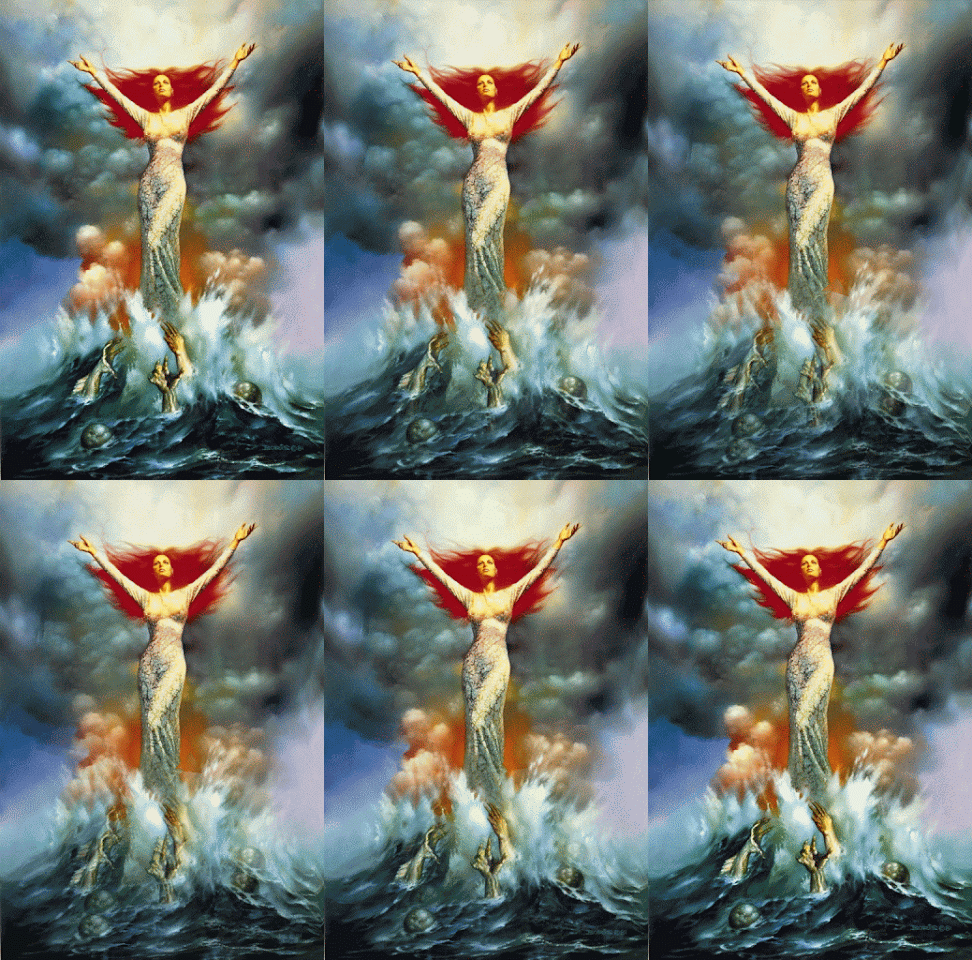
Whether it is as the vampire "Goddess" (it's complicated) from True Blood or the first of all demons from Supernatural, the name Lilith has pervaded popular culture, especially the fantasy genre. Consistently, she is viewed as an "evil" character, as a corrupted being who seeks to tempt and lure protagonists into danger or perform some other great act of evil. Marvel adopted her not once, but twice, as the eldest daughter of Dracula and as the mother of all demons. In even more contemporary and young adult popular culture, there is a demon in Cassandra Clare's Moral Instruments named Lilith. 

Whenever a character appears in a book, a show or a game with this name, you know that they are going to turn out to be more than they might initially appear (take for example Lilith as she appears in Fable II or as she appears in something as far removed from Fantasy as Frasier) and you know that, more often than not, she will turn out to be your foe. Characters named Lilith are always female, always rebellious and almost always in possession of some dark power or part of some unholy hierarchy. 

Image posted by Sadisticupid

But who exactly is this figure of Lilith? Where does she come from?

The short answer is that Lilith appears as a highly mysterious and somewhat prolific figure in the Jewish mythologies of Assyria and Babylonia. Mentions of her are widespread and, as with many ancient figures, she seems to have a huge number of different incarnations According to most accounts, Lilith is a demon or somehow linked to demonic or dark forces. Often, she is associated with childbirth, as a negative influence who seeks to steal and devour children, or as a temptress who seduces and ultimately destroys men, thus preventing them from having children with mortal women.

According to some sources, once a child was born in a Jewish family, they would be given an amulet to wear, which would have been spelled in order to protect them from Lilith. This was often worn until the child was circumcised, at which point they were seen as protected by God through the Jewish Covenant. 

So, from this reading, we have an evil, monstrous figure indeed, one which deserves the legacy she has received: appearing throughout our culture as a seductress and corrupter, as a demon, a devil or a witch. And yet, this is not the only reading of the figure of Lilith, there is another...

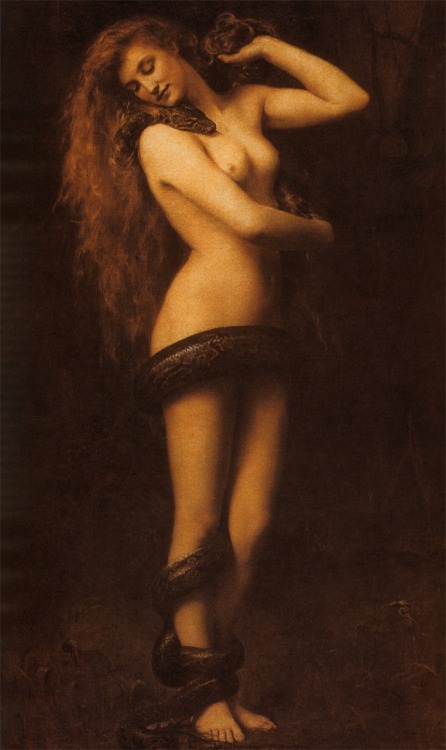
Painting by John Collier

According to this second reading of Lilith, the earliest evidence of which is to be found in the Alphabet of Sirach, Lilith is no demon. In fact, she is the wife of Adam, as in Adam and Eve. Furthermore, she is Adam's first wife and, unlike Eve, she was not created from Adam's rib after he was created, but at the same time as him and from the "earth". Naturally, having been made from the same stuff as her husband, Lilith considered herself, and rightly so, Adam's equal and therefore she refused to submit to him. Thus, according to the legend, she leaves him and the Garden of Eden forever, refusing to return and somehow ends up mating with the archangel Samael (in religious texts, these things just seem to happen). 

We can read Lilith as a female version of Lucifer, though I would argue that the crimes of Lucifer are far greater than those of Lilith. True, both are defying what is seen as the will of God, a complex concept to be sure, but whereas Lilith is asserting that she is equal to Adam, Lucifer asserted himself as the equal to God. Hence, Lucifer is punished with damnation, whereas the story as to what happens to Lilith after her "rebellion" becomes immediately unclear.

So, the question I shall ask is this: if we are to read the story of Lilith in this second way, why does our culture continue to connect her name with evil and corruption?

If Lilith's only crime is that she, as a woman, wanted to be equal with Adam, representative of man, what is so evil about it? I think that we can find an answer within traditional, particularly religious, attitudes to gender and sexuality, attitudes which our culture, in spite of numerous assertions to the contrary, have still failed to entirely shake.

The rebellion of Lilith against Adam can be easily read as the threatening of masculine power by the feminine. She disobeys him, refuses to submit to him. This is her original crime and it is this transgression that has led to her demonisation. By refusing to obey her husband and perhaps because she is depicted as copulating with an Archangel, she is consider a tempter and a corrupter. True, Samael is not considered entirely innocent, but the majority of the blame is placed on Lilith, for she is the anomaly: a rebellious woman. 

Image posted by Caligo Chaos Reigns
If we harken back to the two traditional roles given to women within literature, we can see more easily how she is so easily likened to demons, devils and the like. According to a traditional attitude towards literary woman, one which is, thankfully, heavily outdated yet, unfortunately, still relevant today, women fit into the category of the Lady or the Whore. Ladies are noble, delicate, subservient the ultimate example of what woman should be according to traditional gender roles. They are significantly desexualised in that they do not participate in such activity, certainly outside of the marital bed, but this only serves to make them more desirable to the male characters around them. Whores, however, are seen as the complete antithesis to the traditional role of women. They are disobedient to or outside of, or at least on the fringes of, the patriarchal structure, and sexually free. This leads to the corruption of their image, the corruption of Lilith's image.

We can see, with no shortage of clarity, how the traditional has influenced modern representations of Lilith. Whilst she is, undoubtedly, shown as a tempter, she is almost always cast in traditionally female roles. In Supernatural, Lilith is the first demon, making her effectively the mother of all demons as well as the bride or daughter of Lucifer. The Lilith of True Blood is the mother of vampires and the bride of God. Modern representations of Lilith within fantasy all seem to buy into this conception of her as a demon and temptress, but also as a traditional woman.

What I am saying, then, is that, whilst I have no problem with the name of Lilith being used for demonic and seductive characters (I still think that such representations can be interesting, original and entertaining) I do think that her namesake can be used for a lot more. Yes, Lilith has diabolic connotations and those can be interesting to explore. But still, this alternative interpretation of her character and what she means within Jewish mythology means that characters named for her should not be eternally limited to the role of the harbinger of darkness and desire.

Interestingly enough, her namesake has been used in one manner, though not in the form of a character. There exists a feminist, Jewish magazine which uses her namesake to convey their message of respect for woman, their desire for equality as well as reconciliation with Judaism. Lilith is a name with many connotations and much potential and it should not be confined to the demonic.


LILWi14-Cover
Cover of the latest issue of Lilith