A topic covered extensively by many Star Wars enthusiasts concerns the links of the Jedi religion to that of various schools of Buddhism. I, for one, have definitely noticed (not so much when I first experienced the series as a child, more so now that I have done some peripheral research into various Buddhist topics) how readily certain ideas within the Jedi religion lend themselves to comparison with some ideas within the Buddhist belief structure.
Of course, there are many who love the series who would argue that such comparisons are of no merit, as we are dealing with a fantasy world here. To those individuals I would say, fair enough, you can consider it to be pure escapism if you wish, but also that the world we live in is so amply called a world, as it is our entire realm of experience. Thus, it informs any attempt to escape it, it bleeds into the fantasies we create for ourselves and there are many of us who enjoy picking apart these fantasies, not with the intention to be critical of them (at least not all the time) but to use the ideas presented within it as a kind of thought experiment, as a projection of thought which might be able to reveal to us something about the world beyond the escapist fantasy.
My intention is not to replicate a post drawing such comparisons, for sources (which are far more informed than I) have already done so. However, to provide an illustration of the kinds of comparison I am discussing, one need only look at the concept of the Force. Within the Star Wars universe, the Force is a power which resonates throughout the whole of creation, a metaphysical power which is linked to life itself. This in itself can be compared to eastern ideas of the Chi, though the more interesting comparison comes with the examination of the idea that Jedi strive to become unified with the force after they die. Likewise, within Buddhist thought, the goal is to avoid rebirth through relinquishing attachment and achieve a unity with the rest of creation, ultimately relinquishing one’s individuality, which is, within Buddhism, often viewed as illusory. Of course, some of those who achieve such unity remain as force ghosts, though this in itself is comparable to the idea of certain figures within Buddhism who are able to return to this world in order to help guide those who have yet to attain Nirvana.
Now that I have addressed such cavils, it is time to turn my attention to that which I wish to focus on in this entry: Emotions.
Jedi Catechisms
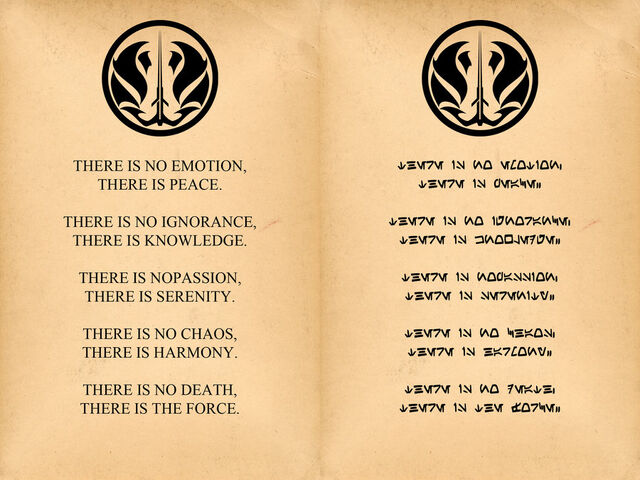
Presented above is the Jedi Code, the central tenants of their religion, the principles which inform their actions, which guide them on how to behave. True enough, the code itself does not provide instruction in the same as, for example, the ten commandments of the Judeo-Christian faith. Instead, this code present a series of assertions which are phrased somewhat metaphysically. They are presented in pairs, denying one thing and affirming its opposite. On one reading, we could consider this to be actively denying the existence of certain things, though a more likely interpretation is that they are presenting certain ideas as undesirable.
Emotion, ignorance, passion, chaos and death all exist. They are not things which can be denied, at least not in the same way that certain metaphysical concepts (with the exception of chaos, which is one such metaphysical concept) can be doubted, for they are each very real parts of the experience of life.
Thus, I consider the code to be largely arguing against certain concepts, prescriptively instructing its adherents to move away from them and instead embrace certain other ideals, which are contrasted against those prohibited.
Some of these contrasts, however, seem to be somewhat questionable. When someone is peaceful, they often say that they “feel” peaceful or they “feel” at peace. Likewise, we experience our emotions as a “feeling”. This does not entirely deconstruct or disregard the comparison which has been established here, but it allow us to contrast the two concepts without viewing them as being in complete opposition. Likewise, serenity and passion are by no means entirely opposed, for the former is a lack of trouble and the latter is simply and enthusiasm or desire. Naturally passion can often lead away from serenity, but, unless we understand serenity as opposed to excitement (which is possible), then there is no reason to see them as in direct opposition. Finally, chaos and harmony are by no means opposed. Chaos is opposed to orderly, whereas harmony means without opposition. I consider it possible for something to be without order yet without opposition. Of course, here chaos is characterised in its links to destruction, though we need not consider these two ideas wed.
“Attachment is forbidden. Possession is forbidden. Compassion, which I would define as unconditional love, is essential to a Jedi's life. So you might say, that we are encouraged to love.” - Anakin
Fundamentally, the Jedi are against emotions, against attachments. On the surface, this seems relatively unproblematic, for it seeks to attain an ethical ideal in which one surrenders their ego, their self-centeredness and attempts to give themselves entirely to others generally, rather than to another individual. It seeks complete equality, to open up compassion to all with not conditions required. At first, it seems like this is a good thing, that this is something we should all try to work towards. Whilst I agree that a little more selflessness would be a good thing and that I would more than encourage others (and myself) to seek to act with greater depth of compassion, striving to undo attachments does cause a few problems.
First of all, this kind of extreme equality completely deconstructs and eliminates what we can term “Relationships of Preference”. By this I mean any kind of relationship which, by definition, requires preferential treatment. The most iconic of these would be marriage or committed romantic attachment. You save your loved one over a stranger because they are your loved one. In virtue of being your loved one, granting this kind of preferential treatment is, in a way, required. Of course, this has limits. It is more justifiable to save your loved one over one stranger, less so to save them over five strangers and almost completely non-justifiable to save them over one thousand strangers.
Of course, Jedi, like many members of religious orders, are discouraged from forming romantic attachments, engaging in sensual relations and producing children, so these love relations are openly forbidden by them, thus weakening the criticism. This is true, but romantic relationships are not the only Relationships of Preference. Another, more important one is friendship.
Friendship too is a relationship of preference, for you favour your friends over those you do not know. If you do not, then the integrity of the friendship is called into question. Obviously, friendships, as with all human relationships, are complex and vary infinitely based on the difference combinations of individuals and circumstances. Yet, underneath the specifics, the very concept of a friendship is one based on preference and attachment.
Yet, these two things are forbidden by the strict ethical aspirations of the Jedi, at least in theory. In practice, attachments are obviously going to develop between masters and padawan and between members of the order more generally. However, underneath this, their spiritual philosophy does not encourage them to embrace such attachment, but to attempt to transcend it.
I am not sure on my thoughts on this, at least not entirely, though I think it difficult to build a belief system based on compassion if, at its very centre, it conceptually forbids all preference and therefore the very idea of friendship.
The Dark Side
“Fear is the path to the dark side. Fear leads to anger. Anger leads to hate. Hate leads to suffering.” - Yoda
Now, the Jedi have their reasons for this opposition to emotions, as they seek emotions themselves as a link to what they deem to be the evil, Dark Side of the Force. According to their believe system, anyone who attempts to wield the force and yet who embraces their emotions is doomed to fall from the light side of the force and become corrupted by a force of destruction, leading away from equality and peace and into rage, domination and passion.
Presented above is the Sith Code, which presents itself more as a pathway than the code of the Jedi. It opens through establishing passion as truth, contrasting it to peace and then showing how this can lead one onwards into other, stronger concepts, with the ultimate goal being that of freedom.
If they Jedi seek unity with the force and to undo the bonds of individualism, the Sith seek to wholeheartedly bask in their ego, in their individual identity. This comes with a terrible narcissistic side effect, in turn leading to megalomania. Essentially, the Sith embrace what the Jedi try to escape: emotion, particularly the darker feelings of fear and hatred. In embracing these feelings and harnessing their strength, the Sith gains great power, but they do so at the expense of their own control, for ultimately they become slaves to their own unfettered emotions, which they are unable to impose control over, for fear of losing them and thus the source of their own power.
Sith are powered on uncontrolled desire and there is a possible allusion to the philosophy of Nietzsche, more specifically the idea of the Will to Power, which is loosely considered to be the driving force behind all humanity: the desire for influence and power. Likewise, the Sith ultimately seek control, corrupted by their uncontrolled desires.
However, the Jedi have seemingly tarnished all emotion due to the threat of the Dark Side. Rather than acknowledging that darker emotions can bring a great amount of power and corruption and yet realising that this corruption is not only linked to darker emotions but also to the manner and degree with which they are embraced, they instead treat the very concept of emotion as the element of corruption.
One possible argument, which I personally do not regard highly, is that the Jedi are not at all contra emotions, but instead they oppose themselves to uncontrolled emotions, to wild and unshackled passion, which, alongside the emotions involved, seems to be half of that which leads to one’s becoming a Sith. However, the very first line of the Jedi code “there is no emotion” defies this interpretation, as it sets their entire philosophy up in opposition to the very idea of emotion.
Fundamentally, I consider attachment and emotions as something which has an important role within the life of a human being. I sympathise with the Buddhist viewpoint, as a great deal of suffering lies within such things and I definitely contend that there is something important in their attitudes. Releasing yourself of some attachment and feeling can be excellent, but removing it entirely, seems to strip you of one of the most innately human aspects of being a person.
Of course, we cannot go the other way and wallow in our feelings all the time, as reason as an equally important part to play within the framework of being. A concept which is explored within the work of Plato is the idea that passion and desire are both important for the individual to be a complete person, yet must always be guided (not controlled, as some might think) by reason and rationality.
Star Wars however, does not do this. Its narrative, especially within the film series, less so in the expanded universe (which is, in my opinion, the best part), very clearly establishes it as a fight between good and evil, with the Jedi and their “emotionless” philosophy firmly presented as good with any alternative presented as wrong or associated with the Dark Side. Ultimately, Star Wars seems to hold a strange message that emotions cannot be trusted, that those with power (shown within as the force) must always strive to abstract away from the emotions which make us fully fleshed out individuals.
My attitude it simple: both sides are wrong in their approach to emotions and this is why neither of them ultimately manage to succeed, as even though the films conclude with the fall of the Dark Side, one glance at the expanded universe reveals that light and dark have struggled and overcome one another cyclically throughout history.
Therefore, I consider neither the Jedi nor the Sith to have the ultimate philosophy due to their inability to deal with emotions in an understandable manner. Emotions are fundamentally important to us both as indicators of identity, and also as elements of morality (those moral systems which attempt to abstract away from emotion seem to ultimately prove hollowly impractical) and thus cannot be expunged, as the Jedi would have it. However, they cannot be allowed to run riot, otherwise we result in an inability to exist within plurality. Uncontrolled emotions allow the ego to swell, make an individual truly that, individual with no ability to recognise the full humanity of another person. Only through tempering emotion with empathy and compassion can this be achieved.
Thanks for reading :)