Showing posts with label Identity. Show all posts

Friday, 17 March 2017

Chimamanda Ngozi Adichie and Speaking For Another

“…my feeling is that trans* women are trans* women. I think if you’ve lived in a world as a man with the privileges that the world accords to men and then…change, switch gender it’s difficult for me to accept that then we can equate your experience with the experience of a woman who has lived from the beginning in the world as a woman and who has not been accorded those privileges that men are. I don’t think it’s a good thing to conflate everything into one, I don’t think it’s a good thing to talk about women’s issues being exactly the same as the issues of trans* women. What I’m saying is that gender is not biology, gender is sociology.”[i]

These words, spoken by Nigerian writer and feminist Chimamanda Ngozi Adichie in a short interview with Channel 4 News have been the source of much contention and fallout over the past few days.[ii] Since its posting earlier this week, the video has faced outpourings of backlash from LGBT+ activists, whether they themselves are trans* or advocating on behalf of trans* people.
The charge is one of trans* exclusion. As one may expect, this has led to claims that Chimamanda is a trans-exclusionary radical feminist (TERF), a claim which not only fixes her within a particular feminist tradition (rightly or wrongly) and which further employs the acronym as a pejorative. The attack is a simple one. It is an accusation that she is wrong (or perhaps incorrect, if this distinction is to figure anywhere here). This has been accompanied with a plethora of comments which (in same breath as declaring her a TERF) deny her the status of feminist and denounce her ‘ignorance’. According to commenters, she’s woefully misguided, denying ‘facts’,[iii] ignoring the basic reality of trans* people and is, at once, just plainly unaware of the ‘established discourse’. It is unclear as to what discourse this could be.[iv] Perhaps more interesting are those who accuse her of ‘speaking for’ trans* people, where this ‘speaking for’ seems to be an act of ventriloquism, of wrongly inhabiting their space and experiences.
I am not concerned with Adichie’s status as a feminist – in as far as it is an identity label – nor am I particularly concerned with whether or not her views mesh with whatever is perceived as the established discourse. Indeed, this would prompt further questions as to whose discourse this is, where it is enacted (and by whom), and to what end it is employed. Furthermore, it endorses the term ‘feminist’ as an identity status, transforming it from an adjective, a descriptor, to a noun in the form of “I am a feminist”.[v] Instead, my interest is, firstly, the question of trans* exclusion. Does Adichie exclude trans* women from the category of woman? If so upon what grounds? Secondly, I consider the other side of this situation, in which the accusation is one of accusing trans* women of possessing “male privilege”. What exactly this means to say is a question of socialisation, of attitudes towards individuals in terms of how they are recognised in relation to others. It is of central importance to the feminist project as a whole (however one might seek to formulate it) that these concepts are elucidated. For without them, the grounds upon which one wishes to discuss the oppression of both women and female-bodied persons (both in as far as these coincide and split apart), is torn away and the very notion of patriarchy goes with it.
Reading the words Adichie used, it is clear to see why they have been read in this way. Trans* women are spoken of in conjunction and, given the context, opposition with “women”. The structure here is othering, pitting one against the other. One should not rush to condemn those who find issue with this phrasing, there is clearly a tension within the words used. But does this amount to trans* exclusion? Well, as Adichie explained in a clarificatory Facebook post three days after the interview:
“Perhaps I should have said trans women are trans women and cis women are cis women and all are women. Except that 'cis' is not an organic part of my vocabulary. And would probably not be understood by a majority of people. Because saying ‘trans’ and ‘cis’ acknowledges that there is a distinction between women born female and women who transition, without elevating one or the other, which was my point.”[vi]
Within this clarification, Adichie seeks to right misinterpretations of both her meaning and her intentions. At other points within this post, she further establishes not only her personal discomfort with being seen to hold this view, but also with the view itself.[vii] We must of course remember the context of her original comments. They are given to us in a recorded interview (under six minutes in total length), and are not formulated within words which can be edited and revised. Furthermore, the interviewing body is that of Channel 4 News, a national channel. Whether for the sake of inclusivity or not, Adichie makes clear that in this context, the term cis – a term which, by means of its introduction, I think beautifully clears up the charge of trans* exclusion – is likely not to have been understood. The very term cis is part of one particular gender vocabulary which, whilst popular, is far from universally understood – particularly by the general public, with all its subdivisions.
If then, to paraphrase, Adichie is saying that trans* women are trans* women, cis* women are cis* women and both trans* women and cis* women are women, as I think she does, the charge of trans* exclusion becomes more difficult to maintain. All she seems to be maintaining is, as she makes quite clear in her original comments, that we should not be so quick to conflate the two identities, to reduce them into an artificial unity. To be sure, it is strange to me that anyone would wish to challenge this, especially if one wishes to maintain the accusation of her wrongly ‘speaking for’ trans* people. For if trans* women and cis* women are the same, reduced to one, then Adichie, as a cis* woman, is as much a part of the category of trans* woman as a trans* woman is part of category: cis* women.
This would appear to posit a messy state of affairs and one which would only serve to silence issues facing one group, or even both.
So much for trans* exclusion. Yet another issue remains. Adichie makes it clear that, according to her, one of the motivations for separating cis* and trans* women lies in their differing experiences and within the privileges that trans* women face as male-bodied people, presumably before coming out, stating their gender identity or changing their gender performativity.[viii] It is the claim that trans* women have at one time possessed ‘male privilege’ that has been seemingly most picked up to support this claim of ‘speaking for.’
Yet is Adichie inhabiting the voice of a trans* person? Is she speaking on their behalf or disclosing the kinds of experience they may face? Perhaps in part, but it seems that she is more concerned with speaking about trans* people, as someone who is not trans* herself. The line between speaking about someone and ventriloquising them, occupying their voice (perhaps falsely), is a murky one.
As a staple concept within feminism (beginning of course within the ‘second wave’ and radical school of feminism) male privilege from its inception has been articulated by female-bodied people, those often regarded (rightly or wrongly) as women. Male privilege speaks of reception and of experience, and is therefore at least in part speaking on behalf of another. The concept enables us to speak of its lack, it’s converse: formulated originally as female oppression. It is from then that we are able to make any kind of articulation of oppression on the grounds of one’s sex, perceived sex, and – through the developments of queer feminist theory – one’s gender. If it through speaking on behalf of another that such concepts of privilege can be articulated, then it does not seem to be that such ventriloquism is to be solely frowned upon. On the contrary, they are an essential to the very trans-inclusive feminist project.
Of course, this is not to ignore the differences between men and trans* women (including the obvious difference of men being men and trans* women being women), particularly in terms of power and position.[ix] All I wish to note is that speaking of or about (and perhaps even in some sense for) another should not be regarded as some kind of violation or overstepping one’s ‘right’. Feminism as a discipline has – as I think I can state somewhat uncontroversially – been primarily driven and maintained by women (and here I do explicitly include both cis* and trans* women).[x] It has made commentary about both the social position of men – and indeed their experiences – from without, as the nature of the claims do not concern solely the subjective experiences of men, but their socio-political position. Feminism has also commented on the position of women, despite many women claiming (both rightly and wrongly, depending on the case) that feminism misrepresents them. I am thinking here in particular of those women who regard feminism as an elaborate form of ‘whining’, and who are often unaware of those nebulous social forces which shape their experiences. Speaking about and for another, whether one shares with them or is divided from them by some category of identity or another, should not be dismissed de facto.
It should be noted that privilege is not so much about identity in as far as an individual self-identifies, but instead concerns identity in the mode that the individual is seen. Were it so simply the case that self-identification afforded an individual all the privileges of the category with which they identified, then there would be no great disparity between the treatment of trans* and non-binary people compared to the treatment of cis* individuals. This is not the case. We could think of this in terms of simply regarding oneself as human. Historically, those in oppressed categories (whether based on gender, sex, sexuality, race etc.) have been scornfully regarded, in various ways, as sub-human and thus not afforded basic human rights and dignity. This persists even today in spite of the strong sense in which those so oppressed regard themselves as human. This is to say that the possession of such privilege is not so much the ‘fault’ or responsibility of the individual who has the privilege, for the privilege is given (or not given) often in ways that are outside of the direct control of the individual. Thus, to say that someone possesses such a privilege should not be conflated with a moral judgement of the one with the privilege. Of course, I do not mean to ignore the history of using notions such as male privilege to exclude trans* women from the category of woman, but I do contend that no such exclusion is occurring here. But the point stands that one does not need to speak for, or steal the voice of another person, in order to speak about male privilege. It is something which is articulated from without.
If we are to speak of male privilege and speaking about or for others, we must speak of socialisation.
From a young age, socialisation takes root. Whilst I uphold the sex/gender distinction as much as I am able, one must recognise that this conceptual division does not reflect the ‘common sense’ reality. For many people outside feminist discourse, sex and gender are interchangeable and this is reflected in the treatment of children. This is what we could refer to as the ‘common sense’ attitude. As soon as a child is coded as male or female, which most commonly occurs shortly after birth, the child inherits a whole array of gendered meanings. Treatment by others shapes their social position and certain privileges are afforded to those who are – or at least who are regarded as – male-bodied. This and this alone is what is entailed within the claim that trans* women (or at least those who were/are male-bodied) possess/possessed male privilege. Of course, the situation is in some sense changing, resulting in a perhaps more accepting world; but we cannot – in our want to change the world and challenge those elements we find not to sit well with us – ignore the predominant view, the ‘common sense’ approach. In order to challenge this approach, we must first understand it and be able to communicate with those who purport it. Such would be to deny the world to which one wishes to object, to deny the very problem feminism could be said to arise in opposition to.
Laurie Richards’ objections to this point (in her ThinkProgress article) have been objectionably phrased in terms not only of “political dishonesty” (whatever one considers this to mean in this context) but also as ignorance of “decades of scientific research”.[xi] The central claim here appears to be that Adichie is simplifying, erasing a huge amount of emotional turmoil and difficulty (both internal and external) which trans* women experience, that she is using the basis of their once having had male privilege to deny their oppression. Not only is this reading of Adichie’s words somewhat mitigated within her clarification,[xii] but I, as well as at least two prominent gender theorists,[xiii] take further issue with the ‘born this way’ narrative with which she presents trans* experiences (which ironically seems equally if not guiltier of simplistically collapsing trans* narratives than anything Adichie may have said).[xiv] This is reminiscent of the very biological essentialism trans* people so often have to fight against. Furthermore, I consider her understanding of ‘male privilege’ to be quite narrow. We must remember, male privilege is not so much about subjective experience, but about one’s treatment by others. And part of this is to recognise that one may possess privileges, but that these do not mitigate or invalidate any oppressions which one may face.
But conversely, such oppression furthermore does not erase one’s privileges, as Richards seems to claim. To think such would be as reductive as it is claimed Adichie’s comments are. I am thinking here in particular of the response by trans* icon Laverne Cox, whose essential claim is that her being perceived as a feminine boy (whether before or after coming out) erased any male privilege she may have had.[xv] On Cox’s own terms, it is the way in which one is perceived that shapes one’s privilege, but even being regarded as a feminine boy is to be regarded as a boy, as one who is assumed (in this case wrongly) as male. Cox further criticises Adichie – wrongly, I think – on the grounds of presenting a singularising narrative for both trans* and cis* identities.[xvi] Nothing in Adichie’s comments speak to this charge. Instead, she is clear that we should instead be mindful not to conflate and reduce things to simple unities. This stands for cis* and trans* identities as much as it does the overall category of woman.
My main concern here is that to view male privilege so reductively, is to undermine a central aspect of patriarchy. I’ve spoken somewhat lengthily here about Richards’ article on ThinkProgress. As a website, ThinkProgress shares important stories, highlighting key feminist issues. It rightly speaks about the oppression of female-bodied people and women (again, both is as far as these two cohere and divide), drawing attention to issues of oppression which are far more than isolated occurrence, but are caused by the underlying, patriarchal structure of western cultures. In order to speak of these structures, to speak of the system as a whole, we must step outside of ourselves. This is not to say that we leave behind our subjectivity – not that this would be possible anyway – or that we ignore individual voices, but it does necessitate a willingness to speak about and for others. If this is forbidden and viewed exclusively as a transgression, we have reached a dangerous position, one in which we are robbed of the vocabulary with which systemic oppression can be articulated.
One cannot help but feel that this controversy passes comment on the nature of liberal feminist discourse. Whilst overly fixating on the language Adichie uses to express herself – a language which, it must be noted, she explicitly declares as not her own[xvii] – commentators are using an altogether too static notion of discourse. In so doing, they appear to regard feminism and its questions not as a lively field of discussion and engagement, the natural fallout of which is disagreement, but as a foregone conclusion. This is mirrored in those who wish to, on the basis of perceived trans* exclusion, exclude Adichie from feminism itself. The basic formulation is that one must believe this or one may not speak of it at all. It is a dangerous state, one which collapses the richness of diverse discourse. To be clear, this is not a simplistic call for any kind of freedom of speech, and I am certainly not saying that all contributions (I have in mind here hate speech) are to be welcomed equally. Instead, I think it misunderstands the very dynamism at the core of feminism, indeed at the core of anything we might speak of as political speech.[xviii]
To close my thoughts, I would like to end as I began, with Adichie’s own words:
“To acknowledge different experiences is to start to move towards more fluid – and therefore more honest and true to the real world – conceptions of gender.”[xix]


[i]Channel 4 News, Chimamanda Ngozi Adichie On Feminism, 2017 <https://www.channel4.com/news/chimamanda-ngozi-adichie-on-feminism> [accessed 15 March 2017].
[ii] I include here only two examples, for the sake of brevity. See: Noah Michaelson, ‘Author Chimamanda Ngozi Adichie Under Fire For Comments About Trans Women’, Huffington Post, 11 March 2017 <http://www.huffingtonpost.com/entry/chimamanda-ngozi-adichie-transgender-women-feminism_us_58c40324e4b0d1078ca7180b> [accessed 15 March 2017]. and Laurie Richards, ‘No, Trans Women Do Not Grow up with Male Privilege’, ThinkProgress, 15 March 2017 <https://thinkprogress.org/trans-women-do-not-grow-up-with-male-privilege-e51eba1eb42c#.ctt1q0lhw> [accessed 15 March 2017].
[iii] Which is of course to beg the questions of whose facts these are, in what context they are situated, whence comes their factual status.
[iv] To speak of this in terms of ‘the feminist discourse’ would not answer this question, but supplant it with another: which feminist discourse?
[v] There is a sense in which this totalises the status of feminism, collapses its discursive elements into a doctrine
[vi] Chimamanda Ngozi Adichie, ‘CLARIFYING’, 2017 <https://www.facebook.com/chimamandaadichie/photos/a.469824145943.278768.40389960943/10154893542340944/?type=3&theater> [accessed 15 March 2017].
[vii] Adichie.
[viii] Speaking of course as in Butler’s sense, see: Judith Butler, Gender Trouble (New York: Routledge, 1990).
[ix] Power is, however, complex and the disparities and similarities across identities and their enactedness and reception is more dense a topic than I can elucidate here fully.
[x] This is obviously not to ignore the many male/masculine contributors to such theory, notably (at least for radical feminism) a reasonably well-known figure: Karl Marx.
[xi] Both quotations are taken from the subtitle in: Richards.      
[xii] “A trans woman is a person born male and a person who, before transitioning, was treated as male by the world. Which means that they experienced the privileges that the world accords men. This does not dismiss the pain of gender confusion or the difficult complexities of how they felt living in bodies not their own.” - Adichie.
[xiii] I think in particularly here of Judith Butler’s work on sex and gender within: Butler. particularly the chapter ‘Foucault, Herculine, and the politics of sexual discontinuity.’ and Michel Foucault’s work within: Michel Foucault, The History of Sexuality, trans. by Robert Hurley, 5 vols (New York: Pantheon Books, 1978), i.
[xiv] Richards
[xv] Laverne Cox, ‘Laverne Cox - Twitter’ <https://twitter.com/Lavernecox?ref_src=twsrc%5Egoogle%7Ctwcamp%5Eserp%7Ctwgr%5Eauthor> [accessed 15 March 2017].
[xvi] Ibid.
[xvii] Adichie,
[xviii] My thoughts here are informed by Hannah Arendt’s notion of novelty as intrinsic to any true political discourse, see: Hannah Arendt, The Human Condition, 1st edn (Chicago: University of Chicago Press, 1998).
[xix] Adichie.


Works Cited

Adichie, Chimamanda Ngozi, ‘CLARIFYING’, 2017 <https://www.facebook.com/chimamandaadichie/photos/a.469824145943.278768.40389960943/10154893542340944/?type=3&theater> [accessed 15 March 2017]
Arendt, Hannah, The Human Condition, 2nd edn (Chicago: University of Chicago Press, 1999)
Butler, Judith, Gender Trouble: Feminism and the Subversion of Identity (New York: Taylor & Francis, 2006)
Channel 4 News, Chimamanda Ngozi Adichie On Feminism, 2017 <https://www.channel4.com/news/chimamanda-ngozi-adichie-on-feminism> [accessed 15 March 2017]
Cox, Laverne, ‘Laverne Cox - Twitter’ <https://twitter.com/Lavernecox?ref_src=twsrc%5Egoogle%7Ctwcamp%5Eserp%7Ctwgr%5Eauthor> [accessed 15 March 2017]
Foucault, Michel, The History of Sexuality, trans. by Robert Hurley, 5 vols (New York: Pantheon Books, 1978), i
Michaelson, Noah, ‘Author Chimamanda Ngozi Adichie Under Fire For Comments About Trans Women’, Huffington Post, 11 March 2017 <http://www.huffingtonpost.com/entry/chimamanda-ngozi-adichie-transgender-women-feminism_us_58c40324e4b0d1078ca7180b> [accessed 15 March 2017]
Richards, Laurie, ‘No, Trans Women Do Not Grow up with Male Privilege’, ThinkProgress, 15 March 2017 <https://thinkprogress.org/trans-women-do-not-grow-up-with-male-privilege-e51eba1eb42c#.ctt1q0lhw> [accessed 15 March 2017]

Works Consulted

Ahmed, Sara, Queer Phenomenology: Orientations, Objects, Others (Durham: Duke University Press, 2006)
de Beauvoir, Simone, The Second Sex, trans. by Constance Borde and Sheila Malovany-Chevallier (London: Jonathan Cape, 2009)
Butler, Judith, Bodies That Matter on the Discursive Limits Of ‘sex’ (Routledge, 2011)
Butler, Judith, Subjects of Desire: Hegelian Reflections in Twentieth-Century France (United States: Columbia University Press, 2012)
Irigaray, Luce, To Speak Is Never Neutral (New York: Routledge, 1997)
Witt, Charlotte, ‘Anti-Essentialism in Feminist Theory’, Philosophical Topics, 23 (1995), 321–44

Monday, 13 July 2015

Vivienne - Beneath the Surface

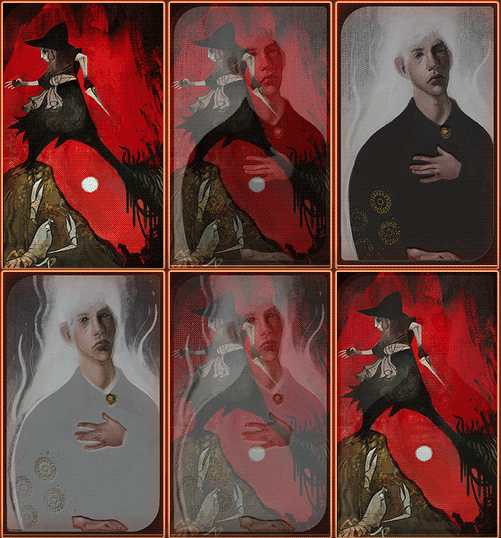
Known as the 'Ambition', Vivienne is the verbose, shrewd and magnificent First Enchanter of the Montsimmard Circle of Magi. As an individual, she has been graced with mixed reception by both stalwart fans and newcomers to Thedas alike. Some see her as a typical establishment mage, indoctrinated by the very chantry which suppresses her freedom to the extent that she pro-actively seeks to extend these limitations (some might refer to such things as injustices) to others of her 'kind'. Others, however, view her as a particularly caring and maternal figure who simply wishes to keep the world in good shape, despite the many instabilities and new-found forces who seek to usurp it.

Image shared by sledixx

So, without further ado, let us turn our attention to the pillar of order that is Madame de Fer. 

The Imperial Game

Though she was born in the Free Marches, Vivienne was transferred to the Circle of Montsimmard whilst still an apprentice. We know not what means she came from, but we can be certain that the move to Orlais and her subsequent victories have served as a major improvement in her social standing. She became the mistress to Duke Bastien de Ghyslain, the head of the Council of Heralds (a political body responsible for reconciling all heraldic disputes and which has a role in determining claims to nobility). From here, Vivienne has pursued the completion of her goals and her own advancement doggedly and has refused to allow any to stand in her way. For this reason, many regard her as a 'heartless bitch' or a 'typical social climber'. 

Of course, Vivienne has shown us that what she wants is to make a place for herself in the tumultuous world of Thedas, a difficult task for any Mage, let alone when one is attempting to achieve such a thing within the Imperial Court of Orlais without the boon of noble birth. In order to do this, she has had to play the great game to the best of her abilities and as demonstrated consistently that she is enjoys it. She has followed the hierarchy as it has been presented to her, climbing to the rank of First Enchanter and from there claimed an almost entirely ceremonial role as Enchanter to the Imperial Court. Before her appointment to this role (which would not have been possible without the endorsement of her lover) it held few political advantages. Upon taking it, Vivienne has transformed it into a position of great importance and prestige. 

Rightly, Vivienne is named 'The Ambition' by the developers and she has earned herself the title Madame de Fer, the lady of iron, for she is both respected and feared. We are told that she finds such a title amusing. She is headstrong and can be stubborn, but she acts relentlessly and in spite of that which may seek to divide her from her goals.
"Rest assured, dear Seeker. I'm never truly out of my element."
Naturally, her links with Bastien opened many doors, and many fans of the games have dismissed her a social climber, who is perfectly willing to exploit others and manipulate them to her own advantage. Of course, this is certainly the case, for she could not have attained such a position without indulging in such behaviour. From what insights we have gained of the imperial court, one cannot be honest and hope to endure within it for long. However, the charge that she does not care about Bastien is certainly unfounded. Those who have followed Vivienne's personal quest-line (Bring Me The Heart of Snow White), fetched the heart of a snowy wyvern and followed her to what will become Bastien's deathbed, will know the genuine sadness and upset caused by watching him die. Some have said that her upset is selfish, for she can no longer use his position to her advantage, but the truth is that she does not need to. She has already established herself as a First Enchanter and the Enchanter to the Imperial Court of Orlais, two of the highest positions a mage could hope to claim. Any tears she sheds for him are genuine. Furthermore, why would one spend so many resources attempting to prolong the life of someone for whom one only has an instrumental care?

Already, we can see that Vivienne is an emotional human being, though one who possesses a thick skin and who has become accustomed, mainly due to her experiences within the empire, to always maintaining a façade. Within Orlais, if one's only mask is the very literal garment upon one's face, then one is not playing the game well at all.

Image shared by carolsusanjanedanvers

Thus, from a very early stage in her life, she has lived within the Masked Empire of Orlais and this is certainly noticeable in the manner through which she conducts herself politically. Each of her actions is calculated and she holds appearance in the highest regard. Some might dismiss this as shallowness or some 'lack of character' but the care with which she fosters a perfect outward appearance is not done out of vanity or pride, at least not primarily. Instead, her experiences within Orlais have taught her the importance of how one presents themselves. The Empire places great weight upon appearance and one's conduct and, in order for one to make a place for themselves at court, one has to be willing to cultivate these things. 

Her experiences within the empire have had extensive formative impacts upon her character, fostering her desire to improve her station as well as instilling her with keen social awareness. She knows how to act, how to dress, what is expected of her and to what extent she is able to ignore these demands and how much she should co-operate with them. The result is an ostentatious, astute figure who has learnt the importance of adaptability and what can be gained from the tactical employment of social graces. In many ways, she is a natural product of the imperial environment into which she has both been flung and flung herself. 

Blackwall: You must miss the comforts of your mansion, travelling with us as you do.
 Vivienne: I miss them. I do not require them. But please, continue to imagine me a pampered lady, if it makes you feel superior.

Image shared by Shem Rights Activist

The Chantry and The Chant

"We need an institution to protect and nurture magic. Maker knows, magic will find neither on its own."

Vivienne is often regarded as a typical traditionalist, valuing the pre-existing norms of society and choosing to stand for this order whilst dismissing the subversive voices. This is due to her relatively conservative views regarding magic and those who are able to use it. Vivienne is a firm supporter of the circles, regarding them as entirely necessary for those who are capable of working with magic. She equally understands the Templar Order as a necessity, for not all who are given the ability to wield the power of the Fade are quite up to the task. Her distrust of uncontrolled magic spills out through her initial interactions with Dorian, during which she constantly derides him and Tevinter for their foolish and lax attitudes toward magic. Without such institutions in place, able to provide the requisite guidance and tutelage to young mages, the world would be forever ravaged by abominations, with no capable force at the ready to protect the innocent. She sees the Chantry as the only force able to stand between a civilised world and one of blood magic, possession and chaos. 

"In my own experience, nothing is more deadly to young mage than a lack of knowledge."

But she does not hold these views for the sole benefit of those who do not possess magic. To her, the circles ensure the protection of mages, granting them a haven from a world which has been forever trained to hate them and what they perceive to be their curse. Of course, she is aware that this ideal has, in places (she does specifically mention Kirkwall as among the worst), entirely failed. The Templar Order has become a shadow of what it should be, enabling the abuse of young mages, which is certainly not something that she permits. She is aware that all who live within the circles have vastly different experiences and that there is no such thing as a singular vision of circle life. Furthermore, she understands this as something which is necessarily going to happen, but her vision is a circle that is a haven for mages, but not one which values their personal freedoms above collective safety. 
"I will once again ensure they are protected from a world that hates and fears them."
Many think that she simply wishes to revert to the old system, but should one decide to endorse her as divine, one clearly sees that this is not the case. True enough she re-establishes the Templar Order as well as the Circles, but the mages are granted additional freedoms (which come hand in hand with responsibilities) and the Templars are more firmly leashed under her control. We can surmise that mages under her vision are more like she is: able to understand the power of magic and to respect it, but also trained to use it masterfully and able to enjoy a life outside of the circle. 

"Kirkwall gave the world a reason to remember its fear of magic. A mage killed hundreds with a snap of their fingers. Across Thedas, a new tangible fear of magic grew. Commoners and nobles alike called out to the Chantry for protection. But the malcontents in the towers thought nothing of this.

In truth, she treats her those of her former colleagues who have openly embraced the mage rebellion with open disdain, bordering on disgust. Considering the timing of the rebellion, (which followed the terrorist destruction of the Kirkwall Chantry by Anders at the end of Dragon Age II) she views the separation from the Chantry as hugely damaging, as the rebel mages were fleeing into a world which had just renewed the vigor of its anti-magic sentiment. 

"Magic is dangerous, just as fire is dangerous. Anyone who forgets this truth gets burned."

Due to these views, as well as her willingness to become Divine if the option is given her, it is relatively safe to assume the Vivienne is Adrastian. It is because of this attitude that Vivienne is rightly understood as a pillar of order, but that it is also wrong to regard her as an indoctrinated zealot who has been trained through years of conditioning to simply tow the line. In truth, however, Vivienne demonstrates a canny grasp of the political forces operating within Thedas and whilst some might dismiss her as cold, she has a well-reasoned point to make concerning the politics of magic.

"I never worry, darling. A leash can be pulled from either end."
Image posted by carolsusanjanedanvers

From the Inside

Of course, Vivienne's own experience as a mage of the Circle and all that entails have served to shape her views on the proper place of magic, as well has her treatment of other characters. 

I have already mentioned her initial interactions with Dorian, through which she uncovers a deep-rooted rejection of the altogether overly-liberal attitudes of Tevinter. She wishes to hold true to the catechism at the heart of the Chantry's teaching that 'Magic Exists to Serve Man' and this comes with a wholesale rejection of the very image of a Tevinter mage, who lords his power over those who are unable to resist him and seeks only his own advancement. This image is fixed within her mind and thus informs her expectations of Dorian. It is not until later that she allows herself to question.

Dorian: Vivienne, are you saying you wouldn't rather live in a land where mages aren't herded into cages like dogs?
Vivienne: Which land is that? The one where mages are feared and despised as tyrants?

I do not intend to imply that Vivienne is not critical of the structures of power which operate around her, for I think I have already established the opposite to be the case. Instead, I wish to press the point that Vivienne is cautious wherever anything concerning magic arrises. Those who detract from her and regard her as 'typically establishment' often forget what a devastating force magic can be for those who can wield it (particularly unwitting) as well as for those around them. Particularly where the Fade is concerned, and it often is, being the source of magic, there is the potential for possession, the entire loss of the self which often leads to far more destructive ends. Magic is a mighty force and much of it is not understood. 

Image posted by bossuary

Solas: Your rigorous training lays a solid foundation, true. It also creates boundaries, limits, where none need 
exist.
Vivienne: I do prefer to have boundaries between myself and the demons, my dear.

In conversation with Solas, it is clear that he regards her as restricted and close-minded, unable to even begin to understand anything outside of her ivory tower. When Vivienne invites Solas to make a claim against he responds with "You would not believe me. You have learned your lessons all too well." It is also true that when Solas seeks to advise her, she responds with "I sincerely doubt you could add anything." Further banter occurs in which Vivienne criticises Solas' lack of technique and he in turn makes jibes about imperfections within her own magic. Notably, when Solas attempts to encourage her to abandon her training, she responds with "Ah, the temptation to leave the path. You sound like a pride demon."

These exchanges establish not only Vivienne's trust in the circle, but also her dependence upon them. Whilst her talents are great, she is in many ways limited by them. Above all, Vivienne requires control, an environment in which she is able to keep herself in check and for her, this is the circle. Outside of it, she is nothing and has no guiding principle which she can turn to. This is her support, her world, and its principles are deeply her own. Those who turn away from the doctrine of the circle leave themselves open to disorder and through this disarray they are rendered open to becoming tolls wielded by demonic hands.
Solas: "You need never concern yourself with the possibility that your Circle was wrong."
Magic is often an agent of chaos and destruction, capable of dealing great harm to all who come into contact with it. It is control and self-restraint alone which prevent a mage from becoming possessed or turning their power on an innocent. For Vivienne, the only institution capable of providing the instruction conducive to this level of discipline is the Circle, where mages pass their wisdom on to others, whilst also protected from themselves by the Templars. 

Importantly, many of Vivienne's attitudes are revealed through her interactions with Cole. Revealed to be a spirit of compassion, Cole joins the Inquisition because he wants to help. Vivienne does eventually come to care for Cole, though she keeps this attitude very much to herself, but initially she is outright hostile to him, regarding him as a demon and an influence which should be expunged from the Inquisition, for he could undo it from within.

Her scepticism is born from a life spent learning of the dangers of the Fade, learning that its denizens are malicious and cannot be trusted, for they all they seek is possession or the death of any mage. Having been told all her life that the Fade is universally a place of peril and that all which hails from within it only serves to undo the precarious order the Circle seek to preserve, she naturally is suspicious. Furthermore, Vivenne's experience of spirits is limited, for the Circle actively avoid such things and study into such areas is restricted if not completely forbidden.
"The Circle taught me the tricks demons play to gain the trust of any mage foolish enough to listen."
A notable exception is the Harrowing, a trial by fire through which a mage is forced into the Fade to face a demon, to demonstrate that their will is strong enough to resist possession. We learn of Vivienne's Harrowing through conversation with Cole. 
Cole: Everything bright, roar of anger as the demon rears. No, I will not fall. No one will control me ever again. Flash of white as the world comes back. Shaking, hollow, Harrowed, but smiling at templars to show them I'm me. I am not like that. I can protect you. If templars come for you, I will kill them.
Vivienne is not only Harrowed, note the capital, but she is hollow and shaking. Her only known experience within the Fade (we might presume, due to her extensive time in the Imperial Court, that she had little time to run around the world of dreams) has evidently been traumatic, thus preventing her from becoming open to the possibilities of spirits. Not only has she been taught to view all spirits as malignant, but she has also only extensively experienced the wrath of demons.

Considering how dangerous magic has been clearly established as being throughout the Dragon Age series (think on just how many renegade mages within Kirkwall suddenly flipped out as a demon took control), Vivienne's response to Cole, though naive and incorrect, is entirely reasonable. Even Cole admits that he might be a demon, that he simply does not know and that is enough for Vivienne to rightly be suspicious. Not only that, but Cole is clearly using her memories to get closer to her, as spirits do, and she interprets this as trying to coerce her into lowering her guard. He further makes matters worse by offering to kill templars, mimicing the offer made to apprentice mages by many demons "I will protect you and give you the power to free yourself from your chains". 

This interaction reveals Vivienne's dependence upon the Circle and its structure. Though she is wary of the templars and evidently fears them, she does not wish them dead, as they are an integral part of her own security. Above all, she fears possession and a loss of control. She never wishes to be at the whim of external forces and for this reason, she endeavours to become the very image of a perfectly disciplined mage, which is only possible through the circle. She then seeks to extend this to others, for what she perceives to be their own benefit. 

Conclusion

Through this entry, I hope to have established Vivienne as not only a pillar of the established order, but provided her reasons for serving as such. She is not the unthinking follower of a doctrine, for she consistently demonstrates an acute awareness of how things are working and it is perhaps this insight into the bigger picture which leads her to what many view as a conservative stance regarding magic. Sure, her extensive experiences within the Chantry have contributed to her views significantly, but they are not the sole reason she thinks as she does. 

Despite her title as Madame de Fer, Vivienne acts as she does because she genuinely believes that she acts in the best interest of the mages. She is warm of heart and evidently cares very deeply about the situation the mages have found themselves in, though she does not mince words and is quick to curtly remind those who have only made matters worse of their errors, lest they forget. Were one to elect her as Divine Victoria, she would create world in which mages could prosper within their circles, given proper security and tutelage. Surely, there would still be malcontents wishing to live libertarian lives independent of the Chantry entirely, but that will always be the case. If her vision were to be realised, magic might slowly become less and less stigmatised and things could be better. Of course, this is pure speculation. 

On a final note, I stand by my claim in an earlier entry that Vivienne is an ENFJ. Though she might be mistaken for an ENTJ, she is simply too aware of the feelings of others and to able to manipulate them too fluidly for this latter typing to be accurate.

Image posted by gerryarthur

Sunday, 4 January 2015

Meeting the Inquisition

So with the, relatively, recent release of Dragon Age: Inquisition, the third instalment in the Dragon Age saga, we have been introduced to a fantastic new cast of characters. It took me a while before I was able to play the game, but I have recently been devouring it eagerly. As the university term is about to begin once again, I thought it would be interesting to produce a couple of entries on the saga. Naturally, with such a large number of new characters (and more than a few recurring) I could not resist the temptation to type all of the characters with MBTI. 

Needless to say, this entry is going to discuss the characters in relative detail. There may be spoilers. Consider yourselves warned. 

With that in mind, let's get right in there.

The Warriors

Image posted by GirlPlaysGame

Blackwall - ISFJ (The Protector)

Typical of an ISFJ, Blackwall has an incredibly strong sense of duty and this manifests in his strong dedication to the Grey Wardens. His dominant Introverted Sensing (Si) manifests in a clear understanding of general forms, of the way in which things should work. Though not entirely bound by them, he regards traditions highly, often more willing to adopted the tried and tested ways of behaving, slow to embrace novel methods. In his devotion to the Wardens, a further respect for the lessons of the past is revealed. Through speaking to him, he reveals a constant interest in his previous experiences, discussing his decision to reject the aid of a Chevalier, which could have led him to a previous life. Further evidence of the traditionalism of his Si is revealed though this is revealed further through his auxiliary Extroverted Feeling (fe). When faced with that which would challenge his personal views, his response is primarily emotional. Disrespect the Wardens and he immediately becomes hostile and openly disapproving. His understands how others feel and is able to respond to them emotionally, with compassion. However, his Fe is contained by his Si, for he keeps mostly to himself. His tertiary Introverted Thinking (Ti) allows him to hold consistent views and subject his past experiences to criticism. As this is introverted, Blackwall is able to organise his experiences and feelings into a logical structure of his own design, allowing him to develop his own approaches. It is down to the independence granted to him by his Ti that Blackwall is able to operate independently of the Grey Wardens. His somewhat rebellious or independent streak is further encouraged by his inferior Extroverted Intuition (Ne) which encourages him to move towards novelty and is sometimes able to lead his Si astray. 

Image posted by GirlPlaysGame

Cassandra - ESTJ (The Supervisor)

Almost every fibre of Cassandra's being is focused upon establishing order and control within her external environment. Without a doubt, her dominant function is Extroverted Thinking (Te), through which she focuses her attention on the outside world and seeks to see the rational connections between the various concepts of her environment and arrange them in such a manner as to serve a particular goal. She professes that her superiors always criticised her for acting too hastily, and this is evident of the quick conclusion producing abilities of her Te. After all, the Inquisition is born from both Leliana's vision and Cassandra's pragmatism. Under her orders, all of the component parts are brought together and moulded to fit a singular purpose. What marks Cassandra as an ESTJ over an ENTJ is that the order she seeks to enforce is not one of her own making. It is not her own vision that she seeks to fulfill, but another's, albeit one she shares. In the absence of Justinia's guiding hand, Cassandra turns to her past experiences and the established way of things for inspiration, an indication of her auxiliary Introverted Sensing (Si). Relying on routine gives her an extreme respect for the status quo, though she recognises that some things need to change. Her tertiary function, Extroverted Intuition (Ne) aids in the development of these new conclusions. When she encounters that which disillusions her to the established ideas (such as the discoveries concerning the Order of Seekers during her personal quest), she is forced to use her Ne to reveal a new path, connecting the established ideas, known through her Si and enforced through her Te, to explore new possibilities. Cassandra is not one to share her feelings, keeping them close to her and dealing with them in solitude unless she is very close to the one with whom she is sharing them. As her inferior function is Introverted Feeling (Fi) her emotions can become problematic for her, influence her behaviours in a less than conscious manner. Whereas she may see herself as a disciplined and rational Seeker, she is susceptible to her motions that she cares to admit. Take, for instance, her arguments with Varric. 

Image posted by GirlPlaysGame

The Iron Bull - ESTP (The Promoter)

Undoubtedly among the reasons he was selected to be Ben-Hassrath, the Iron Bull's dominant function is Extroverted Sensing (Se), indicating that he is extremely present. In short, Bull Keeps it real. He is less concerned with the ways in which things should be (as one might expect from a Qunari) in either a generic or abstract way but is more content to deal with things as they are. In spite of his association with the Qunari and the Qun, he has spent so much time away from it that he has learnt to be far more pragmatic and down to earth than idealist. The ease with which he can be encouraged to abandon the Qun and live as Tal-Vashoth for the sake of his friends is evidence of this. He also adores physical sensations, as is evident to anyone who takes him to slay a dragon. Simply because he is not dedicated to the Qun does not mean that he does not like structure. As said to those who romance him, he likes structure and organisation in the world, something to tame his impulses and this is evidence of his Introverted Thinking (Ti). When encountering something novel, he is quickly able to organise it into his personal system, which has certainly been shaped by the Qun, though it is not limited to it. Bull is open about his feelings, though is less serious about them at first, as is clear to any who romance him. Due to this Extroverted Feeling (Fe), he can seem very much like an open book, for any feelings are easily shared. In this position, however, the function is relatively simplistic. Underneath it all, he is guided by gut instincts and raw luck. This is representative of an underdeveloped inferior Introverted Intuition (Ni).


Rogues

Image posted by GirlPlaysGame

Varric - ESFP (The Performer)

Highly observant, Varric's attention is near constantly fixed upon the state of the world around him. He regards events and people and objects and absorbs them all through his dominant Extroverted Sensing (Se). Varric enjoys new experiences, for his delight comes from taking these and weaving them into over the top tales and stories. Furthermore, he has fine taste, epitomised in his love of commerce and money, which is a fundamental drive for his mercantile side. The true analysis comes from his auxiliary Introverted Feeling (Fi) which reviews his experiences as produces private emotional responses and an internal system of subjective ethics. Interesting, this leads him to fail to involve himself with either side of the Mage/Templar war, though he is not unsympathetic to its nature. The presence of such sympathy is shown through his remaining with the Inquisition and even contacting Hawke for their assistance, even though he could easily leave. Varric does have an idea which he wishes to push out onto the world: one in which he is able to live a relatively quiet life as a merchant, making enough money by which to live and ultimately keeping himself free from the dangers of the grand stories of history. This tertiary Extroverted Thinking (Te) is what ultimately leads him to stay with the Inquisition, for he realises that without its success, he cannot have his ideal life. His inferior function, Introverted Intuition (Ni) does not seem all that developed to me, though perhaps further reflection will reveal more to me at a later date. 

Image posted by GirlPlaysGame

Sera - ESFP (The Performer)

Similarly to Varric, Sera simply wants to lead a quiet life outside of the grand chapters of the history books. Her dominant Extroverted Sensing (Se) manifests through her attitude of living in the moment, her ability to be incredible flexible and her love of novel sensations. Were she able to, Sera would fill her days with the pleasures of food, wine, song and women and, like Varric, it is her realisation that she cannot have her goal, through her tertiary Extroverted Thinking (Te) that she ultimately remains with the Inquisition. Auxiliary to her Se is Introverted Feeling (Fi) which manifests itself through pranks and playful attempts to engage with others. For example, she constantly mocks Vivienne for her nobility, though she does not seem to want to cause offence so much as engage in some harmful expression. Beneath everything, she seems to hold several principles which effect the rest of her behaviour, evident of an Inferior Introverted Intuition (Ni). She does not seem to critically engage with these, which make them her greatest weakness. An example of such is her unreasoning dislike for the Dalish "elfy elves". 

Image posted by GirlPlaysGame

Cole - INFP (The Healer)

Though the dominant function of an INFP is Introverted Feeling (Fi) which is focused far more upon the self, rather than the feelings of others and whilst feeling in an extroverted form is more able to pick up on the feelings of others, the way in which Cole interacts with emotions seems to me to be highly introverted. Due to the fact that he is a spirit, Cole's personhood and sense of self are often called into question. Speaking with him reveals that he is very unclear as to what he is and who he is and this void is filled with the needs of others. He experiences the pain of others, not through empathy, but through living it himself, he literally experiences their pain and their memories and then deals with the emotion internally before he 'helps' them. This, coupled with the fact that he treats all those he helps in a highly individual sense, rarely, if ever, regarding them generally betrays a strong sense of Fi. The manner in which he helps others is often through helping them forget, though he approaches each case with a sense of wonder, every one of them requiring that he test several approaches, making them forget him each time her fails. This is evidence of his auxiliary Extroverted Intuition (Ne), which helps him expand on a key idea (that of helping another) and allows him to generate novel ways of approaching them. Tertiary is his Introverted Sensing (Si) which naturally turns him away from the world and places him in a dreamlike state (which is obviously augmented by his being a spirit). His experiences of people allow him to develop, and he is able to look to previous cases in order to develop a method of helping, though ultimately he prefers to use his Fi and Ne in conjunction. Extroverted Thinking (Te) is his inferior function and it manifests in his desire to eliminate pain, an end goal to which he is always working. However, this function has often, in the past, at least, caused him issue. He used to murder individuals in order to help them, so dedicated to his goal was he. 

The Magi

Image posted by GirlPlaysGame

Dorian - ENFP (The Champion)

Dorian is driven by a desire to improve the world, though he has no clear goal in mind, no clear vision of the future. Primarily, he desires to make things better in Tevinter, though he has no clear idea as to how to go about this. He shows himself as wondering at the potentials which lie within the future, with all the potentials. Due to this, I consider his dominant function to be Extroverted Intuition (Ne). Whereas Solas and Leliana (to be discussed later) both work toward a "closed conclusion" with a specific nature and path, Dorian champions liberation in order to open up worlds of possibility. He is not deterred by the insurmountability of the problem, for he deals in possibilities, not in facts. Personal emotion is highly motivating for Dorian. He champions the liberation of Tevinter because it is personal to him, because his personal ethic demands it. This is demonstrable of auxiliary Introverted Feeling (Fi) which concerns the subject itself. It is further evident in his demand for authenticity above pleasing others. Rightly so, he does not wish to change himself to please his family or his culture, and, though the act is not without challenge, he finds it easier than he might have done to bear the burden of his exile, for he has earned it through being his genuine self.  This goal and his sense of self lead him into becoming a voice for those who a voiceless, or at least he desires to become such a thing. Genuinely, he wants other people to be themselves, and he realises that the world must change in order to allow it. This reflects his tertiary function Extroverted Thinking (Te) through which he seeks to impose an order of things, no matter how lax this may be in practice, upon the world. His inferior, and thus most problematic, function is Introverted Sensing (Si) which is predominantly concerned with the past and his own experiences. Dorian struggles with these, mainly due to the nature of them as so different and overtly opposed to the sense of genuine self he has created with his Fi. The past is a place of worry for him, thus he turns himself to a future of infinite possibility. 

Image posted by GirlPlaysGame

Solas - INFJ (The Prophet)

This section will include discussion of spoiler material most explicitly, and is also based upon my own theories and understandings of the character. When originally considering him, I had him penned down as an INFP, the same type as Cole, however, all things now considered, I am almost certain that he is an INFJ. However, I think that, like many INFJs, he is guilty of putting on masks and appearing as another type. I think it is possible to mistype him as an ISFJ. 

Look away now. 

As is revealed in the post-credits epilogue, Solas is in fact Fen'Harel, the Dread World, a deity of elven myth who has survived the fall of Elvhenan. There are currently many theories as to the nature of this character. In short, I consider him to have indeed sealed the elven Gods, save for Mythal (and perhaps Andruil), who were, like him, ancient elven rulers. In doing so, he created the Fade and sealed away the spirits, alongside the other Gods. He then rested and upon awakening, discovered that his people had been overwhelmed by the Tevinter Imperium. Since, he has single-mindedly pursued the goal of releasing the Gods. 

Solas is fixed upon the future and his singular pursuit of a very important goal and he constantly seeks it, it defines him entirely. This is a fundamental trait of Introverted Intuition (Ni) his dominant function, for he always looks for the connections between ideas, in this case various articles of magical power, in order to know best how to bring these elements together in the right way and thereby achieve his goal. Furthermore, he is captivated and repulsed by Dalish myths, in which he is portrayed as a traitor and an antagonist. When looking at the tales, and the fate of his people, he looks beyond facts, seeking deeper meaning, another trait associated with Ni. It is further reflected in his want to understand spirits and the Fade, a world of hidden and concealed meaning. His drive is emotional, he feels so very strongly about his failure. This is his auxiliary function, Extroverted Feeling (Fe). As we seek him in Inquisition, he keeps his feelings to himself most of the time, mainly due to his attention focused on his goals and his inner world. However, he is among the first to speak out when emotionally engaged with an issue. He will switch from a quiet demeanour to one of anger the moment you chose to take a path he objects to. Another reason he is so distant is due to the fact that his Fe seeks out connections, though the connections he wants, those with his people, are impossible or unwanted. Modern day elves reject him. However, when he speaks with Flemeth/Mythal (Flemythal) during the epilogue, someone with whom he is very close, he instantly becomes expressive. However, his pursuit of his goal is not mindless. He is not simply guided by instinct and emotion, he rationally assesses before taking a step and this is his tertiary function, Introverted Thinking (Ti). Thought the conclusions he reaches are attained through Ni and Fe, he checks his methods through Ti. His connection with the physical is far weaker than the mental, shown in his preference for the Fade over reality. He is able to understand his experiences and study them, but that which he experiences for himself is far less important to him than the deeper meanings and emotional responses they produce on inspection. This is evidence for an inferior Extroverted Sensing (Se). 

Image posted by GirlPlaysGame

Vivienne - ENFJ (The Teacher)

Though she does not always care about it, Vivienne is supremely able to understand what others are feeling. She is empathic in the sense that she is able to comprehend and play the social area to her advantage. Should the inquisitor take the view that justice and lofty concepts are more important than people, she responses to say that most people would never be able to understand such an abstract position and that people need to be cared for first and foremost. This is her dominant Extroverted Feeling (Fe) coming out to play. However, though she prefers people to ideals, she is rather concerned with ideals herself. She has a clear vision of the future for Mages. She wants the Circle to be restored and young magi to be protected and nurture. ENFJs generally concern themselves with the nurturing and teaching of those they care for and her understanding of the Circle as a place where magi can be protected clearly shows her compassionate side. Her clear vision for the future and her almost stoic ethics (she seeks reality as a series of necessary restrictions and the wise focus only on the choices they have, something I will be discussing in depth later, I would imagine) reveal that she is fluently able to understand deeper meanings. Introverted Intuition (Ni) is thus her auxiliary function. Importantly, her tertiary function, Extroverted Sensing (Se), expresses itself in her affluence and her desire for beauty. Vivienne has high standards and good taste. She delights in pleasant experiences, though is not dominated by them. As she tells Blackwall, she misses her comforts, but does not need them. Though it is not her greatest trait, Vivienne is able to understand her inner thoughts in a structured and coherent manner due to her inferior Introverted Thinking (Ti). 

The Advisers

Image posted by Fenris-Garrus

Cullen - ISFJ (The Protector)

Defined largely by his desire to serve others, Cullen's attitudes are defined largely on reflection through his past experiences and established traditions. His motivations for joining the Templars was born out of his need to do good and to help others and he certainly seems more willing than most templars (save for the moments immediately following the collapse of the Ferelden Circle during Dragon Age: Origins) to sympathise with Magi. During Inquisition, he reflects often on his experiences during Dragon Age II in the Kirkwall Circle and these experiences directly feed into his attitudes towards the present. This is typical of a dominant Introverted Sensing (Si) function. His judgements and his conclusions are heavily motivated by his emotions. He cares for people, which both leads him to value magi and also demand, temporarily, that they are heavily restricted in order to protect others. Though he is certainly able to act in a detached and purely 'rational' manner (evident of a tertiary Introverted Thinking (Ti) function) his central mode of operation is emotional. He seeks to provide and accommodate his allies and, though he will often share his opinions and his capable of criticism, he values unity and coherence above all else. This is the work of his auxiliary Extroverted Feeling (Fe). At his core, he is shaped by a desire to seek novelty and new ideas, which is his inferior Extroverted Intuition (Ne). However, this function is not so developed. 

Image posted by Fenris-Garrus

Josephine - ESFJ (The Provider)

A diplomat through and through, Josephine works towards unity and harmony. She is able to understand the feelings of others, abstract herself into their perspectives and then fluently manipulate, plucking the right strings at the right time in order to provoke the desired response. Her intention is to ensure that the Inquisition is viewed positively and to avoid war and conflict with other organisation. Her warmth and her tendency towards harmony and kindness is representative of Extroverted Feeling (Fe) her dominant function. Among the reasons she is so good at being able to perform this task is through being able to rely on her own experiences. When in doubt, she turns to the past, reflects on previous situations and how she can best learn from them. This indicates that her auxiliary function is Introverted Sensing (Si). However, she is certainly not bound by her own experiences and she is able to produce novel approaches and ideas through abstract thinking. When presented with a problem, she ensures that there is a way around it. She can smooth over situations with other organisations and this penchant for problem solving is aided by her inspired sense of novelty, which is representative of a tertiary Extroverted Intuition (Ne). Though she has relatively little need to, she is able to reflect upon the internal consistency of her ideas and approaches, developing an inner framework and approach. This is her inferior Introverted Thinking (Ti).

Image posted by Fenris-Garrus

Leliana - INFJ (The Prophet)

In a previous entry, I typed Leliana very differently. This was done at a time when I did not understand MBTI and its subtleties as I do now. As mentioned regarding Solas, INFJs have a tendency to hide themselves behind the mask of another type and this may be true of Leliana.

During Inquisition, Leliana more than any other character is concerned with the final outcome, with the fact that the Inquisition is working towards a particular set of goals. She is not so limited as to think that is purpose is solely to close the Breach and end the crisis, for she realises that its goals will be far more wide-reaching. What she desires is the levelling of the playing field, so to speak, to equalise things for all people. Through her series of informants, she gathers together many experiences, though these do not directly shape her attitudes so much as the deeper significances of them. It was by her vision that the Inquisition was able to come into being, and there are hints that it was her vision, shared with Justinia, which eventually led to the creation of it. For these reasons, I contend that her dominant function is Introverted Intuition (Ni), focused on outcomes, conclusions and, as any good spymaster, on connections. I struggled to decide between INFJ and INTJ when I was typing her this time around, though I think that her auxiliary function is Extroverted Feeling (Fe). She cares for others and it is her compassion and her anger which drives her towards her vision. Furthermore, as a Bard, she has developed this function and is able to manipulate the emotions of others through her exceptional reading abilities. Though guided by inner inspiration (somewhat divine, one could say), Leliana does consistently use her tertiary function, Introverted Thinking (Ti) to ensure that her framework of approach is logically consistent. However, she is willing to sacrifice somewhat on it if doing so allows her to feel as if she is remaining true to her guiding vision. She does possess a love for fine things and for external sensations, which is represented in her inferior Extroverted Sensing (Se), though she is a far more conceptual being, which is shown in her preference for remaining behind the scenes. When she has to, however, she is able to engage directly. She was, after all, very helpful to the Warden in Dragon Age: Origins.


So there we have it, an MBTI analysis performed on each of the characters. Let me know what you think. Of course, I may be wrong. We shall see!

I hope you enjoyed reading.