Showing posts with label True Blood. Show all posts

Friday, 4 July 2014

Lilith: Redeeming a Legacy

Whether it is as the vampire "Goddess" (it's complicated) from True Blood or the first of all demons from Supernatural, the name Lilith has pervaded popular culture, especially the fantasy genre. Consistently, she is viewed as an "evil" character, as a corrupted being who seeks to tempt and lure protagonists into danger or perform some other great act of evil. Marvel adopted her not once, but twice, as the eldest daughter of Dracula and as the mother of all demons. In even more contemporary and young adult popular culture, there is a demon in Cassandra Clare's Moral Instruments named Lilith. 

Whenever a character appears in a book, a show or a game with this name, you know that they are going to turn out to be more than they might initially appear (take for example Lilith as she appears in Fable II or as she appears in something as far removed from Fantasy as Frasier) and you know that, more often than not, she will turn out to be your foe. Characters named Lilith are always female, always rebellious and almost always in possession of some dark power or part of some unholy hierarchy. 

Image posted by Sadisticupid

But who exactly is this figure of Lilith? Where does she come from?

The short answer is that Lilith appears as a highly mysterious and somewhat prolific figure in the Jewish mythologies of Assyria and Babylonia. Mentions of her are widespread and, as with many ancient figures, she seems to have a huge number of different incarnations According to most accounts, Lilith is a demon or somehow linked to demonic or dark forces. Often, she is associated with childbirth, as a negative influence who seeks to steal and devour children, or as a temptress who seduces and ultimately destroys men, thus preventing them from having children with mortal women.

According to some sources, once a child was born in a Jewish family, they would be given an amulet to wear, which would have been spelled in order to protect them from Lilith. This was often worn until the child was circumcised, at which point they were seen as protected by God through the Jewish Covenant. 

So, from this reading, we have an evil, monstrous figure indeed, one which deserves the legacy she has received: appearing throughout our culture as a seductress and corrupter, as a demon, a devil or a witch. And yet, this is not the only reading of the figure of Lilith, there is another...
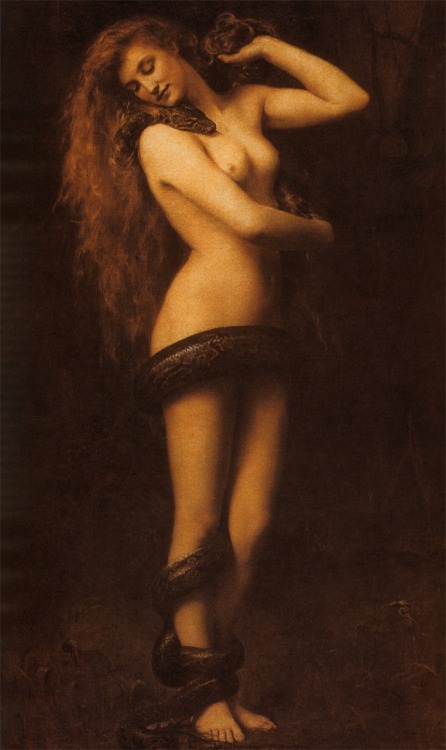
Painting by John Collier

According to this second reading of Lilith, the earliest evidence of which is to be found in the Alphabet of Sirach, Lilith is no demon. In fact, she is the wife of Adam, as in Adam and Eve. Furthermore, she is Adam's first wife and, unlike Eve, she was not created from Adam's rib after he was created, but at the same time as him and from the "earth". Naturally, having been made from the same stuff as her husband, Lilith considered herself, and rightly so, Adam's equal and therefore she refused to submit to him. Thus, according to the legend, she leaves him and the Garden of Eden forever, refusing to return and somehow ends up mating with the archangel Samael (in religious texts, these things just seem to happen). 

We can read Lilith as a female version of Lucifer, though I would argue that the crimes of Lucifer are far greater than those of Lilith. True, both are defying what is seen as the will of God, a complex concept to be sure, but whereas Lilith is asserting that she is equal to Adam, Lucifer asserted himself as the equal to God. Hence, Lucifer is punished with damnation, whereas the story as to what happens to Lilith after her "rebellion" becomes immediately unclear.

So, the question I shall ask is this: if we are to read the story of Lilith in this second way, why does our culture continue to connect her name with evil and corruption?

If Lilith's only crime is that she, as a woman, wanted to be equal with Adam, representative of man, what is so evil about it? I think that we can find an answer within traditional, particularly religious, attitudes to gender and sexuality, attitudes which our culture, in spite of numerous assertions to the contrary, have still failed to entirely shake.

The rebellion of Lilith against Adam can be easily read as the threatening of masculine power by the feminine. She disobeys him, refuses to submit to him. This is her original crime and it is this transgression that has led to her demonisation. By refusing to obey her husband and perhaps because she is depicted as copulating with an Archangel, she is consider a tempter and a corrupter. True, Samael is not considered entirely innocent, but the majority of the blame is placed on Lilith, for she is the anomaly: a rebellious woman. 

Image posted by Caligo Chaos Reigns
If we harken back to the two traditional roles given to women within literature, we can see more easily how she is so easily likened to demons, devils and the like. According to a traditional attitude towards literary woman, one which is, thankfully, heavily outdated yet, unfortunately, still relevant today, women fit into the category of the Lady or the Whore. Ladies are noble, delicate, subservient the ultimate example of what woman should be according to traditional gender roles. They are significantly desexualised in that they do not participate in such activity, certainly outside of the marital bed, but this only serves to make them more desirable to the male characters around them. Whores, however, are seen as the complete antithesis to the traditional role of women. They are disobedient to or outside of, or at least on the fringes of, the patriarchal structure, and sexually free. This leads to the corruption of their image, the corruption of Lilith's image.

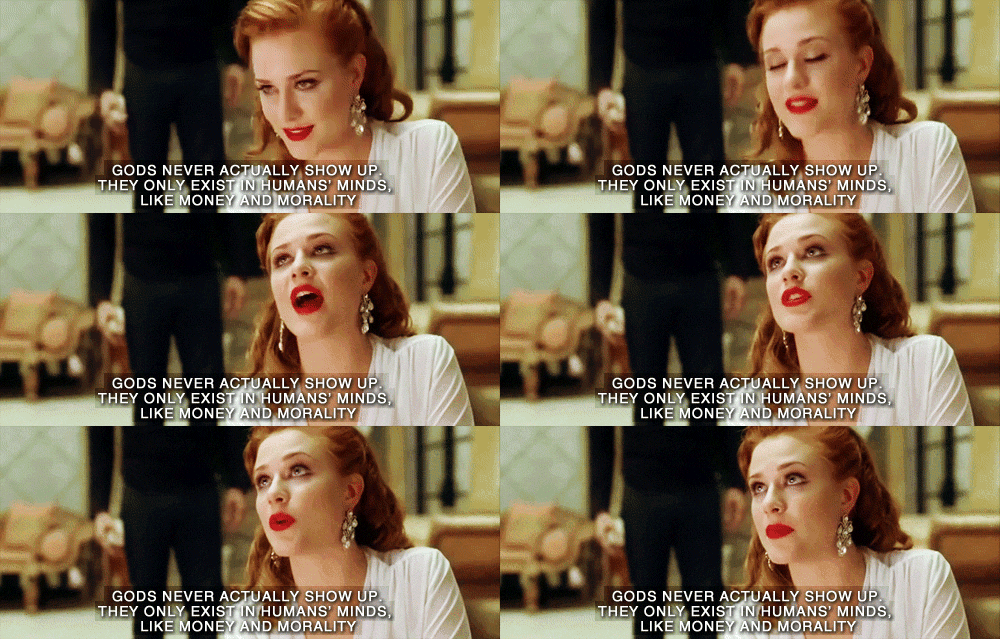
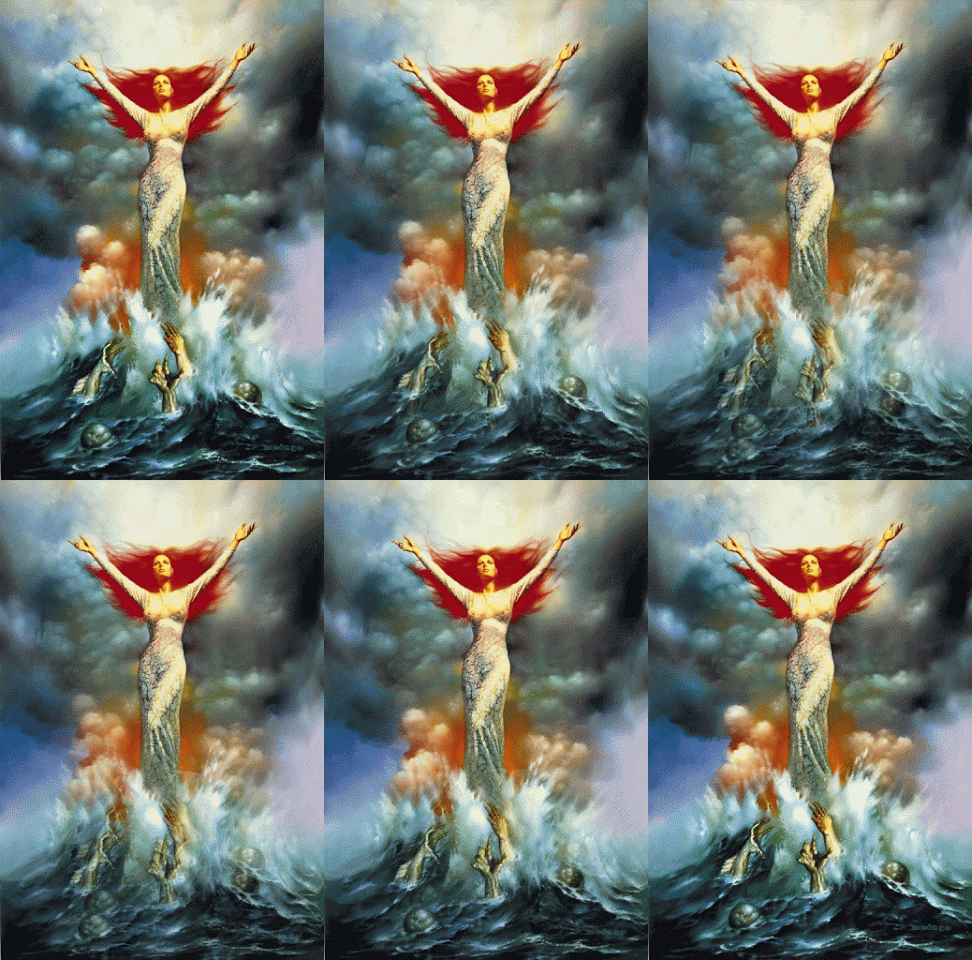
We can see, with no shortage of clarity, how the traditional has influenced modern representations of Lilith. Whilst she is, undoubtedly, shown as a tempter, she is almost always cast in traditionally female roles. In Supernatural, Lilith is the first demon, making her effectively the mother of all demons as well as the bride or daughter of Lucifer. The Lilith of True Blood is the mother of vampires and the bride of God. Modern representations of Lilith within fantasy all seem to buy into this conception of her as a demon and temptress, but also as a traditional woman.

What I am saying, then, is that, whilst I have no problem with the name of Lilith being used for demonic and seductive characters (I still think that such representations can be interesting, original and entertaining) I do think that her namesake can be used for a lot more. Yes, Lilith has diabolic connotations and those can be interesting to explore. But still, this alternative interpretation of her character and what she means within Jewish mythology means that characters named for her should not be eternally limited to the role of the harbinger of darkness and desire.

Interestingly enough, her namesake has been used in one manner, though not in the form of a character. There exists a feminist, Jewish magazine which uses her namesake to convey their message of respect for woman, their desire for equality as well as reconciliation with Judaism. Lilith is a name with many connotations and much potential and it should not be confined to the demonic.


LILWi14-Cover
Cover of the latest issue of Lilith

Tuesday, 1 July 2014

Beyond Morality: Why Morality Is More Than Human

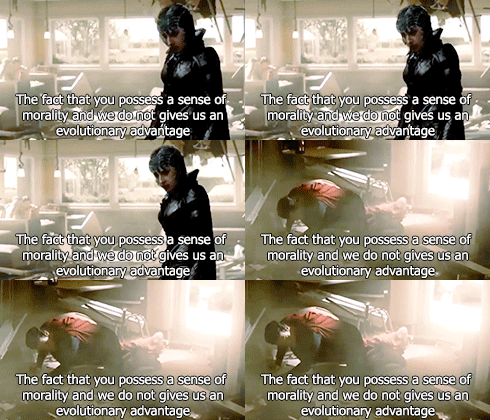
Within the fantasy genre, there is an annoying trend in which any kind of being which consider themselves to be better, or "more evolved", than humans consider themselves to be beyond morality, or when they dismiss morality as a "silly human idea". One of the most grating examples is from the Man of Steel film:

Image posted by Lizbeth Vaughn

I think that this represents a very superficial understanding of what morality and ethics actually are. In fact, I would go as far as saying that this "understanding" is not really an understanding what so ever, but a profound misunderstanding as to the very nature of ethics.

The conception of ethics that is being applied here is likely that of an ethical theory, the most (in)famous of which is Utilitarianism in its many incarnations. Under this understanding, ethical thinking and morality can be, not incorrectly for this system, thought of as merely a tool which one gets out whenever one as reached the point at which they need to make a decision. 

If one takes a far more holistic view of morality, in which one is able to view everything as participating in a moral dimension, then we encounter a problem with this perspective. What do I mean by moral dimension? Simply the idea that moral thinking and attitudes pervade all areas of life, that moral ideas are expressed in almost every action that one takes. In short, that all aspects of life can have moral relevance and understood in a moral context. Upon this view of ethical practice, I think that it becomes nonsensical to say such things as "we are beyond morality" or "morality is a human invention".

I can hear you ask - but why?

Simply because if you consider the characters that are being discussed in these contexts, the super-human characters are not all that different to the human characters. Sure, they have various different abilities and outlooks, but for the most part they are shown to think and react in ways which it is at least possible for a human to react. 

Image posted by Villainous Cenobite

Often, such "amoral" characters are said to have no empathy or an increased desire for vengeance. Sure, lacking empathy at all has ramifications for morality, but it does not render a moral system immediately unquestionable. Were one to study sociopathic behaviour, it is true that they perform acts which others thing deplorable, but they often retain some moral sense, even if it might be a twisted and confused one.

So in short, whilst these beings might possess a different system of morality, and employing different moral concepts or different conceptions of the same moral concepts, they cannot be said to lack a sense of morality. Even if they have a morality which would allow them to do almost anything, they still have a sense of morality. Perhaps it is not the most developed or thought out sense of morality, but it is a sense of morality none-the-less. 

I do not think it is even possible to have a character who entirely lacks a sense of morality. Were a character to view everything as ultimately of no moral value or relevance, such as with moral nihilism, then they still possess a moral system. In fact, the only situation in which I think one could lack a moral system would be for an automaton, who made no decisions of their own. But in this situation, we have another question: are they therefore still a "character"?

Sunday, 29 June 2014

Death and Desire: Vampires and the Seven Deadly Sins

Though I have some more MBTI-related content in mind, I have devoted a lot of time to that over the past few months, so I think it is time for a little break.  

So recently, in anticipation of the final season next month, I have been using the SkyTV Box Set service to watch True Blood. Though not perfect, I have enjoyed the series so far (I am currently midway through the fifth series). This combined with the Steam Summer sale, which has allowed me to download the Skyrim DLC Dawnguard, has meant that I have been assailed with Vampires, both by the TV and on my computer screen.

In immersing myself in both of these top-quality pieces of entertainment, I have begun to reflect upon the Vampire mythology and what thinking about them might be able to say about us, as human beings, especially where the dark portions of our psyche might be concerned. When it comes to discussing the dark motivations of mankind, a good place to start is with the system of the Seven Deadly Sins, used in some branches of Catholic Theology. 

Image by dahlig

For those unacquainted with the system, it seeks to categorise human misconduct into one of seven categories, in order to provide moral clarification for those wishing to avoid transgressing. Whilst Catholicism describes the sins in reference to God, one need not be a believer in order to make use of the system, for they can have a role in a secular ethic, though that is another blog entry entirely. 

Vampires in many ways embody several of these cardinal sins, though naturally different representations provide different emphases. Of course, there are a multitude of varying vampires in popular culture (not to mention classical literature and folklore), meaning that one could immediately be sceptical of trying to discuss vampires in general. But there are certain common traits when it comes to Vampires, and it is those traits which I shall be using above those attributed to them by any particular incarnation.

Image by dahlig
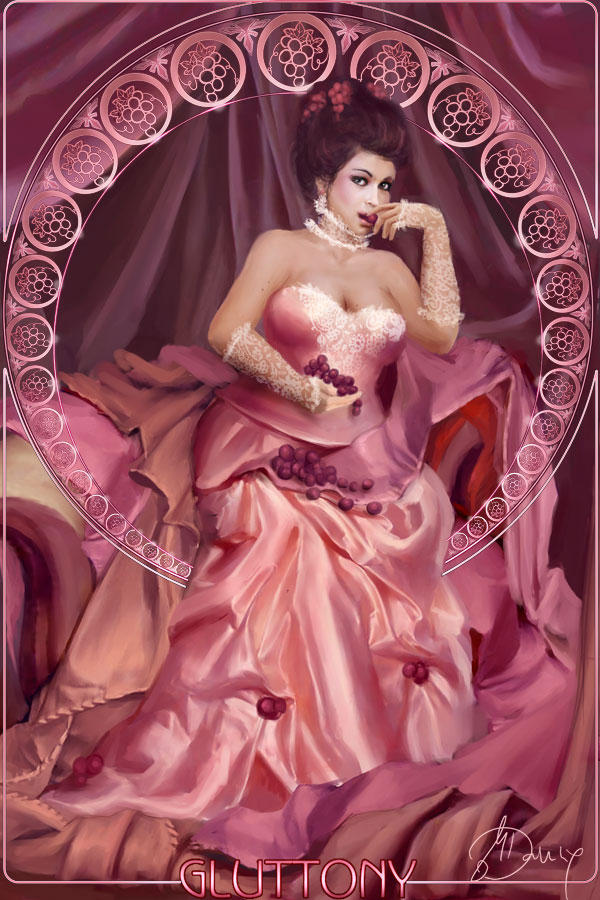
Gluttony

Vampires feed on blood. That is perhaps their most central quality, considered to be even more intrinsic to them than, for example, their inability to walk in sunlight. More modern representations of Vampires include examples of those who can walk around during the day, but none, or at least not one of which I am aware, has even shown a vampire who does not require blood in one way or another.

Furthermore, the vast majority of Vampires are defined by their need and desire for it. Without the blood (in most representations) they would die, true, but they are more often than not depicted as finding the act of drinking the blood of the living as exhilarating. Defining Vampires by their desire to consume endless amounts of blood has clear links to the cardinal sin of gluttony, which can be defined in several ways. The overconsumption of food or drink is the most common definition and, whilst some Vampires may need to consume vast quantities of blood, the fact that their consumption is excessive when compared to that of a human is enough to link their appetite to gluttony. 

Furthermore, their hunger is more often than no depicted as something that is very hard to control, even if the Vampire in question is in possession of an extremely strong will. Should the temptation become too much, their humanity leaves them, as do their wits and they enter into a frenzy to consume and drink more and more. This goes beyond the sin of gluttony and hints at something more primal: the fact that humanity retains something of their original animalistic nature beneath the surface. 

This leads us to the second sin...

Image by Procrust
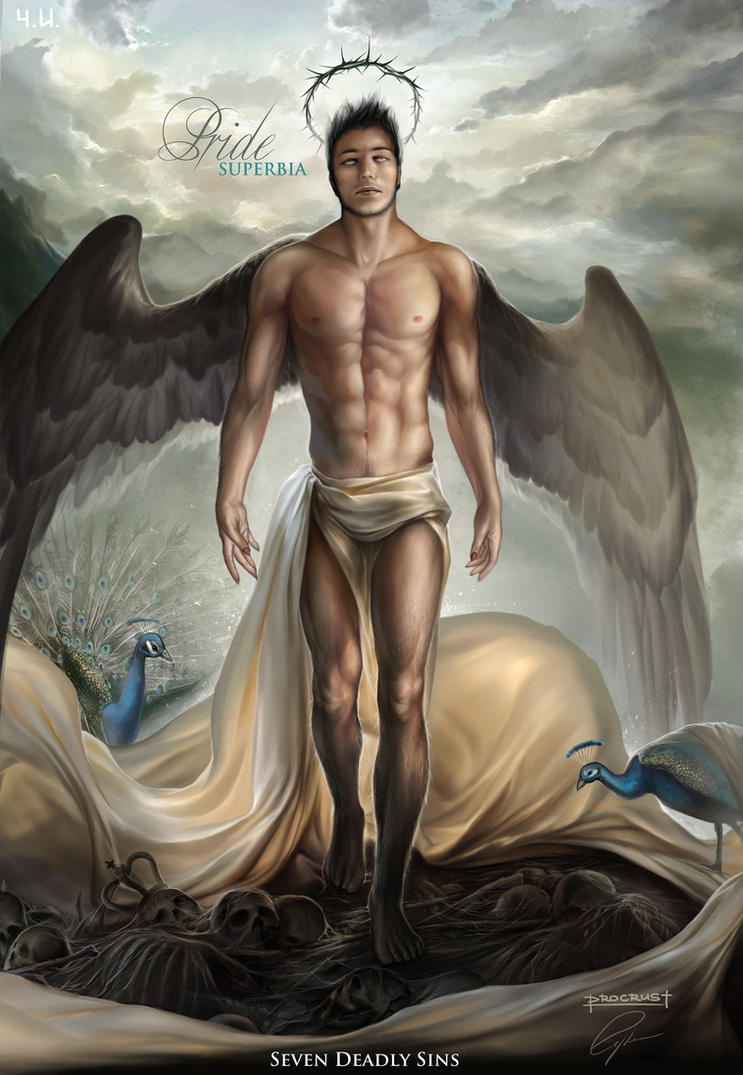
Pride

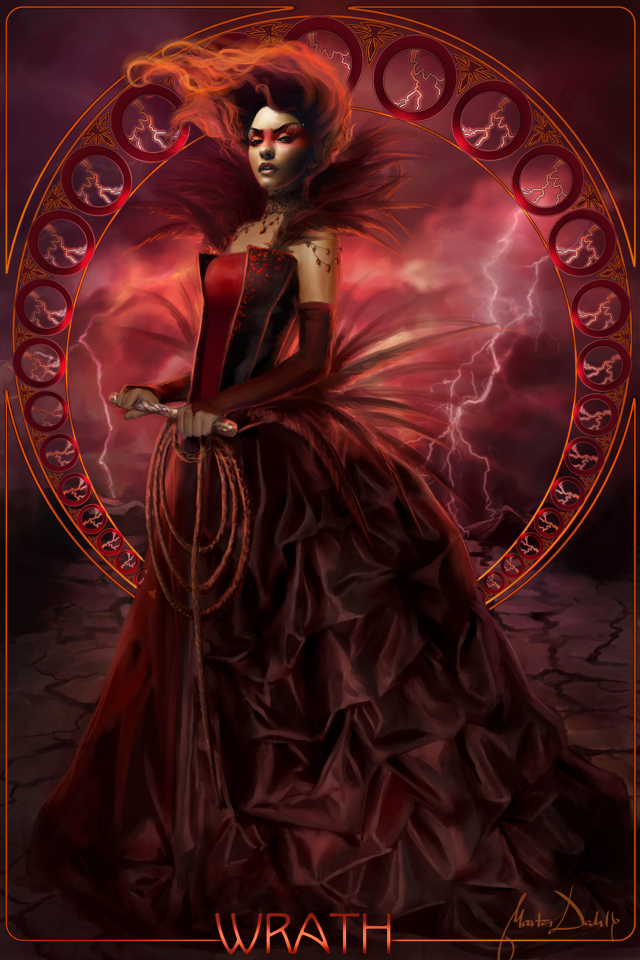
The so-called route of all other sins, Pride is perhaps one of the most ephemeral and difficult to define of the sins, though this is what makes it so insidious, and so difficult to control. When the sins are used as a story telling device, Pride is often treated as being higher in the hierarchy than the other sins and often gains its strength from a pathological ability to manipulate and deceive its enemies. 

The first Vampiric quality which can be tied to this deadliest of sins is the hunger for blood, though this depends on the Vampire in question. On one reading, the attempt to control such a hunger could be seen as an arrogant assumption that an individual is able to change their own fundamental nature, though such a reading could be replaced with one which would cast the attempt at self-restraint in a far more heroic or poetic light. Furthermore, not all Vampires strive to control their hunger, with many of them, certainly in settings where the Vampires are exclusively villains, instead give in to their infinite hunger. 

Secondly, is the Vampiric quality of immortality. A staple of the Vampiric legends is that they are undead immortals, able to live endlessly unless they are slain, the method of which depends on the story. Indeed, in most representations, Vampires are often depicted gloating about their deathlessness, regularly doing so whilst degrading human characters through labelling them as little more than food or cattle. To claim immunity from death, to oppose what is often considered to be the natural order, that seems to be to fit perfectly into the category of Pride. 

Of course, one could easily turn the narrative on its head, instead claiming that Vampiric immortality is a great human achievement, but not one which is overly proud. I would personally disagree, for whilst there may be humble Vampire characters (I am in no way claiming that any of these sins apply to all Vampires, only to the concept of Vampirism in general), the act of rejecting ones own mortality through becoming undead seems to me to be bound up in the concept of Pride.


Image by Procrust
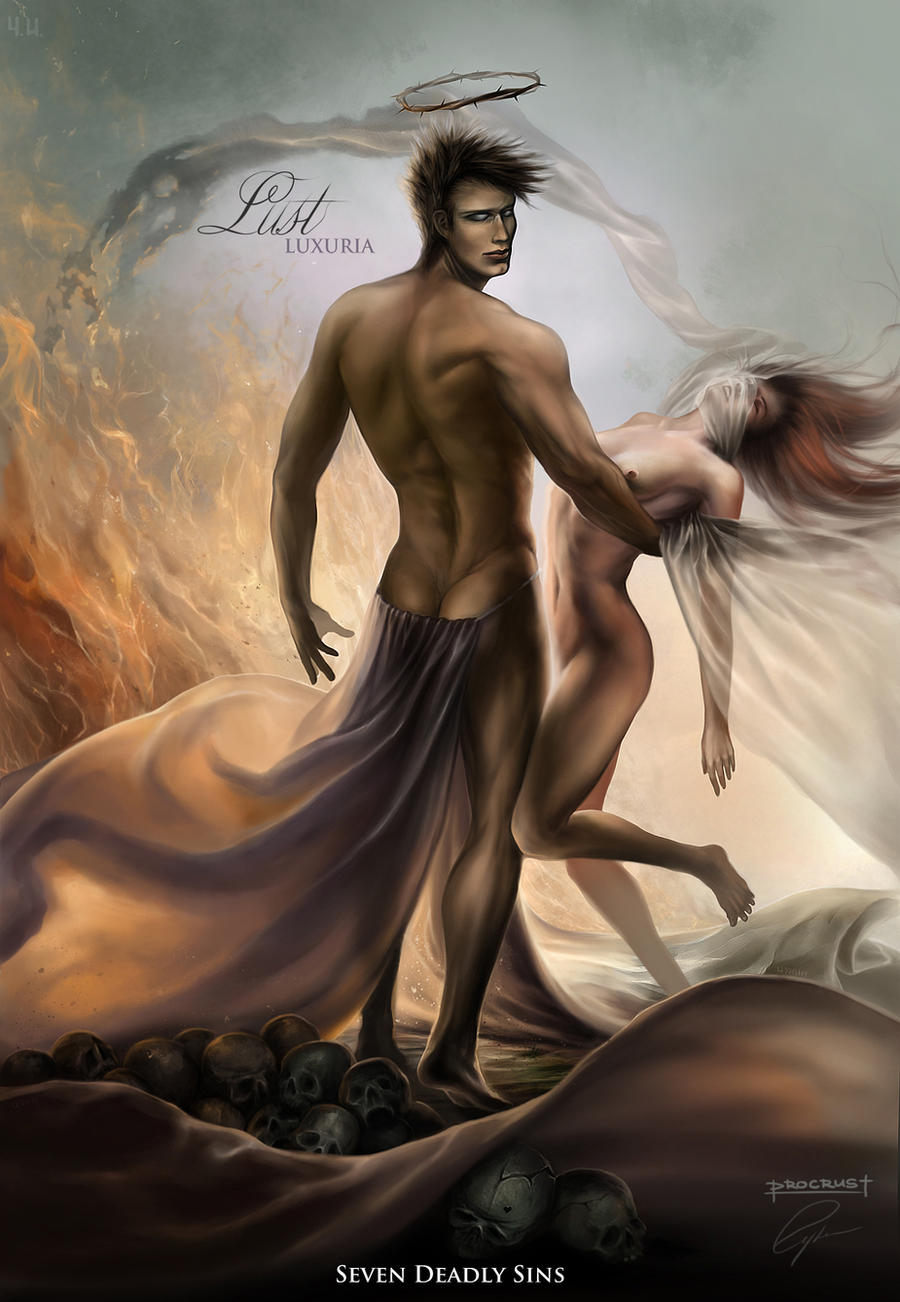
Lust

Our final sin will come as no surprise to anyone who has seen anything produced upon Vampires in the last decade, for modern representations of Vampires seem to be unable to avoid turning them into beautiful, and seductive, far removed from the more traditional legends. A whole subgenre of literature named "paranormal romance" has sprung into being in recent years, rocketing to popularity with the polarising Twilight Saga and its like. So many of these romances claim to be exploring how Vampires, modern culture and modern relationships would interact, though most only manage to place the three elements together, before then descending into works which focus over-much on sexualising these creatures.

Through representing them as eligible for romantic attraction, though through persisting in representing them as outsiders and rejected (or, in the case of True Blood, making the task of their integration a central feature of the plot), they are transformed into paramours and used to represent forbidden desires. Lust as a sin was, in some traditional interpretations, intended to include any kind of sexuality, outside that of the marital bed. In a more modern and liberal understanding of it, it would be better to include certain kinds of deviant sexualities (with animals or corpses, for example) as well as overindulgence in otherwise health sexual activity. Vampires are literally dead. They are fundamentally outside of the norm, they are the forbidden, the tainted. This is how they link to lust. 

It may be the case that the sexualisation of Vampirism is something that can be solely blamed on modern culture, though I think this would be an overly simplified approach. There are a large number of traditional Vampire legends which speak of supernatural seductive abilities, though very few of these actually portray the Vampires as being attractive, instead saying that they needed to rely upon their supernatural powers in order to trick mortals into becoming their willing prey. Traditionally, they were less sexualised, though even in Bram Stoker's Dracula, there is a hint of desire between Mr Harker and Dracula's brides. So perhaps we can argue that Vampires are more sexualised in modern culture than they used to be. But then again, isn't everything?


So there you have it, some examples as to how Vampires can tell us of the darker portions of humanity. Naturally, this is in no way comprehensive, and there is a lot more I could say on this topic. Perhaps I shall, but that is for another entry. I hope you enjoyed reading.

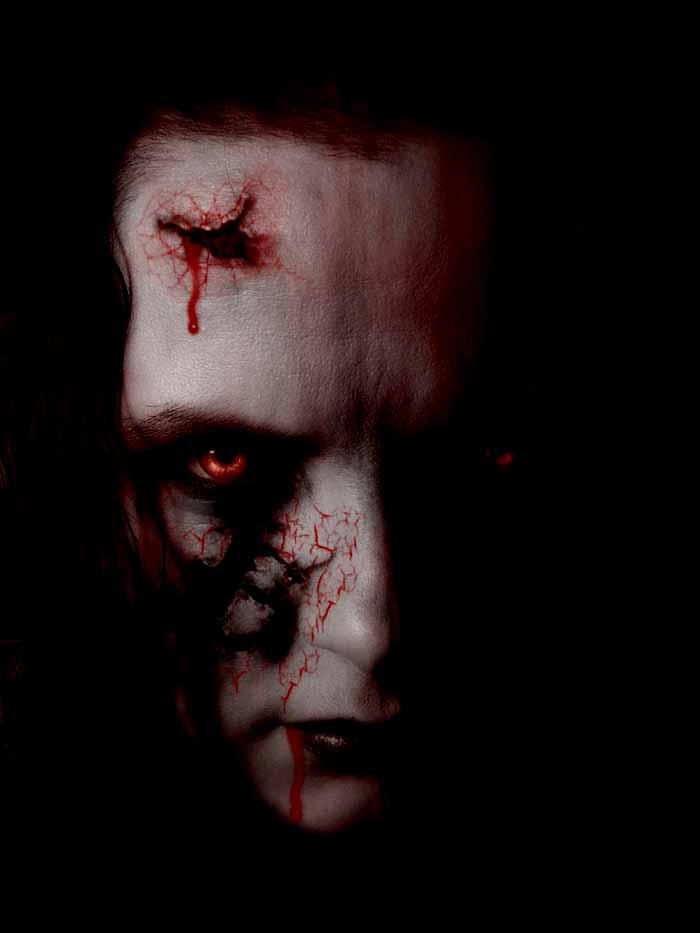
Image by ro0t