|
| Images posted by Storybook Visitor |
Should it be the case that despair at the loss of another living being run as deep, no matter whom has been lost? Should we feel the same sense of loss for the demise of a stranger as we do for a sibling, a parent or a romantic partner? True enough, we all seem to acknowledge that there is a certain feeling that this is an ideal that should be aspired to, though there is also an acknowledgement that this is not how things are.
At a first glance, it might seem, from a moral perspective, that this kind of ‘unbiased’ care is something to be strived for. Any moral approach to the world seemingly must, in the name of consistency, seek universality. By this, I mean that the moral theory must be consistent in the way in which relevantly similar cases are treated, preventing arbitrary application of moral concepts and ideas.
By this argument, we could surmise that the death of a loved one is just that, a death and that all relevant situations, which would be all deaths, under this line of thinking, should be met with the same kind of deep, heartfelt emotional agony. True enough, if we cared for the lives of others as we do for those closest to us, then we would, as Riker suggests, be significantly less bloody and violent.
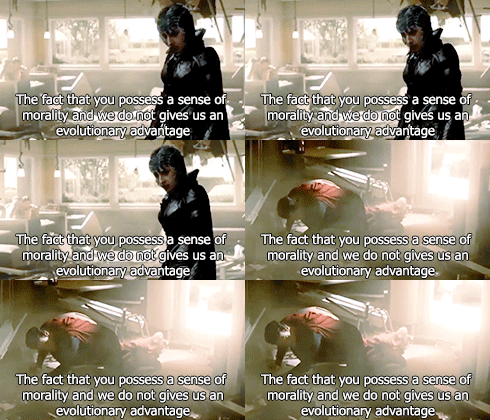
However, I think that this view of death and emotional responses to certain situations is overly simplistic and rather problematic. Firstly, it assumes that we can, as Commander Data does, consider all situations death to be relevantly similar to one another, in spite of the fact that death is a complicated ‘event’ (I use the term somewhat broadly) in both its physical happening (there are manifold ways for one’s life to end) and psychologically (in the impact it has on others).
 |
| Image posted by lllnomadlll |
Discussed in my entry on the implications of the Jedi and Sith faiths is the idea of relationships of preference as well as an outline as to why I consider them to be fundamentally important for one’s moral nature. If we cannot, due to a requirement of morality, treat some individuals more favourably than others due to the existence of an emotional bond, then we forfeit an integral aspect of our humanity. Our emotions are a fundamental part of our lives and to have the concrete, reciprocated, reified elements of them (our relationships with others) taken away by a moral standard of universality is to take the moral away from the world as we live in it. It is an abstract theoretical idea, the implementation of which is inhuman.
Under such relationships of preference, we owe those whom we love more of our emotional energy than those we do not love, in virtue of the fact that we love them. In fact, it is not so much a matter of owing anything to them, so much as it is a matter of the fact that loving someone involves devoting more emotional energy to them, without this one cannot truly be said to love them as they might claim. With this increased investment of emotional energy comes an expectation that the impact on one’s life will be greater and thus the vacuum created upon their loss will be greater.
Though it should not be regarded as simple as ‘the greater an impact they had on my life, the worse I will feel when they are gone’ this principle can be used as a general standard, as a guide which can then be modified by more specific factors, depending upon the situation. Of course, the psychology of grief is exceptionally complicated and it is not a topic I have researched with any degree of depth. I intend only to use this general observation.
Fundamentally, if one cares equally about the death of a loved one and a stranger one is betraying the significance of their relationship of preference. As the name suggests, an integral and definitive part of these relationships is that those within them are granted special status. Simply, if they are not given precedent, if they are not cared for more deeply, then they cannot be said to exist within a relationship of preference.
Thus, adopting the position of caring about all death equally serves to deconstruct and render impossible these relationships of preference which are integral to human existence, integral to the way in which we understand the world and morally interact within and with it. The result would certainly be a less bloody world, but also a less human world.
However, the impact of this does not end there, for death, though we attempt to hide ourselves from it through many devious tools (both on a personal and political / cultural level), is completely ubiquitous. People around us are dying every day and there is no way to escape this. If we cared about every single death we heard of as much as if it were someone very close to us, our lives would become filled with grief, filled with heartbreak. Imagine turning on the news and hearing yet another murder, another accident, but imagine that every victim was your closest friend, your mother, your father or your lover. You would experience so much grief that either life itself would become entirely consumed by it, or you would become so desensitised to death that the value of life would drop until it meant very little. Neither of these outcomes is in any way desirable.
If we care about all deaths equally, each individual is forced to bear the pain and loss of the entire human race and that is far too much for any individual to handle.
Thus, the idea about caring about all human deaths equally is, in my view, no position to be desired to sought for. However, whilst I consider this extreme standard to be somewhat absurd, I find it important to highlight that I am in no way saying that we should not attempt to strive towards being more compassionate to other individuals, or that we should attempt to curb our empathy. In truth, there is not enough empathy present in the world and more of it is to be celebrated, provided that it is does not then go beyond a reasonable standard and become this unrealistic expectation that we should attach the same significance to those important to us and those whom we do not know.
We should each work to develop our compassion, to develop our care for other people, though we should not apply the same standards of care to all we meet, to do so is inhuman, impossible to achieve and comes with many less-than-desirable connotations.
 |