Showing posts with label Mages. Show all posts

Monday, 13 July 2015

Vivienne - Beneath the Surface

Known as the 'Ambition', Vivienne is the verbose, shrewd and magnificent First Enchanter of the Montsimmard Circle of Magi. As an individual, she has been graced with mixed reception by both stalwart fans and newcomers to Thedas alike. Some see her as a typical establishment mage, indoctrinated by the very chantry which suppresses her freedom to the extent that she pro-actively seeks to extend these limitations (some might refer to such things as injustices) to others of her 'kind'. Others, however, view her as a particularly caring and maternal figure who simply wishes to keep the world in good shape, despite the many instabilities and new-found forces who seek to usurp it.
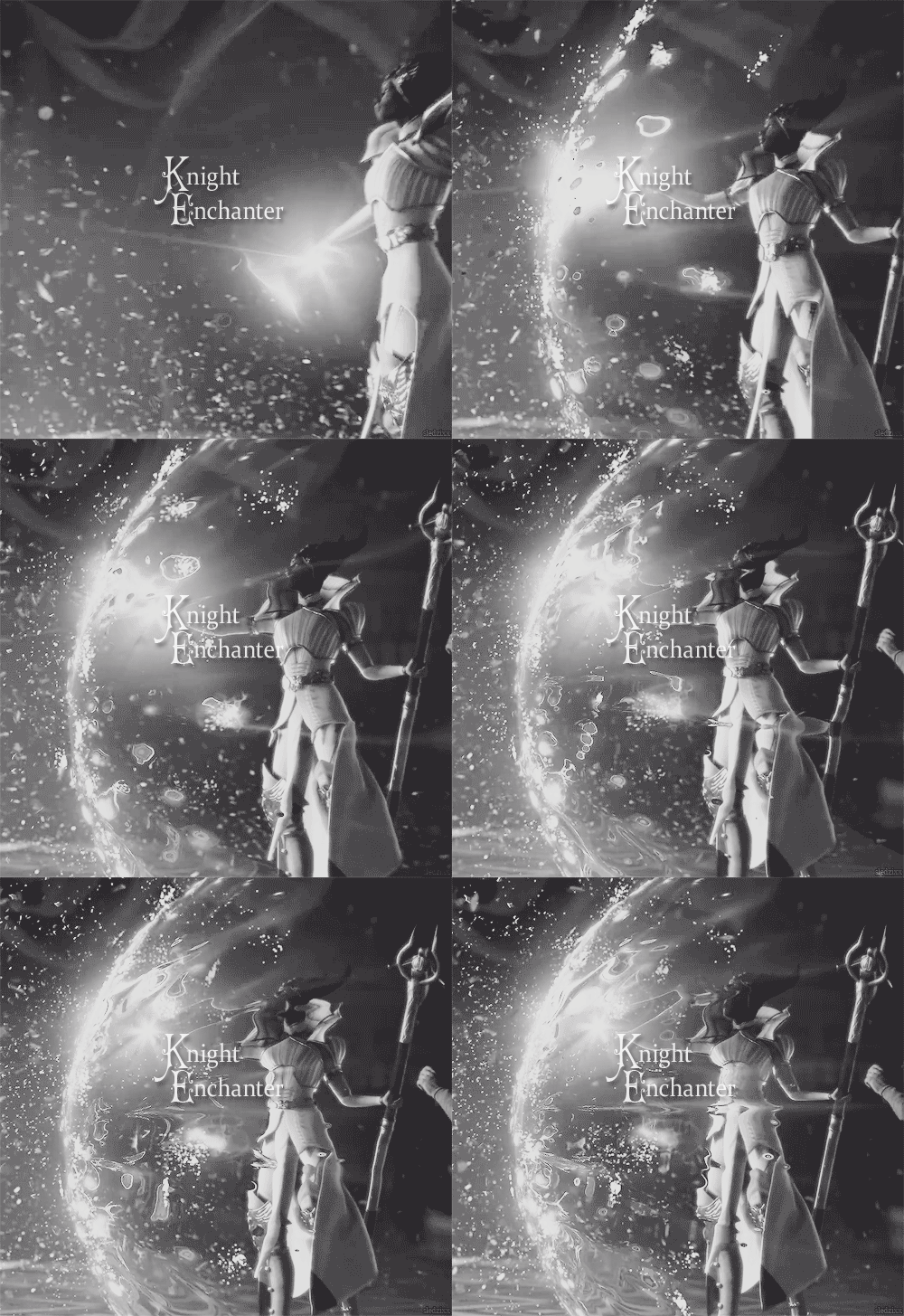
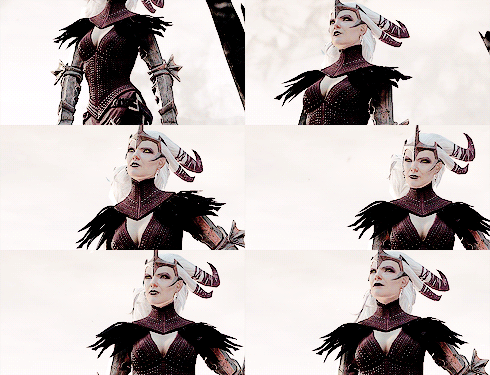
Image shared by sledixx

So, without further ado, let us turn our attention to the pillar of order that is Madame de Fer. 

The Imperial Game

Though she was born in the Free Marches, Vivienne was transferred to the Circle of Montsimmard whilst still an apprentice. We know not what means she came from, but we can be certain that the move to Orlais and her subsequent victories have served as a major improvement in her social standing. She became the mistress to Duke Bastien de Ghyslain, the head of the Council of Heralds (a political body responsible for reconciling all heraldic disputes and which has a role in determining claims to nobility). From here, Vivienne has pursued the completion of her goals and her own advancement doggedly and has refused to allow any to stand in her way. For this reason, many regard her as a 'heartless bitch' or a 'typical social climber'. 

Of course, Vivienne has shown us that what she wants is to make a place for herself in the tumultuous world of Thedas, a difficult task for any Mage, let alone when one is attempting to achieve such a thing within the Imperial Court of Orlais without the boon of noble birth. In order to do this, she has had to play the great game to the best of her abilities and as demonstrated consistently that she is enjoys it. She has followed the hierarchy as it has been presented to her, climbing to the rank of First Enchanter and from there claimed an almost entirely ceremonial role as Enchanter to the Imperial Court. Before her appointment to this role (which would not have been possible without the endorsement of her lover) it held few political advantages. Upon taking it, Vivienne has transformed it into a position of great importance and prestige. 

Rightly, Vivienne is named 'The Ambition' by the developers and she has earned herself the title Madame de Fer, the lady of iron, for she is both respected and feared. We are told that she finds such a title amusing. She is headstrong and can be stubborn, but she acts relentlessly and in spite of that which may seek to divide her from her goals.
"Rest assured, dear Seeker. I'm never truly out of my element."
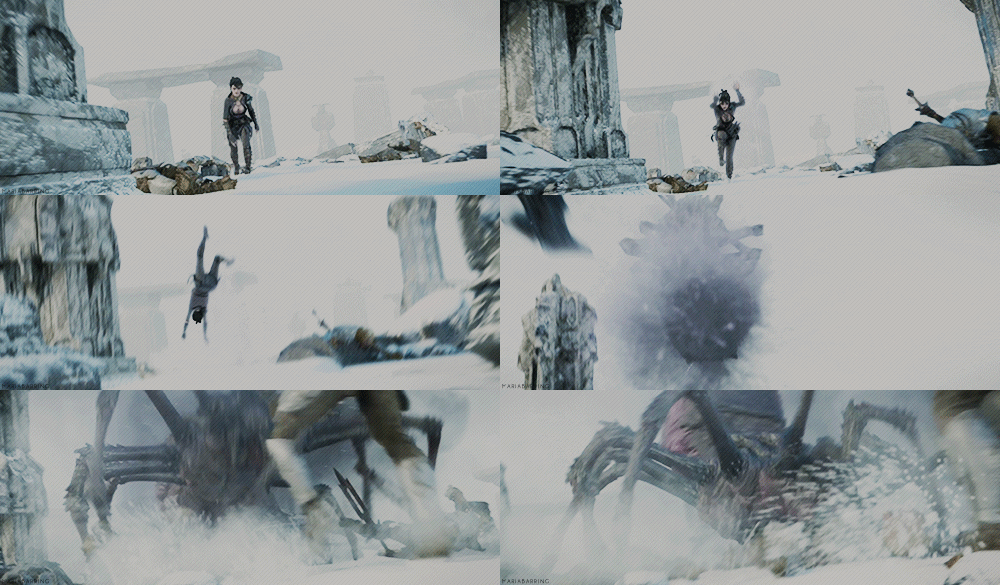
Naturally, her links with Bastien opened many doors, and many fans of the games have dismissed her a social climber, who is perfectly willing to exploit others and manipulate them to her own advantage. Of course, this is certainly the case, for she could not have attained such a position without indulging in such behaviour. From what insights we have gained of the imperial court, one cannot be honest and hope to endure within it for long. However, the charge that she does not care about Bastien is certainly unfounded. Those who have followed Vivienne's personal quest-line (Bring Me The Heart of Snow White), fetched the heart of a snowy wyvern and followed her to what will become Bastien's deathbed, will know the genuine sadness and upset caused by watching him die. Some have said that her upset is selfish, for she can no longer use his position to her advantage, but the truth is that she does not need to. She has already established herself as a First Enchanter and the Enchanter to the Imperial Court of Orlais, two of the highest positions a mage could hope to claim. Any tears she sheds for him are genuine. Furthermore, why would one spend so many resources attempting to prolong the life of someone for whom one only has an instrumental care?

Already, we can see that Vivienne is an emotional human being, though one who possesses a thick skin and who has become accustomed, mainly due to her experiences within the empire, to always maintaining a façade. Within Orlais, if one's only mask is the very literal garment upon one's face, then one is not playing the game well at all.
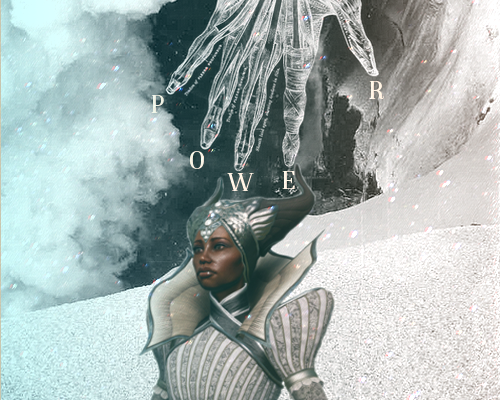
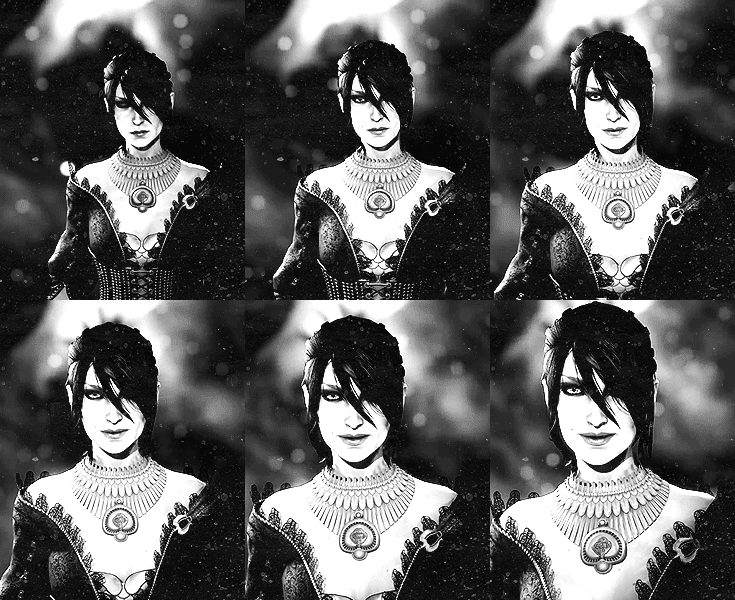
Image shared by carolsusanjanedanvers

Thus, from a very early stage in her life, she has lived within the Masked Empire of Orlais and this is certainly noticeable in the manner through which she conducts herself politically. Each of her actions is calculated and she holds appearance in the highest regard. Some might dismiss this as shallowness or some 'lack of character' but the care with which she fosters a perfect outward appearance is not done out of vanity or pride, at least not primarily. Instead, her experiences within Orlais have taught her the importance of how one presents themselves. The Empire places great weight upon appearance and one's conduct and, in order for one to make a place for themselves at court, one has to be willing to cultivate these things. 

Her experiences within the empire have had extensive formative impacts upon her character, fostering her desire to improve her station as well as instilling her with keen social awareness. She knows how to act, how to dress, what is expected of her and to what extent she is able to ignore these demands and how much she should co-operate with them. The result is an ostentatious, astute figure who has learnt the importance of adaptability and what can be gained from the tactical employment of social graces. In many ways, she is a natural product of the imperial environment into which she has both been flung and flung herself. 

Blackwall: You must miss the comforts of your mansion, travelling with us as you do.
 Vivienne: I miss them. I do not require them. But please, continue to imagine me a pampered lady, if it makes you feel superior.
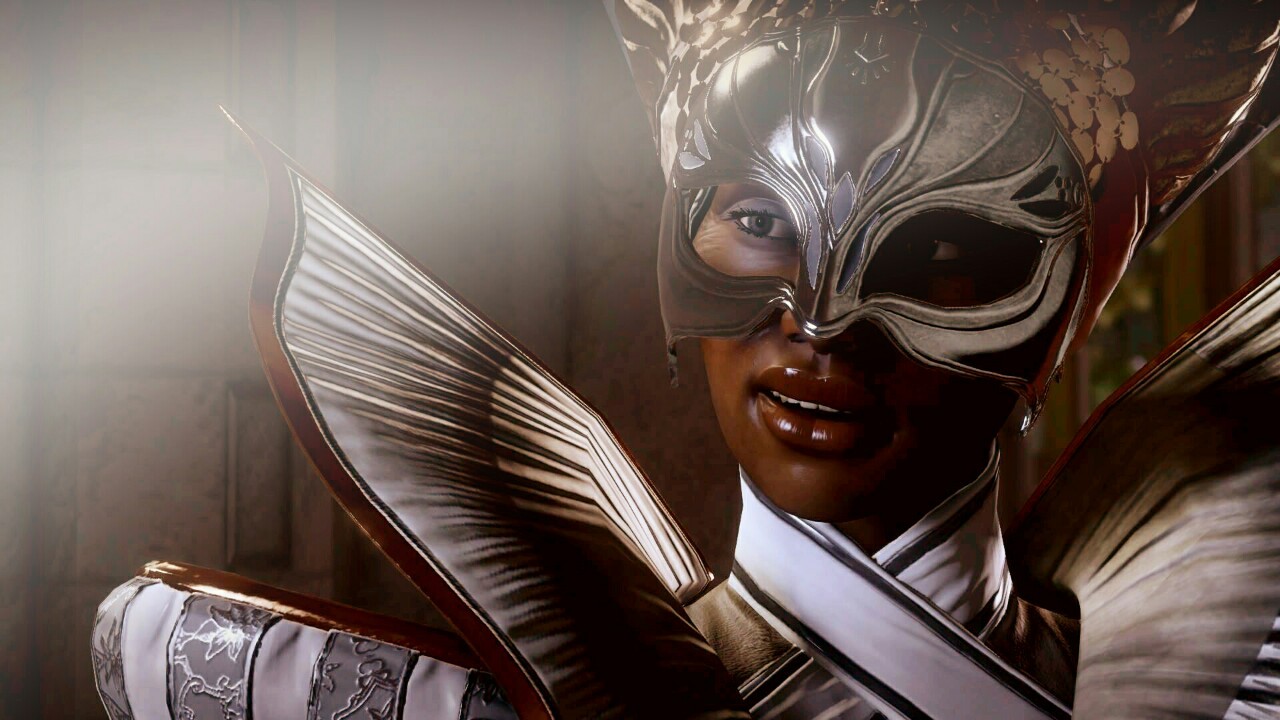
Image shared by Shem Rights Activist

The Chantry and The Chant

"We need an institution to protect and nurture magic. Maker knows, magic will find neither on its own."

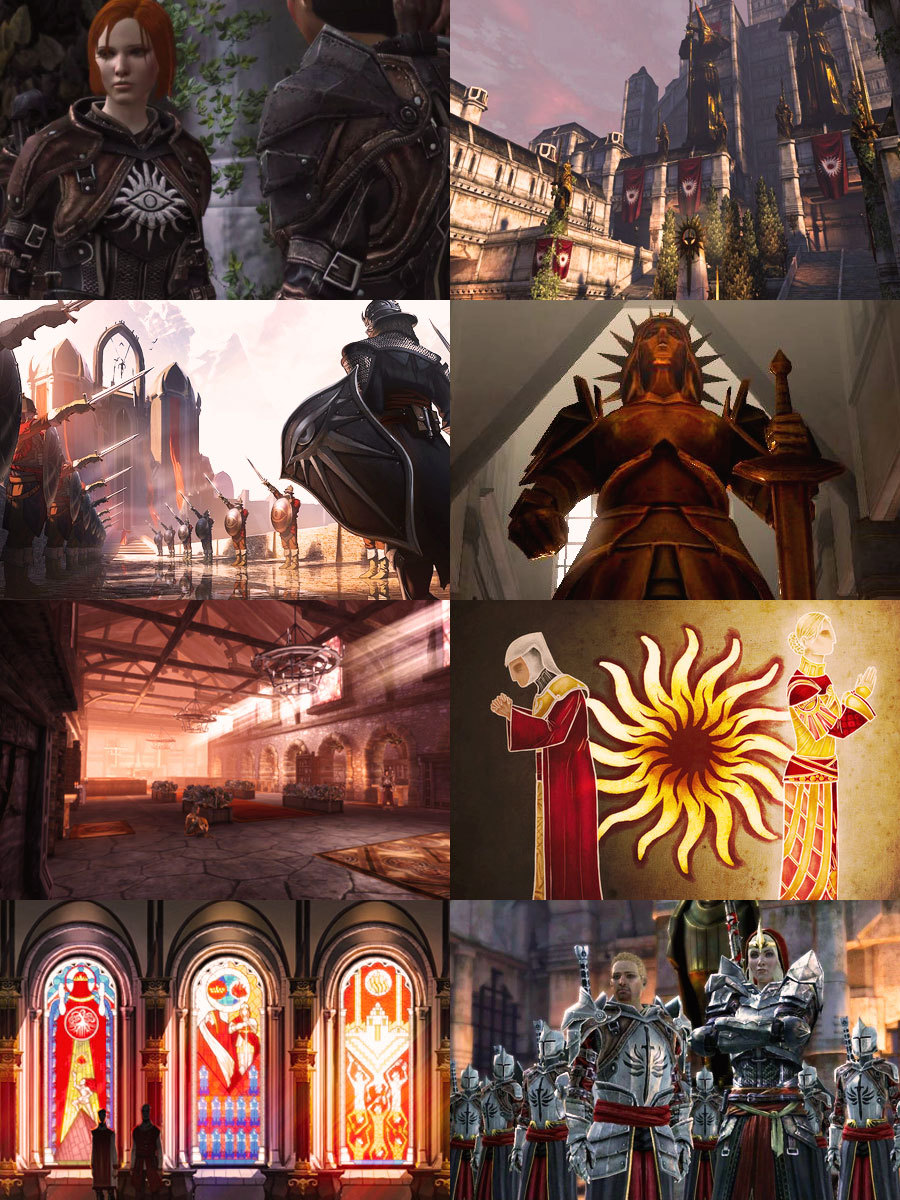
Vivienne is often regarded as a typical traditionalist, valuing the pre-existing norms of society and choosing to stand for this order whilst dismissing the subversive voices. This is due to her relatively conservative views regarding magic and those who are able to use it. Vivienne is a firm supporter of the circles, regarding them as entirely necessary for those who are capable of working with magic. She equally understands the Templar Order as a necessity, for not all who are given the ability to wield the power of the Fade are quite up to the task. Her distrust of uncontrolled magic spills out through her initial interactions with Dorian, during which she constantly derides him and Tevinter for their foolish and lax attitudes toward magic. Without such institutions in place, able to provide the requisite guidance and tutelage to young mages, the world would be forever ravaged by abominations, with no capable force at the ready to protect the innocent. She sees the Chantry as the only force able to stand between a civilised world and one of blood magic, possession and chaos. 

"In my own experience, nothing is more deadly to young mage than a lack of knowledge."

But she does not hold these views for the sole benefit of those who do not possess magic. To her, the circles ensure the protection of mages, granting them a haven from a world which has been forever trained to hate them and what they perceive to be their curse. Of course, she is aware that this ideal has, in places (she does specifically mention Kirkwall as among the worst), entirely failed. The Templar Order has become a shadow of what it should be, enabling the abuse of young mages, which is certainly not something that she permits. She is aware that all who live within the circles have vastly different experiences and that there is no such thing as a singular vision of circle life. Furthermore, she understands this as something which is necessarily going to happen, but her vision is a circle that is a haven for mages, but not one which values their personal freedoms above collective safety. 
"I will once again ensure they are protected from a world that hates and fears them."
Many think that she simply wishes to revert to the old system, but should one decide to endorse her as divine, one clearly sees that this is not the case. True enough she re-establishes the Templar Order as well as the Circles, but the mages are granted additional freedoms (which come hand in hand with responsibilities) and the Templars are more firmly leashed under her control. We can surmise that mages under her vision are more like she is: able to understand the power of magic and to respect it, but also trained to use it masterfully and able to enjoy a life outside of the circle. 

"Kirkwall gave the world a reason to remember its fear of magic. A mage killed hundreds with a snap of their fingers. Across Thedas, a new tangible fear of magic grew. Commoners and nobles alike called out to the Chantry for protection. But the malcontents in the towers thought nothing of this.

In truth, she treats her those of her former colleagues who have openly embraced the mage rebellion with open disdain, bordering on disgust. Considering the timing of the rebellion, (which followed the terrorist destruction of the Kirkwall Chantry by Anders at the end of Dragon Age II) she views the separation from the Chantry as hugely damaging, as the rebel mages were fleeing into a world which had just renewed the vigor of its anti-magic sentiment. 

"Magic is dangerous, just as fire is dangerous. Anyone who forgets this truth gets burned."

Due to these views, as well as her willingness to become Divine if the option is given her, it is relatively safe to assume the Vivienne is Adrastian. It is because of this attitude that Vivienne is rightly understood as a pillar of order, but that it is also wrong to regard her as an indoctrinated zealot who has been trained through years of conditioning to simply tow the line. In truth, however, Vivienne demonstrates a canny grasp of the political forces operating within Thedas and whilst some might dismiss her as cold, she has a well-reasoned point to make concerning the politics of magic.

"I never worry, darling. A leash can be pulled from either end."
Image posted by carolsusanjanedanvers

From the Inside

Of course, Vivienne's own experience as a mage of the Circle and all that entails have served to shape her views on the proper place of magic, as well has her treatment of other characters. 

I have already mentioned her initial interactions with Dorian, through which she uncovers a deep-rooted rejection of the altogether overly-liberal attitudes of Tevinter. She wishes to hold true to the catechism at the heart of the Chantry's teaching that 'Magic Exists to Serve Man' and this comes with a wholesale rejection of the very image of a Tevinter mage, who lords his power over those who are unable to resist him and seeks only his own advancement. This image is fixed within her mind and thus informs her expectations of Dorian. It is not until later that she allows herself to question.

Dorian: Vivienne, are you saying you wouldn't rather live in a land where mages aren't herded into cages like dogs?
Vivienne: Which land is that? The one where mages are feared and despised as tyrants?

I do not intend to imply that Vivienne is not critical of the structures of power which operate around her, for I think I have already established the opposite to be the case. Instead, I wish to press the point that Vivienne is cautious wherever anything concerning magic arrises. Those who detract from her and regard her as 'typically establishment' often forget what a devastating force magic can be for those who can wield it (particularly unwitting) as well as for those around them. Particularly where the Fade is concerned, and it often is, being the source of magic, there is the potential for possession, the entire loss of the self which often leads to far more destructive ends. Magic is a mighty force and much of it is not understood. 
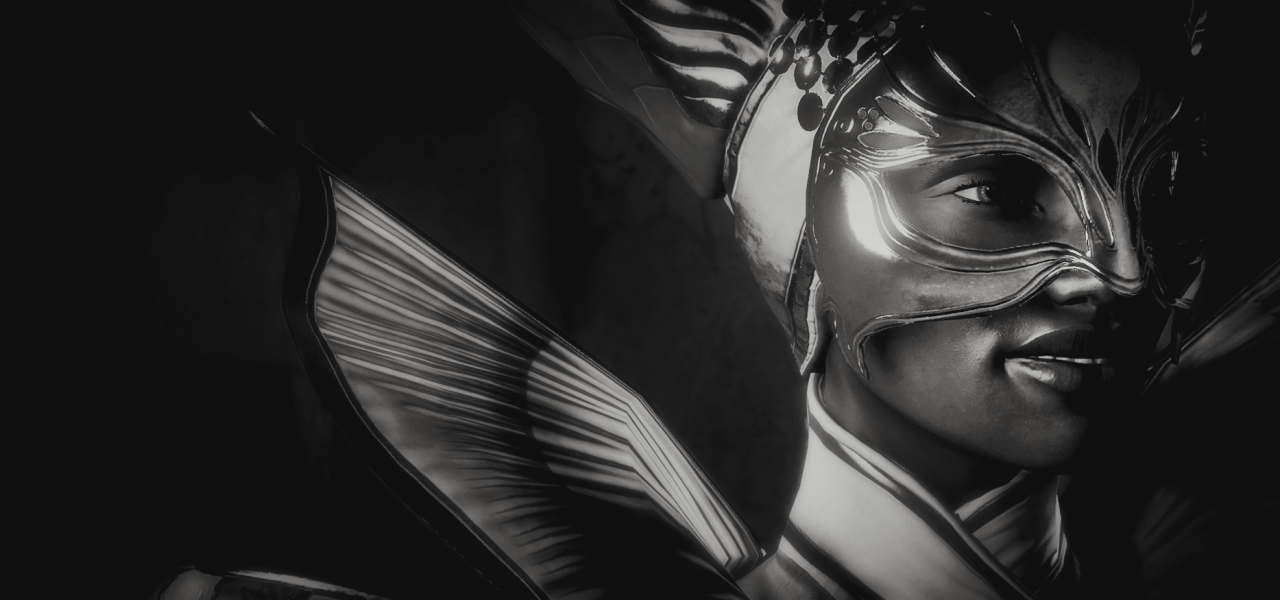
Image posted by bossuary

Solas: Your rigorous training lays a solid foundation, true. It also creates boundaries, limits, where none need 
exist.
Vivienne: I do prefer to have boundaries between myself and the demons, my dear.

In conversation with Solas, it is clear that he regards her as restricted and close-minded, unable to even begin to understand anything outside of her ivory tower. When Vivienne invites Solas to make a claim against he responds with "You would not believe me. You have learned your lessons all too well." It is also true that when Solas seeks to advise her, she responds with "I sincerely doubt you could add anything." Further banter occurs in which Vivienne criticises Solas' lack of technique and he in turn makes jibes about imperfections within her own magic. Notably, when Solas attempts to encourage her to abandon her training, she responds with "Ah, the temptation to leave the path. You sound like a pride demon."

These exchanges establish not only Vivienne's trust in the circle, but also her dependence upon them. Whilst her talents are great, she is in many ways limited by them. Above all, Vivienne requires control, an environment in which she is able to keep herself in check and for her, this is the circle. Outside of it, she is nothing and has no guiding principle which she can turn to. This is her support, her world, and its principles are deeply her own. Those who turn away from the doctrine of the circle leave themselves open to disorder and through this disarray they are rendered open to becoming tolls wielded by demonic hands.
Solas: "You need never concern yourself with the possibility that your Circle was wrong."
Magic is often an agent of chaos and destruction, capable of dealing great harm to all who come into contact with it. It is control and self-restraint alone which prevent a mage from becoming possessed or turning their power on an innocent. For Vivienne, the only institution capable of providing the instruction conducive to this level of discipline is the Circle, where mages pass their wisdom on to others, whilst also protected from themselves by the Templars. 

Importantly, many of Vivienne's attitudes are revealed through her interactions with Cole. Revealed to be a spirit of compassion, Cole joins the Inquisition because he wants to help. Vivienne does eventually come to care for Cole, though she keeps this attitude very much to herself, but initially she is outright hostile to him, regarding him as a demon and an influence which should be expunged from the Inquisition, for he could undo it from within.

Her scepticism is born from a life spent learning of the dangers of the Fade, learning that its denizens are malicious and cannot be trusted, for they all they seek is possession or the death of any mage. Having been told all her life that the Fade is universally a place of peril and that all which hails from within it only serves to undo the precarious order the Circle seek to preserve, she naturally is suspicious. Furthermore, Vivenne's experience of spirits is limited, for the Circle actively avoid such things and study into such areas is restricted if not completely forbidden.
"The Circle taught me the tricks demons play to gain the trust of any mage foolish enough to listen."
A notable exception is the Harrowing, a trial by fire through which a mage is forced into the Fade to face a demon, to demonstrate that their will is strong enough to resist possession. We learn of Vivienne's Harrowing through conversation with Cole. 
Cole: Everything bright, roar of anger as the demon rears. No, I will not fall. No one will control me ever again. Flash of white as the world comes back. Shaking, hollow, Harrowed, but smiling at templars to show them I'm me. I am not like that. I can protect you. If templars come for you, I will kill them.
Vivienne is not only Harrowed, note the capital, but she is hollow and shaking. Her only known experience within the Fade (we might presume, due to her extensive time in the Imperial Court, that she had little time to run around the world of dreams) has evidently been traumatic, thus preventing her from becoming open to the possibilities of spirits. Not only has she been taught to view all spirits as malignant, but she has also only extensively experienced the wrath of demons.

Considering how dangerous magic has been clearly established as being throughout the Dragon Age series (think on just how many renegade mages within Kirkwall suddenly flipped out as a demon took control), Vivienne's response to Cole, though naive and incorrect, is entirely reasonable. Even Cole admits that he might be a demon, that he simply does not know and that is enough for Vivienne to rightly be suspicious. Not only that, but Cole is clearly using her memories to get closer to her, as spirits do, and she interprets this as trying to coerce her into lowering her guard. He further makes matters worse by offering to kill templars, mimicing the offer made to apprentice mages by many demons "I will protect you and give you the power to free yourself from your chains". 

This interaction reveals Vivienne's dependence upon the Circle and its structure. Though she is wary of the templars and evidently fears them, she does not wish them dead, as they are an integral part of her own security. Above all, she fears possession and a loss of control. She never wishes to be at the whim of external forces and for this reason, she endeavours to become the very image of a perfectly disciplined mage, which is only possible through the circle. She then seeks to extend this to others, for what she perceives to be their own benefit. 

Conclusion

Through this entry, I hope to have established Vivienne as not only a pillar of the established order, but provided her reasons for serving as such. She is not the unthinking follower of a doctrine, for she consistently demonstrates an acute awareness of how things are working and it is perhaps this insight into the bigger picture which leads her to what many view as a conservative stance regarding magic. Sure, her extensive experiences within the Chantry have contributed to her views significantly, but they are not the sole reason she thinks as she does. 

Despite her title as Madame de Fer, Vivienne acts as she does because she genuinely believes that she acts in the best interest of the mages. She is warm of heart and evidently cares very deeply about the situation the mages have found themselves in, though she does not mince words and is quick to curtly remind those who have only made matters worse of their errors, lest they forget. Were one to elect her as Divine Victoria, she would create world in which mages could prosper within their circles, given proper security and tutelage. Surely, there would still be malcontents wishing to live libertarian lives independent of the Chantry entirely, but that will always be the case. If her vision were to be realised, magic might slowly become less and less stigmatised and things could be better. Of course, this is pure speculation. 

On a final note, I stand by my claim in an earlier entry that Vivienne is an ENFJ. Though she might be mistaken for an ENTJ, she is simply too aware of the feelings of others and to able to manipulate them too fluidly for this latter typing to be accurate.
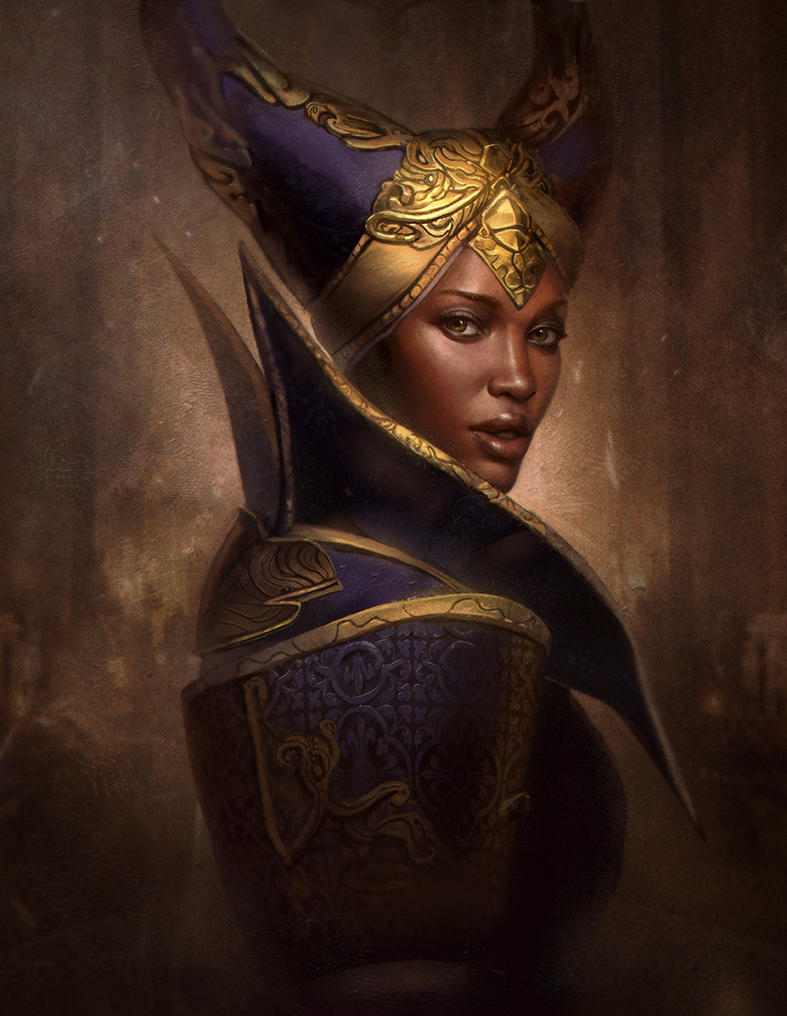
Image posted by gerryarthur

Thursday, 7 August 2014

Morrigan - Beneath the Surface

Welcome to a particularly special entry! It is with no small amount of pleasure that I announce that this here is the 100th, published entry of Counting Reflections, which has been running for about four years. Honestly, I am rather pleased with myself for having reached this number of entries, but hope that I will be able to reach 200 in less than four more years. Here's hoping!


Considering my fascination with identity and all of its nit-picky little aspects and incarnations, not to mention its dire complexity and strangely stubborn-yet-volatile nature, and given that I have discussed identities on here before, I thought that a nice idea would be to delve deeper into these topics and do a whole series of character analyses, devoting an entire entry to the character in question, putting them "under the microscope" to examine them as comprehensively as I can.

Unlike the MBTI series, this series of entries will not have a clearly marked beginning and end, nor will I attempt to cover all characters from a given series. Instead, I shall pick the characters I most wish to write about, when I wish to write about them, though suggestions are always welcome! 

Without further ado, let me introduce the first character to be discussed in what I shall call my "Beneath the Surface" series: Morrigan of Dragon Age: Origins.


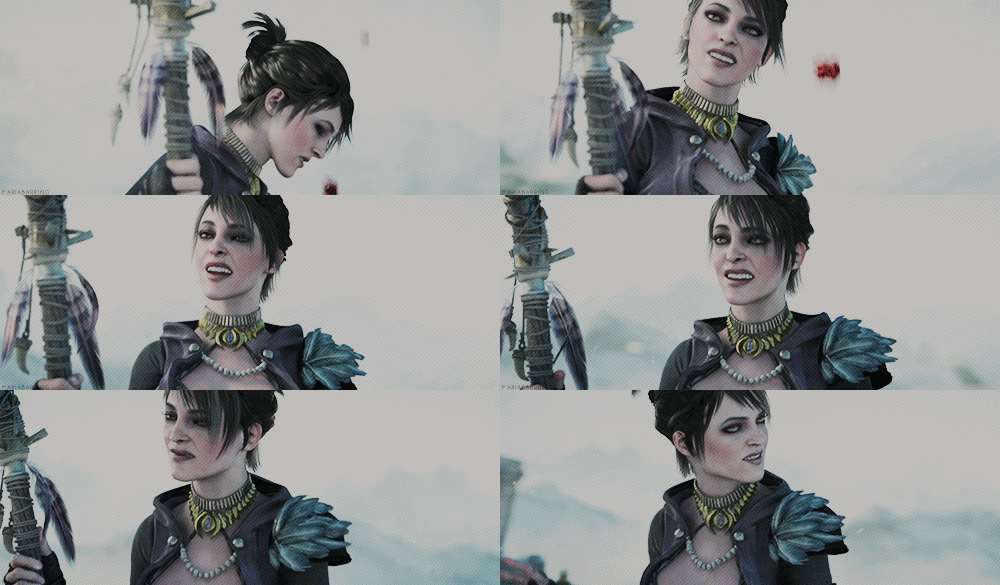
Image posted by Maria Barring

Daughter of the Wilds

Morrigan is a "Witch of the Wilds" an Apostate Mage living in the Korcari wilderness, on the very fringes of civilisation. She grew up far from other people, raised only by her mother, the insidious Flemeth, infamous witch of ancient legend, from whom she learnt the art of working magic, as well as the powers of the Shapeshifter, allowing her to wear the form of an animal. Her mother is a complicated character in her own right (so much so that another of these entries may focus upon her) and she has sought to instill Morrigan with a steadfast resilience against anything she may encounter, producing a tough daughter. Though they have fought off Templars in their time, Morrigan and her mother have evaded capture by the Knights of the Chantry, able to live as Apostates: those mages who live outside of the restrictive confines of the circle and its religious enforcers.

"The Chasind have tales of we witches... I have prowled shadows that you never dreamed existed. Am I an unnatural abomination, to be put to the torch?"

In spite of her reclusive upbringing (and perhaps in no small part due to it), Morrigan has wandered into civilisation before, though each time she has returned to her mother, having always faced some kind of deeply alienating experience or profound rejection from her brief interludes into the "civilised" world. Hence, she has remained by her mother's side...until the Warden came with their quest to save the nation from the Blight and she was instructed to take her leave and aid the Grey Wardens in the preservation of the realm and the downfall of the Darkspawn. 

Such is her story, now to probe a little further...

A Mother's Love

"I raised her to be as she is! I cannot expect her to be less."

When first introduced to Flemeth and Morrigan, it is clear that, in spite of her obvious desire to assert her own capabilities and independence, Flemeth has kept Morrigan under her thumb and there is no question as to her authority over her. This is understandable, for the pair have lived alone together for the majority of Morrigan's life and such a hierarchy (and a level of dependency, fostered by custom) has had time to become firmly cemented. In spite of this, Morrigan is certainly not entirely kowtowed by her mother, she fights back, struggles and asserts herself, though Flemeth seems to take little notice of such outbursts, able to cripple her daughter's efforts with a few words of cutting mockery. 

There does not exist any great warm between these two, that much is apparent on both occasions in which they are met together, though there is a certain degree of sentimental respect on Morrigan's side. When she bids goodbye to her mother, she does so in a very roundabout way, presenting "false" concern which masks a genuine desire not to have to leave. Of course, she very much desires to leave and see the world for herself, rather than to only hear of it through her mother's tales (which is possesses a keen interest in, if Flemeth is to be believed), but this desire can only be achieved by leaving behind the only world she has ever known: the Wilds and her Mother. True, her mother has never been a great source of emotional strength, but she has protected her and raised her, naturally there is a connection there. Morrigan is accustomed to the relative comfort and safety of her environment and is now having to leave it. In spite of her capability and outwardly displayed self-confidence, she is very much a child leaving home. She is vulnerable.

"Morrigan is innocent. She is beautiful. She is vulnerable." - Kate Mulgrew

Image posted by Everything Dragon Age

Needless to say, Morrigan's relationship with her mother is a touchy subject and one which she covers up with humour, trying to appear as if she does not care when in truth she cares very deeply beneath the surface. When asked what she would do if her mother died, she responds with "Before or after I stop laughing?". She evades any such questions as to how she feels and the Warden can lose her respect if they attempt to engage in a sentimental discussion with her about her mother (or any kind of sentimental conversation, which Morrigan, though she does connect with sentiment, openly speaks against). That being said, she evidently respects her mother a great deal, for any attempt to argue against the lessons Flemeth has taught her (that independence is a virtue, that emotional connection is weakness and unnecessary, among other things) is met with open hostility. Though she fights against her mother, she very much respects her and acknowledges her authority and power in a complementary (as opposed to purely cold) manner.

Their relationship is darkened upon the discovery of Flemeth's Grimoire, which had somehow ended up in the Circle Tower. Upon reading it, Morrigan discovers that her mother's longevity has apparently arisen from a cyclical ritual in which she births and raises a daughter in order to take that daughter's body as her own when her previous body has aged beyond usefulness. It is thought that the stronger the daughter is with magic, the easier it is for Flemeth to take her over, thus giving her a motivation to send Morrigan with the Warden, otherwise Flemeth would have sought to protect her greatest asset.

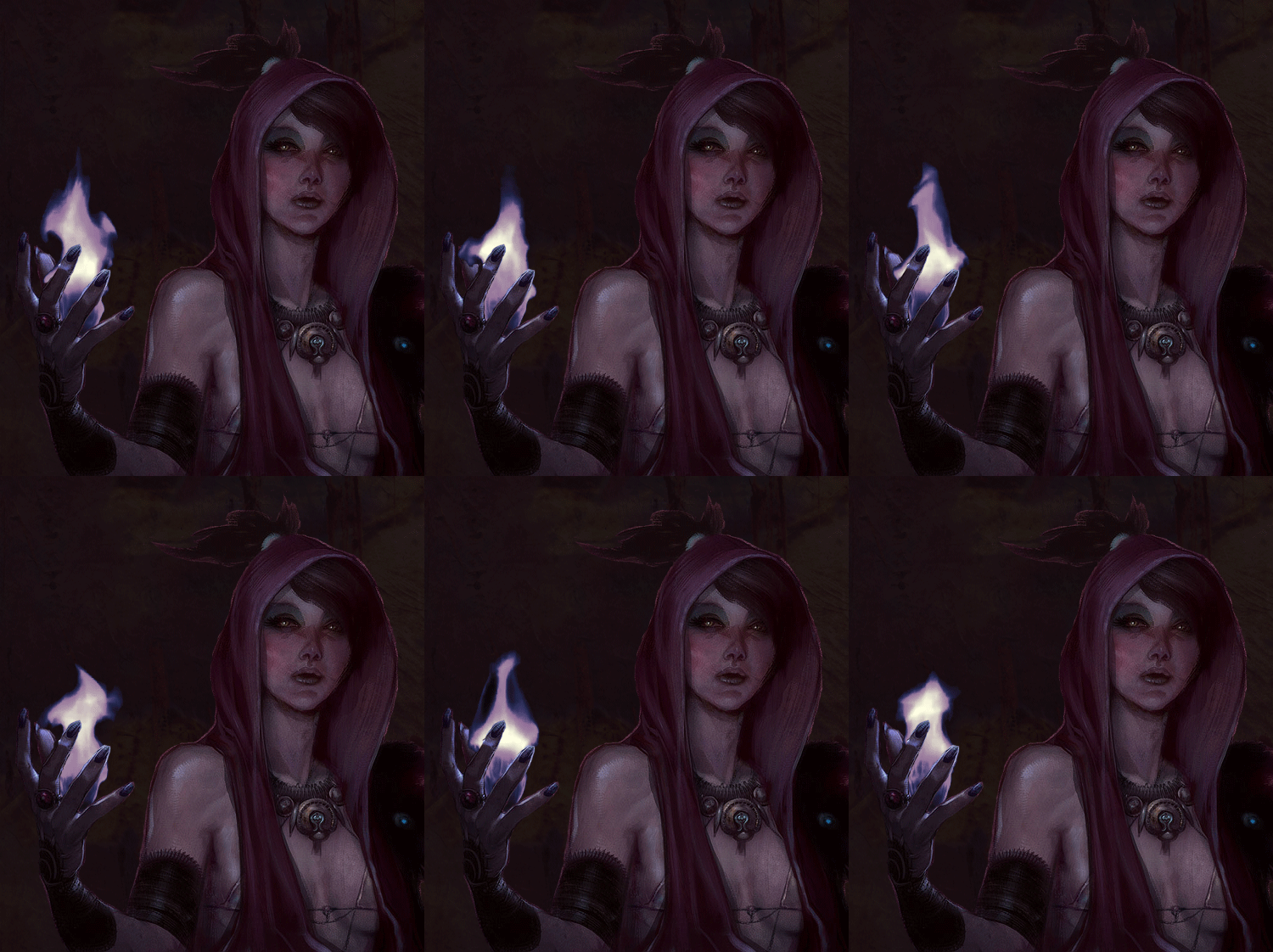
Image posted by Ozoi

This discovery is evidently shocking to Morrigan, who still cannot quite believe the level of "betrayal" within her mother's plot. Though, at the same time, she evidently knows her mother is capable of doing such a thing, for her immediate conclusion, seemingly without much need for consideration, is that the Warden must kill her mother, and she reaches this conclusion without professing any desire to speak with her or displaying anything beyond a basic sentimentality. She does care for her mother, but having discovered her intention to exploit her, Morrigan, who has taken Flemeth's lessons to heart, does exactly what her mother would have done in her place. Though Flemeth, through magic, ultimately survives, Morrigan proves herself as both very similar to Flemeth, but also fundamentally different - for she does open herself to her more emotional side, something which we have yet to see from Flemeth (though there are indications, with her discussions with Merrill in DA:II, that she suffers deep regrets. For what, we do not yet know). 

Morrigan gains her clinical pragmatism and her mistrust of others from her mother and with it comes an inability to understand and correctly handle her own emotions. Though her mother has given her great magical talent and taught her to control it, she failed in giving her the emotional development from which she may have benefitted and, due to the isolation, there was no other source which could have provided her with such. However, compassion comes naturally to human beings and Morrigan evidently has a great deal of it, as well as the ability to empathise. Neither of these are expressed to any great degree, for Flemeth has tried to fashion her daughter into her own likeness. After all, if all goes to plan, Morrigan will one day be Flemeth. 

"I'm not sure whether she's your daughter or your enemy."
"Neither is she." 

Image posted by The Heart Is A Home For Ghosts

Civilisation and Isolation

Having been raised in such an isolated environment, Morrigan is profoundly alienated when it comes to dealing with other people, more so than almost any other character within the series (I would argue even more so than Sten, who may hail from a vastly different culture, but a culture nonetheless), though she is an exceptionally determined individual, so her lack of understanding of social situations is masked behind a veil of apathy. Morrigan has only ever learnt of people "in theory", rather than meeting them, talking with them, developing even basic social skills and thus she views all other people more as ideas and caricatures than as people. She does not care for many others and tells herself that she does not care for those for whom she does care because she has never learnt how to care for others appropriately.

"Ah, look how they moan and wail and gnash their teeth. 'Tis sad to watch how helplessly they scurry about."
We learn our culture and our place within it, and thus, a portion of ourselves, through exposure to it, through being inducted into it. Basically, we learn our culture through living it. Morrigan has never had this, for she has been raised outside of a culture. Flemeth kept her apart from other people and, upon discovering that Morrigan had been occasionally venturing into the "civilised" world, responded with anger enough to leave quite the impact on her daughter. Her mother's desire to hide comes from two motivations: the desire to keep their magic hidden (mainly to avoid hassle rather than danger, considering how powerful Flemeth is) and elitism. Flemeth, rightly or wrongly, considers herself to be better than most others (despite her attempts at presenting herself as humble) and this arrogance has washed off on Morrigan, who ultimately tries to see others are less intelligent than herself. This is again due to her underdeveloped emotional understanding, though she certainly is intelligent.

"I left the wilds more than once when I was young, to seek more of the world of men."

This having been said, Morrigan's responses to civilisation are birthed from a fear of that which is beyond her understanding and yet which inspires within her such a deep curiosity. Though somewhat paradoxical, this is certainly the case and this paradoxical nature is what causes so much strife within her. Flemeth herself says that her daughter wants to venture into the world and see it for itself, but that she has, until the arrival of the Warden, been unable to do so. Morrigan wants to understand other people, she has the capacity to and the desire to come to know them better, on an emotional level, but she is scared of doing so, as such an act requires trust and an open channel with one's emotions, neither of which she is open to experimenting with. Again, this is very much down to her mother, who never responded in such a way as to open up those channels. She is very much stranded in the wilderness, looking into civilisations with a child's curiosity, yet the cynicism of an old crone. 
"I... have never seen such a collection of merchants and people before. 'Tis always so?"
Interestingly, Morrigan's solitude has led to her seek solace in animals, for her Shapeshifter abilities allow her to enter into their world wearing their shape. When asked about it, she reveals that she had occasionally felt the wilds call to her, that she would slip away from Flemeth and take the form of some animal creature, and pass hours with beastial companions. Yet this has not given her any great love for nature, nor has it transformed her into this enlightened "earth mother" character. She is almost as cynical of animals as she is of people, only less so towards them due to her acknowledgement that they cannot scheme and plot as people do. Though she has drawn strength from nature, she does not identify herself with it, thus preventing her from being fully identified with it, though she has certainly been shaped by it more than she herself might wish to believe. 

Image posted by Maria Barring

One could certainly argue that Morrigan's closeness to animals has highlighted to her how different she is from the beasts whose forms she can wear, a difference which she perhaps fails to see in many other people, thus leading her to be cynical about their "human nature" (or elven, dwarven, etc.). Perhaps it is the case that she views other peoples much like she views animals, though she has more respect for the animals who do not pretend to be something that they are not, whilst many people pretend to be better. She does seem to have a preoccupation with considering others to be lying to themselves, deluded or simply misguided.

“The world of man... is dangerous.”
“And frightening, I imagine. Especially for someone ill-prepared for it.”


Apostasy

In so fervently opposing the Chantry and its rulings, Morrigan comes to define herself in opposition to the structures she so hates. As for what she specifically hates about the Chantry, there are a few things to chose from, though I find it interesting to note that there is a degree of bravado present even in her attitudes towards the Chantry.

Before explaining further, perhaps I should briefly summarise what the Chantry is. Basically, it is the major religion of Thedas (literally "The Dragon Age Setting" The-D-A-S, Thedas, which is the world in which Dragon Age is set). They are heavily influenced by Christianity, their history revolving around Andraste, the messiah of their God, the Maker, who arrived to spread his word to the world and was betrayed and burnt at the stake. Most importantly, the Chantry have a very low opinion on magic in general, which stems from the words of their prophet. Essentially, they see it as a curse, as something which "exists to serve man and never rule over him". As with anything taken from a religious text, the scriptures have multiple meanings. Whether it is because they see them as evil, easily manipulated by demons or any other reason they can think of, the Chantry, at minimum, require Mages to be accounted for. This means that most of those who can use magic are forced to live in a Circle of Magi, which is meant to be a safe place for them to live and learn together. It is, in truth, as much a prison as anything else. 

Image posted by Hawkules

In typical Morrigan style, she expresses no sympathy for the Circle Mages upon discovering that the veil has been torn and that Abominations (possessed mages) are running amok, with many magi having been slaughtered. This is a moment in which we can see, perhaps more vividly than elsewhere, the impact of Flemeth's teachings. Morrigan sees magic as something exceptionally important and miraculous, something that should be cultivated and explored and embraced. This is true. However, what she values more is independence, liberty and the individual asserting themselves over an authority which would attempt to constrict it. By willingly, in most cases, allowing themselves to be captured and live under the rule of the Circle, these mages have committed, in Morrigan's eyes an ultimate offence, surrendering of the self to some greater dogma, which she considers exists only to exert control.
"It would be a silly thing, prolonging your life. A waste."
I believe that this is what Morrigan opposes most about the Chantry: their dogma. I know that many consider Morrigan to be atheist, though David Gaider's tweet (displayed below) suggests that this is not the case. I would consider it more likely that Morrigan is an agnostic or that she believes in some kind of deeply personal deity. She is certainly a free thinker, one who opposes limitations or anything which tries to box her thinking. This desire to constantly assert herself and subvert others is what gives us so much to talk about. She wants nothing more that to be herself, though she is not quite sure who that is yet, but she is quickly finding out. Restrictive hierarchies are her anathema and those that follow them are, to her, lost and weak. Though this attitude is shaped by Flemeth, I think it safe to say it is as much her own opinion than hers.
Interestingly, Dragon Age: Inquisition will see her taking a place in a hierarchy as she becomes the Arcane Advisor to the Empress of Orlais. It will be interesting to see how this has changed her, for Morrigan has certainly seemed to have matured (from what little we have seen of her in the trailers and pre-release materials) though I have no doubt she remains fiercely independent, even if she is beginning to work in with the system to a degree. This is but speculation, for answers, we shall have to wait.

Image posted by Maria Barring

Getting Dialectical - Wynne

A trend I have noticed in both Dragon Age games (though to a lesser degree in the second), when it comes to companions, is that there appears to be two characters of each class, one of which serves to subvert the norms whereas the other seems to support them. In Dragon Age: Origins, we have Alistair, a fighter who supports tradition, mostly, and Sten, who is Qunari and thus would change the whole of Ferelden if he could. Likewise, Zevran is an outsider assassin whereas Leliana is a believer in the Chantry. Morrigan is the subversive mage, making her counterpart the mage who supports the circle and what it stands for: Wynne.

Wynne and Morrigan seem, at least on the surface to be completely opposed. The former is an established member of the Circle, who has devoted her life to it and to the task of protecting young mages, who fosters a philosophy of extreme selflessness and whose focus is in magics which restore and heal others. Morrigan hates the Circle, the Chantry, has only ever been devoted to herself (in fairness, she never really had anyone else) and whose magic is far more oriented towards the degradation of her opponents. 

Again, we can define Morrigan through her opposition to Wynne.

“But the Circle is no place of safety. 'Tis a place of subjugation.”
“Is it? It is by no means perfect, I agree, but consider the alternative. At least other mages can understand our struggle. We can help each other.”
Of course, it would be easy to simply say of their relationship that they are polar opposites, impossible to reconcile and, whilst there may be some truth to this, I think there is more to be said. During one of their exchanges, Morrigan almost seems to be swayed by Wynne's view on the Circle as an imperfect place of safety, leading her to perhaps question some of her assumptions slightly. Whilst ultimately she remains resolutely against it, I believe what began to make Morrigan reconsider is the mention of helping one another, a concept which Morrigan would ordinarily claim to find abhorrent or weak and yet it is something which she evidently desires. She wants to be appreciated, she wants the gentleness that comes from being understood and yet Flemeth has prevented her from being able to express herself with enough clarity that she can actually attain any of these things.

'There is no writing on my forehead that says "Please, guide me!"'

Morrigan opposes Wynne's position of authority. I think perhaps she considers her to be in some ways similar to Flemeth, and older woman of considerable magical ability (though nowhere near Flemeth) who seeks to promote her beliefs in others as a guide and a teacher. Morrigan has already suffered under the oppressive dogma of one mother and is in no rush to find another, though at the same time, Wynne has many motherly traits which likely force Morrigan to reflect on the role her own mother has played in her life. Undoubtedly, this is an uncomfortable topic, resulting in heightened hostility towards Wynne, only exacerbated by their oppositional views.

"I am not Alistair, who sees in you a surrogate mother."

Image posted by Warden Cortana Croft

Her Namesake

There is power in a name, such a concept is one of the most ancient, featuring in stories, both fantastical and otherwise as far back as there have been stories. Whilst Dragon Age itself has not implemented any kind of magical power involving names, at least it has not done so to the best of my knowledge, Morrigan bears a particularly interesting name, one which hails from Irish mythology.

The Morrigan is one of these elusive figures which varies according to which source one is reading. She is widely referred to as both the "Phantom Queen" and the "Great Queen" and many sources depict her as a Goddess, one associated with Battle, Strife and Sovereignty. Some theorists consider her to be the Irish counterpart to the Norse Valkyries, female minor deities who would decide the fate of warriors in battle and collect the worthy dead for delivery to Valhalla. This connection is strengthened by the fact that the Morrigan was known for her ability to wear the shapes of many animals, and is associated with the crow, whereas the Valkyries were associated. Both small, black birds.

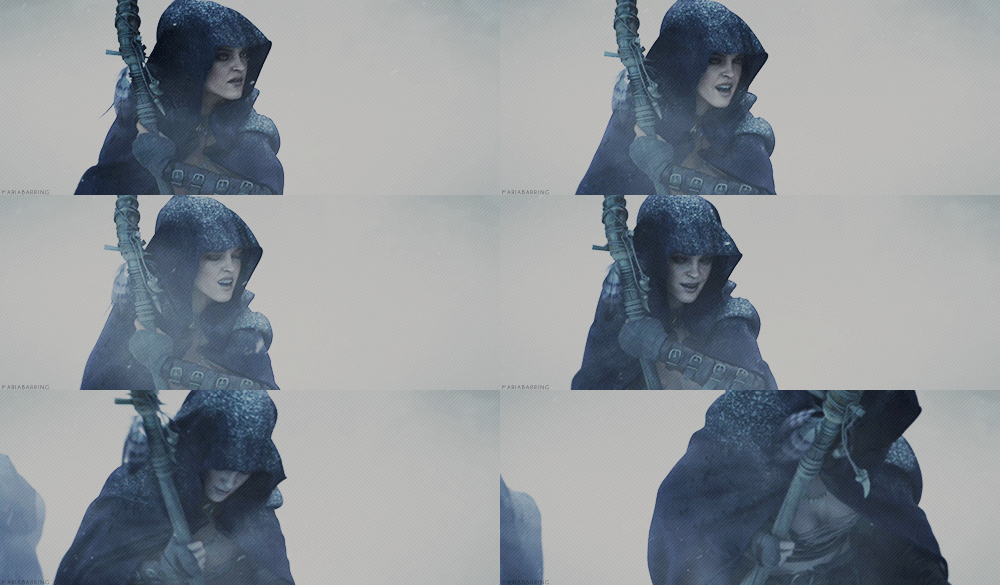
Morrigan of Dragon Age is, of course, a shapeshifter and, whilst the game rules limit her to being able to assume the forms of a spider, a bear or a swarm of flies, she professes to be able to assume the shape of whatever animal she has had the chance to observe for a sufficient amount of time. Thus the shape of a bird is perfectly possible. Additionally, one need only glance at her original robes to note the black feathers upon her pauldron (shoulder). Crow feathers, raven feathers, either are possible. Such references are present.

Image posted by Lemmy Leyra

Additionally, the Morrigan is often considered to be a Triple Goddess, one aspect of a three-part being, which is at once one being and three. There are many examples of these deities throughout history (the Graeae, which were covered in a recent MBTI entry would also fit this category), most notably one could consider the God of Christianity to be a Triple Deity, as he exists as the trinity of the Father, the Son and the Holy Spirit. Furthermore, when it comes to the presentation of witches, three is consistently a number associated with them. A prime example of this would be the Witches three in MacBeth.

Interestingly, the other two deities which are part of her trio are considered to be her sisters, all three of which were born of a single mother. We know from Dragon Age: The Silent Grove, that Flemeth has another daughter, Yavana (who interestingly sees the ritual possession Flemeth is seeking to perform on Morrigan as a gift), and there is nothing to indicate that she does not have others. Thus, there are possible links in the story there.

Therefore, we can see how parts of Morrigan's character, though perhaps not her personality, stem from her Irish namesake. A shapechanger, part of something greater than herself, associated with crows and ravens, bastion of strife.

Image posted by Dorian Xpavus

Finally

Bearing in mind what I have written here, I would class Morrigan as an INTJ, though her secondary type would definitely be INFJ. In terms of Enneagram of personality type, I would place her either as Type 4 (The Artist / Individualist) or Type 8 (The Assertist / The Challenger). Her tarot card would be the Queen of Swords. 

Certainly, it will be interesting to see how Morrigan's character will develop as she appears in Dragon Age; Inquisition, for, as mentioned, she seems to have matured a great deal. Who knows what Morrigan we will be presented with? I for one am sure that she will remain as sarcastic and fiercely independent as ever, though perhaps she will sacrifice some of her nature to aid in the winning of the war? I hope to find out!

So concludes the 100th entry. Thanks for reading!